Ecommerce SEO › AI Shopping
Building a Content Ecosystem for AI Shopping
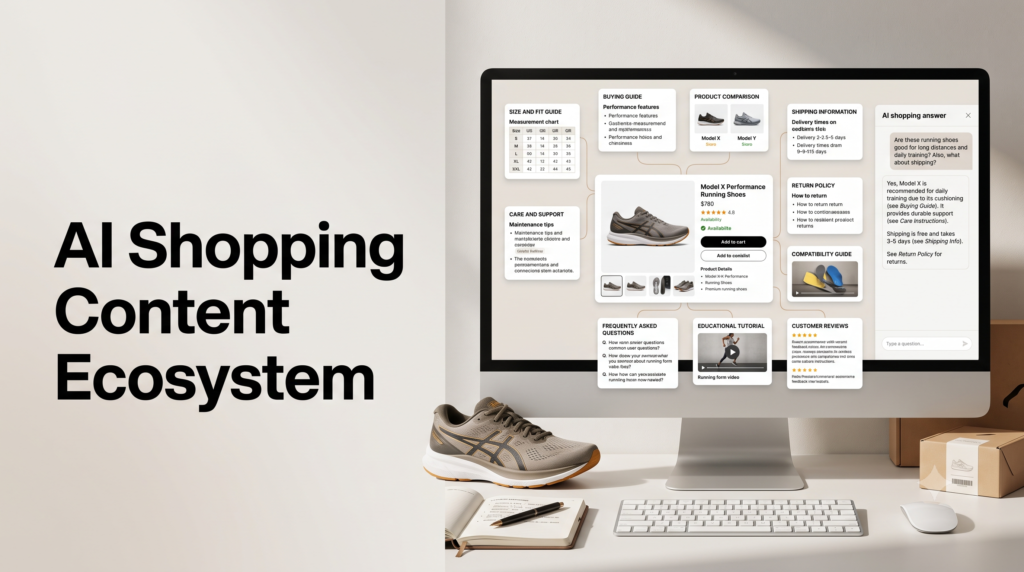
Here’s the surprise in the AI citation data: the pages that get your store cited in shopping answers often aren’t your product pages. They’re your size guides, your return policy, your buying guides, the pages that answer the question the shopper is actually stuck on. A perfect product page isn’t enough. You need the ecosystem around it.
By Rahul Saini, Author at Search Counsel Co. Last updated [Month] 2026. Part of our ecommerce SEO guide.
Featured answer: what is a content ecosystem for AI shopping?
It’s the set of pages around your products, buying guides, size and fit guides, support articles, FAQs, and policies, that answer the decisions and doubts a shopper has before buying. AI assistants cite these decision-answering pages heavily when recommending products, so building them is how you get your store into AI shopping answers, not just your PDPs.
The reframe. Stop asking “how do I make my product page rank.” Start asking “which pages would an AI need to cite to confidently answer this shopper’s question.” When someone asks an assistant “which running shoe is best for wide feet and flat arches,” the answer leans on fit guides, comparisons, and reviews as much as on any single product page. Build for the decision, not just the SKU.
On this page
1) Why a great product page isn’t enough
The technical side of AI shopping, clean feeds, complete schema, and the merchant programs, is covered in our guide to getting products recommended by AI. That work makes your products eligible. But eligibility isn’t the same as being chosen, and this is where most stores stop too early.
An analysis of ecommerce AI citation patterns by SEO specialist Aleyda Solis found something many teams miss: a large share of the pages AI cites when answering shopping questions aren’t product or category pages at all. They’re the pages that help resolve the shopper’s uncertainty, size and fit guides, support and repair articles, return and shipping policies, buying guides, checklists, and educational content. These are exactly the pages ecommerce teams have long treated as secondary. In AI answers, they carry real weight, because the assistant is trying to answer a decision, and those pages are where the decision gets made.
2) What AI actually cites
When an assistant assembles a shopping answer, it pulls from a wider evidence layer than your catalog. The recurring citation-worthy page types are worth building deliberately:
- Size and fit guides. The single biggest source of purchase hesitation in apparel, footwear, and anything with dimensions. A real fit guide (not a bare size chart) resolves it, and doubles as a returns-reducer.
- Support, care, and compatibility pages. “Will this fit my model,” “how do I clean it,” “what’s the warranty.” In categories like electronics and home, these dominate the questions AI is asked.
- Return and shipping policies. Clear, findable policy pages are a trust signal AI surfaces directly when a shopper’s decision hinges on risk.
- Buying guides and comparisons. The consideration-stage content that answers “which one,” covered in depth in our buying guides and comparison pages guide. AI leans on these heavily for “best” and “vs” questions.
- FAQs and educational content. Answer-first pages that address the specific sub-questions a category raises, from “how many lumens do I need” to “what size tent for a family of four.”
The through-line: each of these answers a question, not a product. That’s what makes them citable. A shopper rarely asks an AI to describe your SKU; they ask which one to buy and whether it’ll work for them, and the pages that answer those are the ones that get pulled into the response.
3) Map the ecosystem to your category
You don’t need every page type. You need the ones that resolve your category’s specific uncertainty, and that varies a lot by vertical. The citation analysis showed clear differences: consumer electronics skews toward support and service content, sports and outdoors toward how-to and fit resources, fashion toward size, fit, policy, and local availability. Each maps back to how buyers judge risk in that category.
So work backward from doubt. For your priority categories, the ones with strong margins and demand, list the questions and hesitations a buyer has right before purchase. Then decide which page resolves each one, and whether you already have it, need to improve it, or need to build it. Sometimes the right move isn’t a new article at all; it’s fixing a thin support page, clarifying a sizing chart, or aligning your product data so it stops contradicting itself. Which questions buyers actually ask is a research task, covered in ecommerce keyword research and its prompt-research extension. Build proof around a few priority categories first rather than trying to cover the whole catalog at once.
4) Write content AI can cite
Getting the right pages is half the job. The other half is writing them so an AI can confidently extract and trust them. Three principles matter most.
Answer first, in self-contained blocks. Lead each section with a direct, complete answer to the question in the heading, then add detail. AI systems pull discrete blocks, so a section that answers cleanly in its first sentence is far more citable than one that builds up slowly.
Be specific enough to clear the confidence bar. AI selection runs on confidence, and specificity raises it. “Machine washable at 30 degrees” beats “easy to clean.” “Fits waists 71 to 76 cm” beats “true to size.” Vague, salesy phrasing gives a retrieval system nothing concrete to stand on, and vague products lose to specific ones even when they’re just as good. The gap between the first recommendation and the eighth is often data completeness, not product quality.
Answer, don’t just sell. Your product and guide copy is now read by three audiences at once: a human scanning on a phone, an AI deciding whether to cite you, and increasingly an autonomous agent evaluating the product programmatically. Marketing language satisfies none of the machine readers. Write copy that answers the real questions, with grounded, checkable claims. Page-level extractability and E-E-A-T craft carry over from our on-page content guide; here the point is that citable content reads like a helpful expert answering plainly.
5) Wire it together for AI
A pile of good pages isn’t an ecosystem until they’re connected. Internal links do more for AI than pass ranking signals; they map the relationships between your pages so an assistant can understand your store as a connected body of knowledge rather than scattered documents.
Use a hub-and-spoke pattern. Category pages and buying guides act as hubs that link out to the product pages, use-case guides, and FAQs they reference; every spoke links back to its hub and across to related pages. Guides link to the products they recommend, products link to the guides and size charts that support them, and comparisons link to each option. One study found that adding just a few contextually relevant internal links produced a large jump in AI-sourced traffic, which is an unusually high return for a quick change. The broader model lives in our internal linking guide; the store-specific rule is that no decision-answering page should sit orphaned, and no product page should be a dead end.
Free resource
Find your ecosystem gaps
Our Ecommerce SEO Audit Checklist includes a content-ecosystem section: decision-page coverage by category, answer-first structure, and hub-and-spoke linking. Want it mapped for you? See our ecommerce SEO service.
6) The compounding payoff
This work pays back on two surfaces at once. The same decision-answering content that gets you cited in AI shopping answers also wins the research-phase and comparison queries in Google, where AI Overviews now appear on a growing share of shopping searches and on the large majority of “best product” queries. You build it once and get both. That two-surface logic, and the proprietary-data content that anchors it, is the heart of our content strategy hub.
There’s also a timing argument. Because AI product citations are still being established, consistently cited sources build something like domain authority for the AI era, and the citation landscape in most categories is still sparse. A store that earns steady citations now, through a real content ecosystem plus genuine reviews and mentions on the sources AI reads, builds a lead that late movers will struggle to close. The external side of that, reviews and brand mentions on independent sites, pairs with this owned content and connects to our off-page SEO hub. Whether it’s working, citation share and AI referral traffic, belongs in your AI visibility KPIs.
7) Common mistakes
- Optimizing only the product page. A flawless PDP with no surrounding guides, policies, or FAQs gives AI little to cite when answering a decision. Build the ecosystem.
- Treating support and policy pages as afterthoughts. These are among the most-cited pages in AI shopping. Make them clear, complete, and findable.
- Vague, salesy copy. “Premium” and “easy to use” don’t clear the confidence bar. Use specific, checkable attributes.
- Publishing pages that don’t answer a question. Content that describes rather than resolves a decision rarely gets cited. Start every page from a real buyer question.
- Orphaned content. Unlinked guides and FAQs can’t build the knowledge graph AI relies on. Wire everything into a hub-and-spoke structure.
- Trying to cover everything at once. Spreading thin across the whole catalog beats nothing, but focused depth on priority categories compounds faster.
8) Sources used
| Source | What it supports |
|---|---|
| Aleyda Solis, ecommerce AI citation analysis | The core finding that decision-answering pages (size/fit, support, policy, guides) are heavily cited, the by-vertical evidence mix, and the “map the uncertainty” approach. Directional. |
| AI-search ecommerce analyses (Freddie Chatt, NeuronWriter via EvolveAMZ, Genrise) | Guides and FAQs earning more citations than PDPs, the confidence-threshold idea, answer-first blocks, internal-linking uplift, and the multi-audience read of copy. Directional. |
| WiserBrand, Fastr and Opascope | Third-party proof around priority categories, fit guides as decision tools, and the citation-age early-mover advantage. Directional. |
FAQ: content ecosystem for AI shopping
Why does AI cite my size guide or policy page instead of my product page?
Because those pages answer the shopper’s actual question. When someone asks an assistant which product suits their needs, it’s resolving a decision, and size guides, support articles, and policies are where that decision gets settled. Product pages describe the item; decision-answering pages address the doubt. Analyses of AI citation patterns consistently show these supporting pages carrying more weight than teams expect, which is why the ecosystem matters as much as the PDP.
What pages should I build first for AI shopping visibility?
Start with the pages that resolve the biggest hesitation in your top categories. For apparel and footwear, that’s usually a real fit guide; for electronics and home, support and compatibility content; across the board, clear return and shipping policies plus buying guides for “which one” questions. Work backward from the doubts your buyers have right before purchase, and prioritize a few high-margin, high-demand categories rather than spreading thin.
How do I write content so AI will cite it?
Answer the question directly in the first sentence of each section, keep sections self-contained, and be specific. Concrete, checkable details (“machine washable at 30 degrees,” “fits waists 71 to 76 cm”) clear the confidence bar that vague, salesy phrasing can’t. Write to answer rather than to sell, because your copy is now read by AI systems and shoppers alike, and the machine readers reward grounded, extractable facts.
Is this different from normal ecommerce content marketing?
It overlaps but adds two things. First, emphasis on the decision-answering pages, support, policies, fit guides, that content marketing often neglects. Second, structure and specificity aimed at extraction and confidence, not just readability. The same content still serves human shoppers and Google, so it isn’t a separate program; it’s content marketing done with AI citation in mind, wired together so the pages reinforce each other.
How long until this improves my AI visibility?
It varies with your starting point, catalog size, and how much of the data and content already exists. Some improvements, fixing a thin support page, adding aggregate ratings, tightening internal links, can show up in AI answers within weeks. Building a fuller ecosystem and earning the third-party signals that reinforce it takes months. Because the citation landscape is still sparse in most categories, starting now builds a compounding advantage over stores that wait.
Where to go next
A content ecosystem is what turns an eligible catalog into a cited one. Answer the decisions, write for extraction, wire the pages together, and the same work rewards you in both Google and AI shopping.
From here, pair this with the technical side in getting products recommended by AI, choose the questions to answer with ecommerce keyword research, or step back to the full ecommerce SEO guide and our AI search guide.
Editorial note: This is an expert-informed take on a fast-moving area. Citation patterns, the figures cited here, and AI platform behavior change quickly and vary by category; treat the specifics as directional and current as of writing. Test against your own AI-referral data before committing a large program. General marketing education, not platform-specific advice.