Ecommerce SEO › AI Shopping
AI Shopping: How to Get Your Products Recommended by ChatGPT, Perplexity and Google AI
When a shopper asks an AI which product to buy, it names one or a few, and everything else loses. Getting into that short list isn’t ranking on page one; it’s closer to earning shelf space in a store that has already decided what to stock. Here’s how ChatGPT, Perplexity, and Google AI each choose, and what it takes to be chosen.
By Rahul Saini, Author at Search Counsel Co. Last updated [Month] 2026. Part of our ecommerce SEO guide.
Featured answer: how do you get products recommended by AI?
Give the AI clean, complete data to trust. That means a fully populated product feed (with GTINs, real-time price and stock, ratings, and shipping terms), complete Product schema with aggregate ratings on your pages, and independent signals like reviews and mentions on sites AI reads. The platforms differ, but they all reward products they can confidently interpret and verify.
The state of play. AI shopping is growing fast, and AI-referred shoppers tend to convert better than the average visitor because they arrive pre-qualified by the recommendation. Yet most stores are invisible to it. In one audit of 2,400 product pages, fewer than one in ten had the structured data an AI needs to recommend them. That gap is the opportunity: the fixes are mostly configuration, not magic.
On this page
1) Recommendation is not ranking
Traditional search returns a page of links and lets the shopper choose. An AI assistant does the choosing first. It filters, ranks, and endorses a handful of products, then presents them as an answer. The shopper often never sees the alternatives.
That changes the game. Ranking rewards pages; recommendation rewards products the system can confidently understand and verify. Backlinks and keywords still matter indirectly, but the direct levers are your product data, your trust signals, and your presence on the sources these systems read. A page can rank fine in Google and still be invisible to AI shopping if the underlying product data and structured markup aren’t there. Think of it as qualifying to be on the shelf, not climbing a results page. The wider discipline of being found and cited by AI is covered in our AI search guide; this post is the store-specific version.
2) How each platform chooses products
The three big surfaces work differently, and optimizing for one blindly won’t cover the others. Here’s the short version.
| Platform | How it sources products | What to prioritize |
|---|---|---|
| ChatGPT | Product feeds and the Google Shopping organic index, plus Shopify Catalog for Shopify merchants. It doesn’t crawl your site live. | A complete, accurate feed and strong organic Shopping presence, since its picks track closely with top Shopping listings. |
| Perplexity | Live web crawl plus its Merchant Program feed, and it cites its sources, leaning heavily on Reddit and other community content. | Real user discussion and reviews about your products, plus joining the Merchant Program for complete data. |
| Google AI Mode / AI Overviews | The Merchant Center feed and organic index, with opt-in shopping through Agentic Storefronts. | The same feed and structured-data quality that drives Google Shopping, plus review signals. |
Two patterns cut across all three. First, a clean product feed feeds most of them, so feed quality is the highest-impact work you can do. Second, independent signals, reviews, ratings, and mentions on sites the AI trusts, decide the close calls. One study of tens of thousands of shopping results found that a large majority of ChatGPT’s product picks matched the top of Google Shopping’s organic listings, which tells you the feed and organic Shopping presence you may already have is the foundation to build on. Understanding how these engines pick their sources in general helps here too.
3) Start with the product feed
For most stores, the product feed is where AI visibility is won or lost, and it’s usually treated as a compliance chore rather than the data layer an AI reasons over. Make it complete and current. The core fields:
- Identity: a real GTIN (not an internal SKU), brand, product ID, and condition. Without a true GTIN, the AI can’t match your product to reviews and price databases.
- Title and description: a descriptive title and a description of 100 or more words. AI uses the description to answer feature questions, so a 15-word blurb gives it almost nothing to match against.
- Price and availability, in real time: stale “in stock” data on a sold-out item is one of the fastest ways to get a feed flagged for quality.
- Category taxonomy: use the standard Google product taxonomy. “Apparel > Shoes > Athletic Shoes” matches intent far better than “Footwear.”
- Images: high-resolution, clean, and ideally with lifestyle shots too, which also help visual search tools that let shoppers photograph an item to find it.
Then add the fields most stores miss, which increasingly decide recommendations: review count and average rating, return policy, and shipping details like free-shipping and delivery speed. AI assistants surface these as trust signals when deciding whether to confidently recommend you or default to a competitor with clearer terms. Some feed specs even accept video and 3D-model links, which few stores use yet, so they’re an early-mover edge.
4) Product schema and page signals
Your on-page structured data has to agree with your feed and be complete. Every AI platform needs, at minimum, Product schema with offers (price and availability), brand, a GTIN or SKU, images, and aggregate rating. A common and costly finding is that incomplete schema can be worse than none, because a mismatch between your markup and your feed makes the product look unreliable.
Aggregate rating deserves special attention. If you have reviews on the page, that rating has to be present in the structured data, not just visible to human readers. AI systems treat it as both a trust signal and a quality filter, and products with no rating in their markup often don’t make the recommendation even when they rank normally in search. The full mechanics of product markup, including variants, live in our product schema guide; the point here is that AI shopping raises the stakes on getting it complete and consistent.
Free resource
See what AI can read about your store
Our Ecommerce SEO Audit Checklist covers the AI-readiness basics: feed completeness, Product schema, aggregate ratings, and crawlability. Want it checked for you? See our ecommerce SEO service.
5) Build authority where AI looks
Clean data gets you eligible; independent signals get you chosen. A product mentioned only on your own website lacks the third-party validation these systems lean on, and brand strength acts as a proxy for product quality in their selection.
Where that validation lives depends on the platform, but the pattern is consistent. Perplexity in particular leans heavily on community sources, with a large share of its product citations coming from Reddit and video platforms, and Reddit also shows up as a meaningful share of Google’s AI Overview citations. So the work is: earn genuine reviews on your product pages and on independent review platforms, make sure your products and category are discussed where real users gather, and get brand mentions on credible industry sites. This is the AI-era face of off-page SEO, covered more broadly in our brand mentions guide and in third-party mentions and AI citations. You can’t fake it convincingly, but you can earn it deliberately.
6) Merchant programs and in-chat checkout
Each platform now offers a direct route to share your data and, increasingly, to sell inside the assistant:
- ChatGPT: Shopify merchants surface through Shopify Catalog automatically, and buyers are sent to complete checkout on your store, with the order attributed to the AI channel.
- Perplexity: join the free Merchant Program to give it complete product data. It also offers in-chat checkout for eligible products. Note that Perplexity has confirmed its recommendations are organic, so you can’t pay for placement, which makes data quality and reputation the only levers.
- Google AI Mode: opt in through Agentic Storefronts, with in-chat checkout that can flow orders into your store admin like any other sale.
Setups and eligibility change often and vary by market, so treat the specifics as a snapshot and confirm each platform’s current program before you rely on it. The through-line is stable even as the details shift: complete data plus real reputation is what earns the recommendation. Tracking whether it’s working, citation share and AI referral traffic, belongs in your AI visibility tracking.
7) Common mistakes
- Assuming AI crawls your site like Google. ChatGPT and Google AI shopping lean on feeds, not live page crawls. If your feed is incomplete, you’re absent regardless of how good the page is.
- Internal SKUs in the GTIN field. Without real GTINs, the AI can’t connect your product to external reviews and price data, and it drops from consideration.
- Reviews on the page but not in the schema. If aggregate rating isn’t in your structured data, AI systems treat the product as unverified.
- Stale price and stock. Feed data that misreports availability gets flagged for quality and suppresses your products.
- Thin, salesy product copy. Marketing language with little concrete detail gives retrieval systems nothing to match. Write specific, factual descriptions.
- No presence off your own site. With no reviews or mentions on sources AI reads, you lack the trust signals that decide close calls.
8) Sources used
| Source | What it supports |
|---|---|
| Feed and platform analyses (Passionfruit, Wrkng Digital, Recomaze) | How ChatGPT sources from feeds and the Shopping index, the feed fields that matter, the structured-data readiness gap, and the “recommendation, not ranking” model. Directional. |
| Perplexity, Shopify and Alhena | Perplexity’s live-crawl and citation model, the Merchant Program and in-chat checkout, organic (non-paid) placement, and each platform’s opt-in path. |
| Citation and market studies (Profound, Adobe Analytics via Shopify) | The Reddit-heavy citation pattern, the growth of AI shopping traffic, and AI-referred shopper behavior. Directional. |
FAQ: AI shopping and product recommendations
Does ChatGPT crawl my store to find products?
Generally no. ChatGPT’s shopping recommendations lean on product feeds and the Google Shopping organic index rather than a live crawl of your site, and Shopify merchants surface through Shopify Catalog. That’s why an incomplete or outdated feed can make your products invisible even when your pages rank well in normal search. Fixing the feed is usually the first and highest-impact step.
Can I pay to get recommended by AI shopping assistants?
Not on the organic recommendation surfaces. Perplexity, for example, has confirmed its product recommendations are organic and can’t be bought. That makes clean product data, genuine reviews, accurate pricing and stock, and real reputation the levers that matter. Paid shopping ads are a separate channel; the AI recommendation itself is earned, not purchased.
Why aren’t my products showing up in AI recommendations?
The usual causes are data gaps: an incomplete product feed, internal SKUs where real GTINs should be, missing aggregate ratings in your structured data, or stale price and stock. Audits repeatedly find that most stores are missing at least one of these. They’re configuration fixes rather than deep rebuilds, and stores that close them often begin appearing in AI answers within a few weeks.
How is optimizing for AI shopping different from normal SEO?
Normal SEO optimizes pages to rank. AI shopping optimizes products to be confidently recommended. The overlap is real, structured data, reviews, and a fast, clear site help both, but AI shopping leans harder on feed quality, complete Product schema with ratings, and independent trust signals off your own site. You’re making your products easy for a machine to interpret, verify, and endorse, not just easy to crawl.
Do reviews matter for AI product recommendations?
A lot. Ratings and reviews act as trust and quality filters, and products without visible rating data in their structured markup often don’t get recommended at all. Beyond your own site, reviews and discussion on independent platforms and community sites feed the recommendations directly, since several assistants weight third-party sources heavily. Collecting genuine reviews and getting them into both your pages and your feed is one of the highest-value things you can do.
Where to go next
AI shopping rewards products a machine can trust: complete data, consistent schema, real reviews, and a presence on the sources these systems read. Get those right and you’re eligible everywhere the recommendations are made.
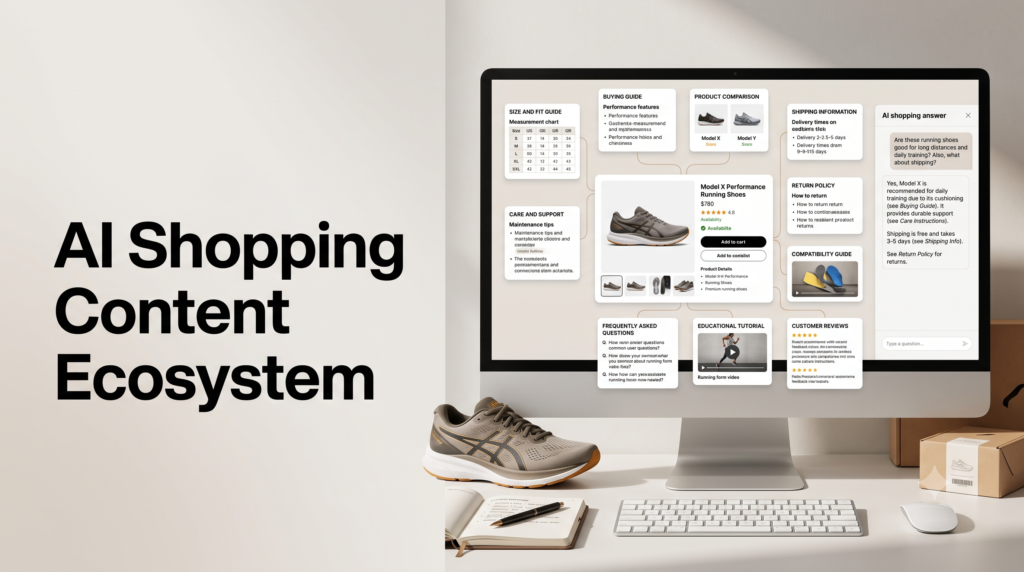
From here, build the content ecosystem for AI shopping that gets your guides and policies cited alongside your products, work out which shopper questions to answer with ecommerce keyword research, or step back to the full ecommerce SEO guide.
Editorial note: AI shopping is the fastest-moving area in SEO right now. Platform pipelines, merchant programs, and checkout features change frequently, and the figures here are directional and current as of writing. Verify each platform’s current documentation before relying on any specific mechanism. This is general marketing education, not platform-specific advice.