SEO Fundamentals & AI Search
AI search is changing where answers appear, how people explore a topic, and how often a ranking turns into a click. It is not making SEO irrelevant. The practical future of SEO is a wider operating model: earn conventional rankings, become a useful source for AI-supported answers, protect click-worthy demand, and connect visibility to business outcomes.
By Rahul S., Founder and SEO Strategist at SearchCounselCo. Last updated August 2026.
Featured answer: What is the future of SEO with AI search?
The future of SEO is not a choice between rankings and AI visibility. Google says its generative search features are rooted in core Search ranking and quality systems. Businesses still need crawlable websites, relevant pages, useful content, internal links, and authority. What changes is the search interface, the value of different queries, and the way visibility, clicks, citations, leads, and revenue are measured together.
Key diagnostic rule: do not blame zero-click search before checking rank depth. A page averaging position 35 is mainly a ranking and relevance problem. A page holding position 3 while CTR falls may have a search-result or snippet problem. The same GSC pattern can require two very different fixes.
Search surface
More than blue links
Visibility can come through standard results, AI Overviews, AI Mode, videos, local results, product experiences, and other SERP features.
Content value
Commodity answers lose leverage
A summary anyone could produce is easy to replace. First-hand evidence, tools, examples, data, and clear decisions create a reason to surface and click.
Query strategy
Click value matters
A high-impression definition may earn few visits. A smaller comparison, local, commercial, or troubleshooting query may produce more useful traffic.
Measurement
Traffic is one layer
Rankings and clicks still matter, but they need to be read beside AI visibility, branded demand, qualified engagement, leads, and conversions.
Jump to what you need
What does the future of SEO actually mean?
The simplest answer is that SEO is expanding, not disappearing. Search engines still need to discover, process, evaluate, and retrieve web content. Users still need reliable information, products, services, comparisons, and places to complete an action. AI changes the route between those two points.
Google’s current guidance is unusually direct: its generative AI features use core Search ranking and quality systems, including retrieval-augmented generation and query fan-out. Google also says that, from its perspective, optimizing for generative search is still SEO. There is no separate Google requirement to add an AI file, special schema, or a particular writing formula. The fundamentals remain the entry ticket. Google’s generative AI optimization guide supports this position.
That does not mean nothing has changed. It means the change should be described precisely. SEO now has to work across two connected layers:
- The retrieval layer: can a search system find, index, understand, and retrieve the right information from your website?
- The decision layer: after a user sees a result or generated answer, is there a clear reason to choose your brand, visit the website, and take the next step?
The first layer depends heavily on familiar SEO. The second increasingly depends on originality, trust, brand recognition, product or service clarity, and how much value remains after a short answer has already been shown.
| Area | What is changing | What remains true |
|---|---|---|
| Discovery | Answers can be synthesized across several searches and sources. | Important content still needs to be crawlable, indexable, relevant, and internally discoverable. |
| Visibility | A brand may appear inside an answer or feature before a conventional result is clicked. | Rank, relevance, source quality, and a clear search presentation still influence discovery. |
| Content | Generic summaries have less defensive value. | Useful, accurate, original, well-organized content remains valuable. |
| Measurement | Visibility can grow without clicks growing at the same rate. | Qualified clicks, leads, conversions, and revenue remain essential business outcomes. |
What does current evidence show about AI search and clicks?
The direction is clear: many searches end without a visit to an external website, and AI-generated summaries can reduce conventional result clicks. The size of that effect is not one universal number. Each major study measures a different panel, period, query set, device mix, or result type.
| Source and period | Observed finding | How to interpret it |
|---|---|---|
| SparkToro, January–April 2026 | 68.01% of measured Google searches ended without a click. | Strong evidence of the wider zero-click direction. The publisher cautions that historical comparisons use different panels and are not perfectly like-for-like. |
| Ahrefs, December 2025 data | An AI Overview correlated with a 58% lower average CTR for the top-ranking page in its study. | The study used 300,000 desktop keywords. It is evidence of a substantial effect within that sample, not a guaranteed reduction for every query. |
| Pew Research Center, March 2025 behavior | Users clicked a traditional result on 8% of visits with an AI summary, compared with 15% without one. | This was observed from 68,879 searches made by 900 U.S. adults. It shows behavior in a defined panel and period. |
| Seer Interactive, 2026 update | Aggregate organic CTR for AIO-present queries rose from 1.3% in December 2025 to 2.4% in February 2026. | The market is still moving. Citation status, query intent, and whether an AIO appears can produce materially different outcomes. |
The responsible conclusion is not that AI always removes a fixed percentage of traffic. It is that click behavior is becoming more query-dependent. A definition, a product comparison, a nearby service, and a technical troubleshooting search should not be forecast with the same CTR assumption.
SearchCounselCo field note: what this article’s first 50 days revealed
Industry studies describe the market. First-party Search Console data shows what is happening to a specific URL. We reviewed this article’s page-filtered Web search data from its publication on June 23 through August 11, 2026.
Observed page-level baseline
Impressions
396
Clicks
4
CTR
1.01%
Average position
32.5
| Active period | Impressions | Clicks | Weighted position |
|---|---|---|---|
| First 25 days | 201 | 4 | 29.23 |
| Last 25 days | 195 | 0 | 35.87 |
Impressions were nearly flat between the two periods, but average position weakened. That makes rank depth and relevance the first diagnosis. It would be careless to attribute the four-to-zero click change entirely to AI Overviews or a zero-click SERP.
The disclosed query rows revealed a second issue. Only 9 of 193 visible query impressions mapped closely to the intended future-of-SEO and AI-search theme. Sixty-two came from zero-click variations, 64 came from publisher or source-name searches, and 58 came from broader or noisy searches. Google withheld additional queries for privacy, so these groups are directional. Still, the pattern shows why query ownership matters: a page can be relevant to a general topic without becoming the preferred answer for its headline task.
This field note also shows why adding more text is not a strategy. The page needed a sharper role, stronger contextual internal links, and a clearer relationship with the site’s specialist articles.
Six changes shaping SEO in 2026
1. Search journeys are becoming multi-query journeys
A person may enter one detailed question, while an AI-supported system explores several related subtopics before producing an answer. Google calls this query fan-out. A useful page does not need to target every wording variation, but it should cover the decisions that naturally belong to its main task.
This makes topic ownership more important than publishing a separate article for every phrase. One page should own the central job. Supporting pages should answer distinct follow-up needs and link back to that owner. For a deeper technical explanation, see how AI search retrieves information and chooses supporting sources.
2. Visibility and traffic are separating
A URL can appear more often without receiving clicks at the old rate. The answer may be visible in the SERP. The user may reformulate the query, open a cited source, choose a video, call through a local result, or finish the session. This is why impressions should be interpreted as visibility, not treated as visits waiting to happen.
3. Original evidence is becoming more valuable
A generic explanation gives a searcher little reason to leave an answer interface. A tested workflow, a real screenshot, a useful template, a transparent calculation, an original dataset, or an expert decision rule offers something that a short summary cannot fully replace.
Google’s current guidance tells publishers to create valuable, non-commodity content and avoid simply recycling what already exists. That is not permission to invent experience. If a business has no original data, it can still contribute a clearer decision framework, verified examples, product detail, local knowledge, or a candid limitation that competing pages ignore.
4. Brand clarity matters before the click
When search results synthesize several sources, the user may encounter a business name before visiting its website. Consistent information about who the company is, what it does, who it serves, and why its claims are credible reduces ambiguity. This is broader than inserting an organization name into schema. The visible website, author pages, service descriptions, external references, and real-world business details need to agree.
5. Query selection matters as much as ranking ambition
Not every impression has the same economic value. A definition may generate visibility but satisfy the user without a visit. A comparison, pricing question, location-specific need, original tool, or difficult problem may create a stronger reason to click. Future-facing SEO therefore protects informational discovery while investing more deliberately in queries that support an action.
6. Measurement is gaining an AI-specific layer
Google introduced dedicated Generative AI performance reports in Search Console in June 2026. The Search report covers impressions from supported generative features such as AI Overviews and AI Mode, although Google is initially rolling it out to a subset of properties. The conventional Web performance report still matters, but eligible sites can now inspect generative visibility separately. Google’s announcement documents the rollout and supported dimensions.
Other AI engines and monitoring platforms work differently. A sampled prompt-tracking tool can help detect mentions, citations, competitors, and incorrect answers, but it is not complete coverage of every possible response. SearchCounselCo’s AI search visibility tracking guide explains how to treat those observations as a repeatable sample rather than a perfect ranking report.
What still works in SEO?
The most durable parts of SEO remain remarkably familiar. They now support more search experiences, not fewer.
- Crawl and index control. Important content must be accessible, return the intended status, use coherent canonicals, and avoid accidental blocking.
- Clear page ownership. Each important URL needs one primary task. Several pages competing for the same task can weaken internal signals and confuse users.
- Intent satisfaction. The page format and answer must match what the searcher is trying to complete.
- Helpful internal links. Links help users and crawlers discover the relationship between a main guide, specialist resources, and commercial destinations.
- Evidence and trust. Current sources, visible authorship, accurate claims, and transparent limitations remain valuable.
- Search presentation. A relevant title and useful snippet proposition still influence whether an eligible impression becomes a visit.
- Business usefulness. A page should ultimately support a decision, enquiry, sale, subscription, visit, or another meaningful outcome.
Structured data can help search engines understand supported information and may make a page eligible for specific rich-result features. It does not guarantee rankings or AI citations. Google explicitly says there is no special schema required for AI Overviews or AI Mode.
The terminology can also create unnecessary confusion. SEO, AEO, GEO, and LLMO are often used to emphasize different search interfaces. The underlying work overlaps heavily. If the labels are becoming the project instead of clarifying the work, use the SEO, AEO, and GEO comparison to decide which outcome actually matters.
What is the alligator effect in SEO?
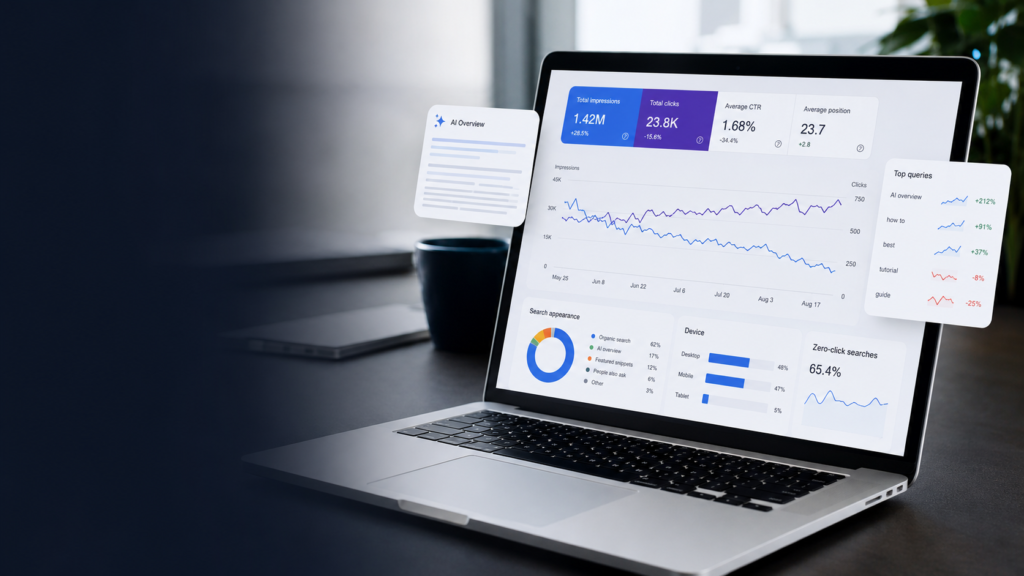
The alligator effect is an informal name for a widening gap between search impressions and clicks. On a performance chart, the impressions line rises while the clicks line stays flat or falls, creating a shape like an open mouth. It is also called the great decoupling.
AI answers and other zero-click features can contribute to that pattern, but they are not the only possible cause. Query expansion can add low-ranking impressions. Device or country mix can change. A title can lose relevance. Demand can shift. Another page can replace the intended URL. Reporting or SERP changes can also affect the lines.
| Observed GSC pattern | First check | Do not assume |
|---|---|---|
| Impressions rise, position stays beyond 20, clicks stay flat | Query relevance, new low-ranking terms, coverage, and internal authority | That a title rewrite will solve the problem |
| Position holds in the top 10, impressions hold, CTR falls | Live SERP features, result title, snippet, competitors, device, and query mix | That the content itself lost relevance |
| Impressions and position both decline | Indexing, canonical, intent, competitors, internal links, demand, and sitewide movement | That a zero-click feature caused the loss |
| Clicks grow but leads weaken | Intent expansion, landing-page fit, geography, and conversion tracking | That more organic traffic automatically means better SEO |
If your data shows impressions without clicks, follow the full low-CTR and ranking-depth diagnostic before changing a title or rewriting the page.
Which searches are still likely to earn clicks?
No query type guarantees a click, and SERPs can vary by market, device, and time. However, searches that require a decision, transaction, local action, personal context, complete dataset, tool, or original proof usually leave more work for the destination website.
| Search need | Why a click may still be needed | Useful destination |
|---|---|---|
| Commercial comparison | The user needs specifications, limitations, prices, alternatives, or proof before deciding. | Comparison, buying guide, service page, or product/category experience |
| Local action | The user may need availability, directions, a call, booking, service area, or current business details. | Business Profile, location page, service page, or booking flow |
| Complex troubleshooting | The correct fix depends on symptoms, environment, sequence, or a detailed diagnosis. | Decision tree, diagnostic guide, support document, or expert service |
| Original information | The full dataset, methodology, case evidence, visual, or analysis cannot fit inside a short answer. | Research report, calculator, template, interactive tool, or case study |
| High-stakes decision | The user needs authoritative detail, current rules, limitations, or professional guidance. | Primary source, complete reference, qualified professional, or transparent service page |
Simple definitions still have a role. They introduce a topic, build understanding, and can support broader site authority. The mistake is valuing every informational impression as if it has the same probability of producing a visit or lead.
A practical 90-day SEO plan for AI search
Days 1–14: establish eligibility and ownership
- Confirm that priority URLs are indexable, canonical, rendered, and present in the sitemap.
- Assign one primary task to each important URL.
- Identify overlapping pages before creating anything new.
- Record page-level GSC baselines and the queries that must be protected.
- Check whether the Generative AI performance report is available in Search Console.
Days 15–35: improve the pages closest to an outcome
- Prioritize aligned queries already appearing around positions 4–20.
- Improve the opening answer, missing decisions, evidence, examples, and search presentation.
- Add contextual links from relevant established pages.
- Connect informational content to the correct product, service, location, or next-step page.
- Do not change a ranking URL without a migration reason and redirect plan.
Days 36–60: create the information competitors cannot copy
- Publish a small original study, benchmark, decision tree, template, calculator, annotated workflow, or verified field note.
- Add useful images or video where they clarify the task.
- Make authorship, methodology, dates, sources, and limitations visible.
- Update inconsistent brand and service information across important web properties.
Days 61–90: measure by cluster and business value
- Compare complete 28-day periods rather than reacting to a few volatile days.
- Review whether the intended query cluster is expanding and moving into stronger position buckets.
- Protect queries that were already producing qualified clicks.
- Measure leads, conversions, engagement, branded searches, and assisted outcomes alongside visibility.
- Decide whether to keep, iterate, build a supporting asset, improve authority, change format, or roll back a specific change.
For the implementation layer—technical access, extractable answers, brand identity, supporting consensus, and measurement—use the complete AI search optimization guide. It owns the detailed tactics; this article owns the strategic decision.
What should the new SEO scorecard include?
A useful scorecard separates visibility, engagement, and business outcomes. It does not replace traffic with vague awareness metrics.
| Layer | Metrics | Question answered |
|---|---|---|
| Eligibility | Indexing, selected canonical, crawl status, rendering, internal discovery | Can the right page participate? |
| Search visibility | Qualified impressions, query count, position buckets, SERP features, generative impressions where available | Is the intended audience finding the correct URL? |
| Choice and engagement | Clicks, CTR by coherent cohort, engaged sessions, key interactions | Does visibility turn into meaningful attention? |
| Brand presence | Branded search direction, sampled AI mentions and citations, answer accuracy, share of observed prompts | Is the brand present and represented correctly? |
| Business outcome | Qualified leads, sales, calls, bookings, assisted conversions, revenue | Is search contributing to the business? |
Measure each layer at a cadence appropriate to its volume. A low-volume page may need 56–84 days before a stable conclusion is possible. A crawl or canonical problem can be checked much sooner. SearchCounselCo’s guide to business-first SEO goals and KPIs provides the wider reporting framework.
FAQ about the future of SEO and AI search
Is SEO dead in 2026?
No. Google says its generative AI search features are rooted in core Search ranking and quality systems. SEO remains necessary for discovery, eligibility, relevance, and retrieval. The work is expanding to include generated answers, broader visibility measurement, stronger original evidence, and more deliberate protection of click-worthy demand.
Does GEO replace SEO?
No. GEO is commonly used to describe efforts to improve visibility in generative answers. Google treats optimization for its generative search experience as SEO. Other AI engines may use different retrieval and crawler systems, so platform-specific checks can still be useful. The disciplines overlap more than the labels suggest.
Why are impressions increasing while clicks are falling?
Possible causes include lower average rank, expansion into broader queries, AI Overviews, featured snippets, People Also Ask, ads, local results, device or country changes, weak result presentation, or demand shifts. Check page-level queries, position, SERP layout, device, country, and the selected URL before choosing a fix.
Are zero-click searches always bad?
No. A local result may generate a call without a website visit. A brand mention may influence a later branded search. Some informational queries have little commercial value. Zero-click becomes a business problem when valuable discovery or decision-stage demand stops producing measurable outcomes and no other useful action replaces it.
Do I need special AI schema or an llms.txt file for Google?
No. Google says no special schema, AI text file, or machine-readable markup is needed for AI Overviews or AI Mode, and its generative AI optimization guide says Google Search ignores llms.txt. Normal structured data can still support eligible search features when it matches visible content.
How long should I wait after updating an SEO page?
Confirm crawling, indexing, canonical selection, and rendering during the first 7–14 days. Review early query movement after about 14–28 days. For a low-volume or competitive article, 56–84 days may be needed before deciding whether to keep, iterate, expand, change format, or roll back a specific change.
The one thing to do next
Choose one important page and classify every meaningful query into three groups: protect, improve, or delegate to another URL. Then inspect position and the live SERP before changing the copy. If the data still does not reveal whether the problem is ranking, ownership, CTR, technical eligibility, or demand, a focused Search Console and SEO strategy review can turn the evidence into a prioritized release plan.
Sources used
- Google Search Central: AI features and your website
- Google Search Central: Optimizing for generative AI features
- Google Search Central: Generative AI performance reports
- Google Search Console Help: Generative AI performance report
- Pew Research Center: Click behavior with Google AI summaries
- SparkToro: 2026 zero-click search research
- Ahrefs: 2026 AI Overview CTR study
- Seer Interactive: 2026 AI Overview CTR update
Platform behavior and documentation were checked in August 2026. The SearchCounselCo field note uses page-filtered Web search data from June 23–August 11, 2026. Detailed GSC query rows were partially anonymized, so cluster shares are directional. Third-party studies use different samples and methodologies; their findings should not be treated as a universal traffic forecast.