AI Search Visibility Guide
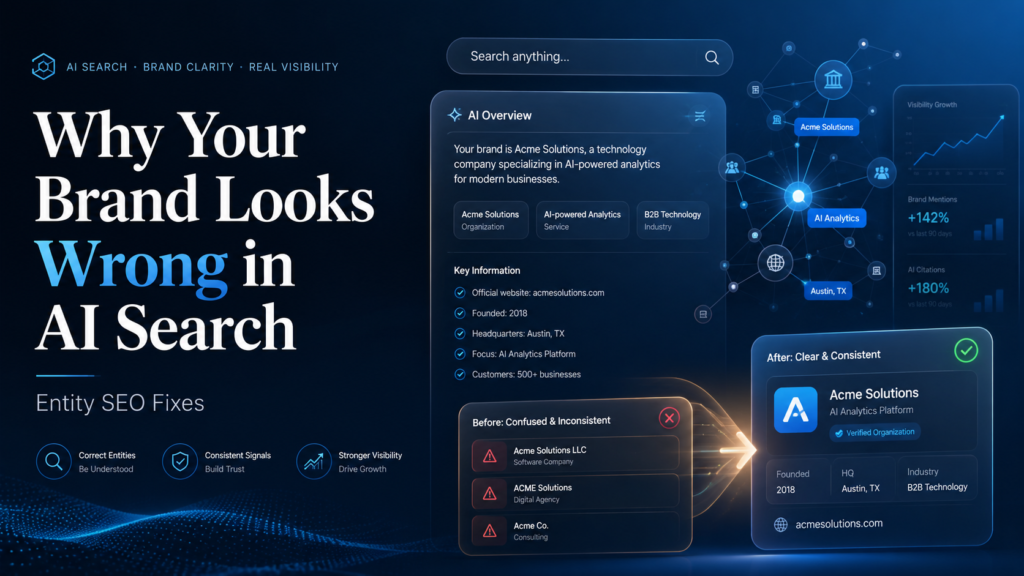
Why Your Brand Looks Wrong in AI Search: Entity SEO Fixes
Your brand may already be appearing in AI search, but not in the way you want. AI tools may call you the wrong type of company, show outdated services, mention competitors more clearly, or summarize public reviews before users ever click your website.
Core Problem
AI tools may describe your business using mixed signals from websites, profiles, reviews, directories, and third-party mentions.
Best Fix
Clean up your brand entity, align your descriptions, add useful schema, and make your brand story consistent across the web.
SEO Goal
Improve brand accuracy, AI search visibility, branded query trust, and conversion clarity before competitors shape the story.
Quick Answer: Why Does Your Brand Look Wrong in AI Search?
Your brand may look wrong in AI search because AI systems combine information from many places, including your website, Google Business Profile, social profiles, reviews, directories, schema markup, old indexed pages, and third-party mentions. If those signals are outdated, thin, inconsistent, or unclear, AI tools may describe your brand incorrectly.
- Your homepage does not clearly explain what your business does.
- Your About page is thin, old, or too generic.
- Your service pages use different wording for the same offer.
- Your Google Business Profile does not match your website.
- Directories show old phone, address, category, or service details.
- Your schema is missing, weak, or not aligned with visible content.
- Third-party mentions describe your brand differently than you do.
Search has changed. A buyer may not always compare ten blue links before making a decision. They may ask Google AI Overviews, ChatGPT, Gemini, Perplexity, or another AI-powered answer system a simple question and trust the short summary they receive.
That creates a new problem for brands. It is no longer enough to ask, “Are we ranking?” You also need to ask, “Are AI systems explaining our brand correctly?”
A recent industry report around AI search visibility found that many marketers still work with fragmented SEO, content, social, and brand strategies. Some marketers also report that AI tools describe their brands inaccurately, show unclear positioning, or mention competitors more often. That is why brand visibility in AI search now needs a serious SEO and entity audit.
What Brand Visibility in AI Search Really Means
Brand visibility in AI search means your business appears and is described accurately inside AI-generated answers, AI Overviews, chatbot responses, and recommendation-style search results. But visibility alone is not the full goal.
A brand can appear in AI search and still lose trust if the answer is vague, outdated, negative, or wrong. For example, an SEO consulting company may be described as a general marketing agency. A local service business may be shown with the wrong service area. A SaaS company may be summarized using old product details.
| AI Search Goal | What It Means |
|---|---|
| Visibility | AI tools mention your brand in answers or summaries. |
| Accuracy | AI tools describe your business, services, location, and value correctly. |
| Trust | AI tools connect your brand with reliable, consistent, and verifiable signals. |
| Sentiment | AI tools frame your brand positively, neutrally, or negatively based on public signals. |
| Conversion Clarity | Users understand what you offer and why they should consider you. |
Brand Visibility vs Brand Accuracy vs Brand Sentiment
Many businesses only ask, “How do we appear in AI search?” A better question is, “When AI search mentions us, is the answer correct?”
Wrong AI visibility can be worse than no visibility. If an AI answer says your business offers old services, serves the wrong market, or has unclear positioning, the buyer may never click through to confirm.
| Problem | Example | Why It Matters |
|---|---|---|
| Brand Invisibility | AI tools do not mention your business. | You lose discovery opportunities. |
| Brand Inaccuracy | AI describes your service or category incorrectly. | Users may misunderstand your offer. |
| Brand Confusion | AI mixes your brand with another company or old entity. | Trust drops before the click. |
| Weak Positioning | AI gives a vague description while competitors look clearer. | Competitors may seem more useful. |
| Negative Sentiment | AI highlights complaints, limitations, or outdated issues. | Buyers may hesitate before visiting your site. |
Your Brand Has an AI Search Identity Problem
AI search may not be wrong randomly. It may be building your brand identity from scattered public signals across the web. If your homepage, About page, service pages, profiles, directories, reviews, and third-party mentions do not agree, AI search may create a mixed version of your brand.
This is why the fix is not only “write more blogs.” The fix is to make your brand entity clear, consistent, and verifiable.
AI Brand Accuracy Score: How Clear Is Your Brand to AI Search?
Before trying to improve brand visibility in AI search, score how clearly AI systems may understand your brand. This simple AI Brand Accuracy Score helps you find whether your business has clear entity signals or mixed public information.
| Score | What It Means | What to Fix First |
|---|---|---|
| 0–3 | Weak AI brand clarity. AI tools may not understand your business correctly. | Rewrite homepage summary, update About page, fix GBP, clean citations. |
| 4–6 | Mixed brand signals. Some platforms describe your business correctly, others do not. | Align service pages, social profiles, schema, and third-party mentions. |
| 7–8 | Mostly clear brand entity. AI search may understand you, but gaps still exist. | Improve entity proof, add stronger service clarity, build better mentions. |
| 9–10 | Strong AI-ready brand identity. Your website and public signals tell the same story. | Monitor branded queries and refresh signals after major business changes. |
A strong brand accuracy score does not guarantee AI search visibility, but it reduces confusion and gives AI systems clearer information to verify.
Where AI Tools May Learn About Your Brand
AI search can synthesize information from many places. Your website matters, but your website is not the only signal. Public profiles, reviews, directories, social pages, and third-party references can all influence how your brand is understood.
| Source | What AI May Learn | What Can Go Wrong |
|---|---|---|
| Homepage | Main business identity | Too generic, vague, or outdated |
| About Page | Who you are and why you are credible | Thin expertise signals or missing brand story |
| Service Pages | What you actually offer | Services described differently across pages |
| Google Business Profile | Category, location, hours, reviews, services | Wrong category, old address, or weak description |
| Social Profiles | Brand voice and positioning | Old tagline or inconsistent company description |
| Directories | NAP and category details | Wrong phone, address, category, or website URL |
| Review Sites | Customer sentiment and service quality | Old complaints or weak review responses dominate |
| Schema Markup | Machine-readable entity clues | Missing, incomplete, or not matching visible content |
| Third-Party Articles | External confirmation of your brand | Old, incomplete, or broad descriptions |
| Reddit and Forums | User-generated perception | Informal or outdated comments may shape summaries |
Real Examples: How AI Search Gets a Brand Wrong
AI search mistakes usually come from mixed signals. Here are common examples business owners may recognize.
| AI Search Mistake | Likely Cause | Entity SEO Fix |
|---|---|---|
| AI calls your SEO consultancy a “digital marketing agency.” | Old directories, broad homepage copy, or vague service descriptions. | Rewrite the homepage summary, update listings, and strengthen SEO-specific service pages. |
| AI shows your old city or service area. | Old citations, outdated Google Business Profile, or location pages still indexed. | Correct NAP data, update GBP, refresh local pages, and add accurate LocalBusiness schema. |
| AI mentions competitors more clearly than your brand. | Competitors have stronger third-party mentions and clearer service positioning. | Build helpful comparison content, improve About page proof, and earn better brand mentions. |
| AI highlights complaints instead of current strengths. | Old reviews or negative third-party content are stronger than current trust signals. | Improve review response strategy, publish stronger trust content, and update proof pages. |
Why Inconsistent Brand Signals Confuse AI Search
If your homepage says one thing, your LinkedIn profile says another, your directories show a different category, and your old blog content still talks about services you no longer offer, AI search may not know which version is current.
This often happens after rebrands, new service launches, location changes, site migrations, or years of content being published without a clear brand system. The old signals do not disappear just because the homepage changed.
- Old brand names or taglines are still indexed.
- Different profiles describe the company in different ways.
- Service pages use inconsistent naming.
- Local citations have old addresses or phone numbers.
- Reviews mention only one part of the business.
- Schema is missing or does not match the page.
- Third-party mentions use outdated positioning.
Entity SEO: The Missing Layer Behind AI Brand Accuracy
Entity SEO helps search systems understand your brand as a real, specific, consistent thing — not just a collection of keywords. For AI search, this matters because the answer system needs to understand who you are, what you do, where you operate, and why your brand is relevant.
Entity SEO includes your business name, logo, website, location, service area, business category, official profiles, organization details, and the way those facts are repeated across your website and trusted sources.
A good entity SEO cleanup often includes your homepage, About page, core service pages, content strategy, schema markup, Google Business Profile, social links, and third-party mentions.
AI Search Does Not Just Rank Brands — It Verifies Them
Traditional SEO often focused on ranking pages. AI search adds another layer: can the system verify the brand information from multiple sources?
This is why brand visibility in AI search is closely connected to data consistency. Does your website match your Google Business Profile? Does your schema match the visible page? Do your social profiles match your current positioning? Do your reviews and third-party mentions confirm what your business actually does?
If the answer is no, AI search may describe your brand in a way that feels incomplete, outdated, or wrong.
Why AI Search May Describe Your Brand Negatively or Incompletely
AI-generated answers may reflect public web signals. If the web contains more complaints, confusion, outdated information, or weak brand descriptions than strong official proof, AI search may produce an incomplete or less flattering summary.
This does not mean AI search is always unfair. It means your public brand footprint matters. If review patterns, old articles, weak service pages, and inconsistent profiles create confusion, AI tools may surface that confusion.
- Old negative reviews are easier to find than current proof.
- Your review responses do not clarify issues or show care.
- Competitors have stronger third-party mentions.
- Your trust pages, case studies, or service explanations are thin.
- Public sources explain your limitations more clearly than your strengths.
- Your brand has not published enough current, helpful, authoritative content.
Owned Media vs Third-Party Mentions: Why Your Website Is Not Enough
Your website is the best place to define your brand clearly. But AI search may also look for outside confirmation. If your website says one thing and the rest of the web says another, the answer may not follow your preferred version.
| Your Website Says | The Web Says | AI Search Risk |
|---|---|---|
| “We provide SEO consulting.” | Directories say “marketing agency.” | AI describes the brand too broadly. |
| “We specialize in technical SEO.” | Reviews mention only blog writing. | AI underplays the real service strength. |
| “We serve one main city.” | Old listings show another location. | AI may show wrong local relevance. |
| “We are a specialist brand.” | No trusted third-party proof exists. | AI may prefer clearer competitors. |
Why ChatGPT, Gemini, Perplexity, and Google AI May Describe You Differently
Not every AI system uses the same sources or returns the same answer. Google AI Overviews may rely heavily on search-indexed sources. Perplexity may show live citations. ChatGPT may vary depending on browsing, available context, and how the question is asked. Gemini may use Google ecosystem signals in different ways.
That is why a serious brand visibility audit should not check only one AI tool. Search your brand across multiple systems and test different prompts:
- “What is [Brand Name]?”
- “Is [Brand Name] a trusted company?”
- “What services does [Brand Name] offer?”
- “Best companies for [service] near me.”
- “Compare [Brand Name] with [competitor].”
The Local Business Problem: Wrong NAP, Category, or Service Area
Local brands are especially vulnerable to AI search confusion. A wrong address, weak category, duplicate citation, old phone number, or unclear service area can create a mixed local identity.
Google Business Profile allows verified businesses to update details such as address, hours, contact information, photos, category, service area, website, social links, and business description. Keeping this data current helps create a cleaner public business profile.
- Check the business name exactly as it appears in real-world branding.
- Choose the most accurate primary category.
- Make address, phone, and website consistent.
- Use the service area field carefully if you serve specific areas.
- Keep business hours and temporary changes updated.
- Make the business description clear and current.
- Connect official social profiles where supported.
Schema Helps, But Schema Alone Is Not Enough
Structured data can help Google understand the content and meaning of a page. Google explains that structured data gives explicit clues about a page and classifies the page content. For brand clarity, Organization schema, LocalBusiness schema, logo markup, sameAs links, and contact details can all support entity understanding when used correctly.
But schema is not magic. If your visible content, Google Business Profile, social profiles, and third-party citations tell different stories, schema alone cannot fix the larger brand problem.
Use schema to clarify:
- Official business name
- Logo and website URL
- Business type or category
- Address or service area where relevant
- Official social profiles with sameAs links
- Contact details
- Founder, team, or organization details where appropriate
Avoid:
- Keyword-stuffed schema
- Fake review markup
- Schema that does not match visible content
- Adding services in schema that are not explained on-page
- Ignoring old incorrect citations while only editing code
AI Search Brand Audit Prompts
Use these prompts in Google AI results, ChatGPT, Gemini, Perplexity, and other AI search tools to check how your brand is being understood. Run the same prompts once a month and record the answers.
Basic Identity
What does [Brand Name] do?
Service Clarity
What services does [Brand Name] offer?
Trust Check
Is [Brand Name] a trusted company?
Competitor Context
Compare [Brand Name] with [Competitor Name].
Reputation Review
What are common complaints about [Brand Name]?
Local Check
Where is [Brand Name] located and what areas does it serve?
Look for repeated mistakes. If several AI systems describe the brand the same wrong way, the issue is likely coming from your public brand signals, not one random answer.
How to Use Google Search Console to Spot Brand Confusion
Search Console will not tell you everything AI tools say about your brand. But it can show whether users and Google are connecting your brand with the right queries.
Start with your branded queries. SearchCounselCo has a full guide on the Google Search Console branded queries filter, which is useful for separating brand demand from non-branded discovery.
Check these query patterns:
- Brand name queries
- Brand + service queries
- Brand + location queries
- Brand + reviews queries
- Misspelled brand queries
- Competitor + your brand queries
- Queries showing wrong service intent
- Pages ranking for old brand terms
- Branded impressions rising but CTR falling
- Non-branded traffic dropping while branded demand stays stable
Simple workflow:
- Open Google Search Console.
- Go to the Performance report.
- Filter branded queries.
- Compare the last 28 days with the previous 28 days.
- Check brand + service terms.
- Find pages getting impressions for outdated terms.
- Compare CTR on brand queries.
- Review whether the ranking page gives the right brand message.
- Fix the page, profile, schema, or citation that sends mixed signals.
AI Brand Accuracy Audit: 10 Things to Check
This is the practical audit SearchCounselCo recommends before chasing broad AI visibility. Fix the brand story first. Then work on wider AI search exposure.
| Audit Item | What to Check |
|---|---|
| 1. Brand Name Consistency | Is the name written the same way across your site, profiles, and citations? |
| 2. Homepage Summary | Does the homepage explain the business in one clear sentence? |
| 3. About Page | Does it support the same brand identity with expertise and proof? |
| 4. Service Pages | Do service names and descriptions stay consistent? |
| 5. Google Business Profile | Does GBP match the website’s current category, location, and offer? |
| 6. NAP Details | Are name, address, and phone details clean across citations? |
| 7. Schema | Does schema match visible content and official profiles? |
| 8. Social Profiles | Are official descriptions updated and aligned? |
| 9. Third-Party Mentions | Do outside mentions confirm the same business category and value? |
| 10. Search Console Queries | Do branded queries show confusion, old services, or weak CTR? |
Brand Problem to SEO Fix Map
Use this map to connect the AI search problem with the right SEO fix. This turns a vague “AI visibility issue” into a practical action plan.
| Problem in AI Search | What It Usually Means | Best SEO Fix |
|---|---|---|
| Wrong business category | Your profiles and pages describe the business too broadly. | Clarify homepage, About page, GBP category, and service page language. |
| Wrong location or service area | Local SEO data is inconsistent. | Fix NAP, GBP, citations, location pages, and LocalBusiness schema. |
| Weak brand description | Your own site does not clearly explain the brand. | Rewrite hero copy, About page, service intros, and organization summary. |
| Competitors appear more often | Competitors have stronger content, mentions, reviews, or category signals. | Create stronger service content, comparison pages, case studies, and third-party mentions. |
| AI mentions old services | Old pages, old profiles, or outdated citations are still visible. | Update pages, redirect outdated URLs, refresh profiles, and request citation edits. |
How to Fix Wrong Brand Descriptions in AI Search
You cannot force every AI system to update instantly. But you can improve the public signals that help search systems understand your brand.
Step 1: Rewrite the homepage brand summary
Add one clear sentence near the top of the homepage that explains who you help, what you do, and what makes the business specific.
Step 2: Strengthen the About page
The About page should confirm your brand identity, experience, team, service focus, location, and proof.
Step 3: Align service pages
Use consistent language for your core services. If your SEO consulting page says one thing and your content strategy page says another, search systems may get a weaker picture.
Step 4: Update Google Business Profile
Correct categories, services, hours, address, phone, website, service area, and business description.
Step 5: Clean up citations
Fix wrong NAP details, old categories, and outdated business descriptions on important directories and profiles.
Step 6: Add proper schema
Use Organization or LocalBusiness schema where relevant. Add sameAs links for official social profiles. Make sure schema matches visible content.
Step 7: Build better third-party mentions
Earn mentions from relevant, trustworthy sites. A few accurate, high-quality mentions can help reinforce the right brand story better than many weak mentions.
Step 8: Monitor branded queries
Use Search Console to track brand + service queries, branded CTR, wrong query patterns, and pages that still rank for outdated terms. SearchCounselCo’s Google Search Console AI-powered configuration guide can help with faster reporting prompts.
30-Day AI Brand Visibility Fix Plan
If AI search is describing your brand incorrectly, do not try to fix every signal at once. Use this 30-day plan to clean the most important brand signals first.
| Timeline | Priority | Action |
|---|---|---|
| Days 1–3 | Brand audit | Search your brand in Google, AI Overviews, ChatGPT, Gemini, and Perplexity. Save wrong or weak answers. |
| Days 4–7 | Owned content | Update homepage summary, About page, core service pages, and trust content. |
| Days 8–12 | Local/entity data | Fix Google Business Profile, NAP details, major citations, categories, and service areas. |
| Days 13–17 | Schema | Add or improve Organization/LocalBusiness schema, logo, sameAs links, and contact details. |
| Days 18–24 | Third-party proof | Update important profiles and earn accurate mentions from relevant sites. |
| Days 25–30 | Monitoring | Check Search Console branded queries, AI answers, CTR changes, and wrong query patterns. |
What Not to Do When Fixing AI Brand Visibility
- Do not create fake mentions or low-quality PR just to appear everywhere.
- Do not buy spam links and call it AI visibility work.
- Do not stuff schema with keywords.
- Do not publish generic AI-written brand content with no proof.
- Do not ignore reviews or third-party reputation signals.
- Do not make different claims on different platforms.
- Do not delete old pages without checking redirects and search impact.
- Do not treat AI visibility as separate from technical SEO, content, and entity clarity.
How SearchCounselCo Reviews AI Brand Visibility
SearchCounselCo reviews AI brand visibility by looking at the full brand signal system, not only one keyword ranking. That can include branded query data, Search Console patterns, entity consistency, homepage clarity, About page strength, service page alignment, structured data, Google Business Profile, third-party mentions, review signals, and technical SEO barriers.
If AI search is describing your brand incorrectly, SearchCounselCo can help review the signals that shape how search systems understand your business. Start with an SEO consulting review, or explore related services like technical SEO, on-page SEO improvements, and content strategy.
FAQs About Brand Visibility in AI Search
Why does AI search describe my brand wrong?
AI search may describe your brand wrong because it combines information from your website, profiles, reviews, directories, schema, old pages, and third-party mentions. If those signals are inconsistent or outdated, the answer may not match your current business.
How do I fix my brand in AI search?
Start by making your brand identity consistent across your homepage, About page, service pages, Google Business Profile, schema markup, social profiles, and major third-party listings.
What is brand visibility in AI search?
Brand visibility in AI search means your brand appears and is described accurately inside AI-generated answers, AI Overviews, chatbots, and AI-powered search results.
Does schema help AI search understand my brand?
Schema can help clarify your brand entity, especially when it matches visible page content and official profiles. It is helpful, but it cannot fix a weak or inconsistent brand story by itself.
Why does ChatGPT describe my business incorrectly?
ChatGPT may describe your business incorrectly if public information is outdated, unclear, inconsistent, or incomplete. The answer may also change depending on browsing, available context, and prompt wording.
Why does Google AI Overview show wrong brand information?
Google AI Overviews may summarize information from search-indexed sources. If your brand data is inconsistent, outdated, or unclear across the web, the summary may not match your current positioning.
Do reviews affect AI search brand visibility?
Reviews can influence public perception and may contribute to how search systems understand sentiment, trust, and service quality. Review quality, review responses, and current customer feedback can all matter.
How do brand mentions help AI search?
Consistent third-party mentions can reinforce what your brand does, where it operates, and why it is relevant. Strong mentions are most useful when they match the brand story on your own website.
What is entity SEO for AI search?
Entity SEO is the process of making your brand identity clear and consistent so search systems can understand your business as a real, trusted entity.
How often should I audit my brand in AI search?
Audit your brand monthly, or after major website updates, rebrands, service changes, reputation issues, location changes, or major search updates.
Conclusion: Fix the Brand Story Before Chasing AI Visibility
If your brand looks wrong in AI search, the issue may not be one ranking problem. It may be a brand signal problem. The best fix is to make your website, schema, Google Business Profile, social profiles, third-party mentions, reviews, and Search Console signals tell the same clear story.
AI search visibility starts with accuracy. When search systems can understand who you are, what you do, where you operate, and why your brand is trustworthy, your brand has a better chance of being represented clearly in the next version of search.