AI Search SEO Guide
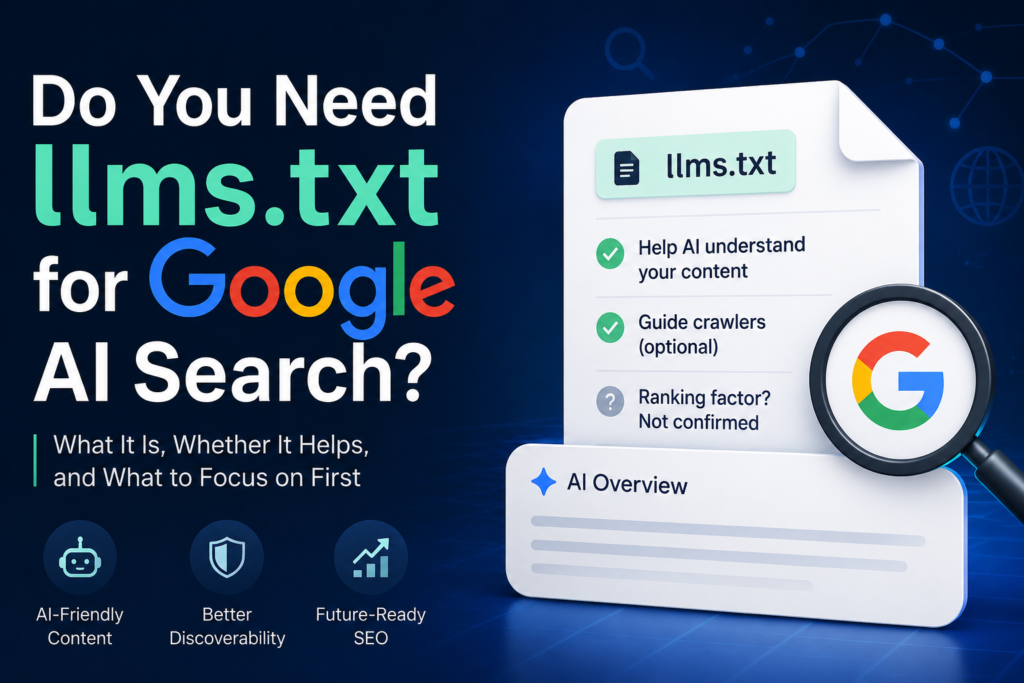
Do You Need llms.txt for Google AI Search?
If you work on SEO right now, you have probably seen the same question coming up everywhere: do you need llms.txt for Google AI search?
Short answer
No, not required
llms.txt is not a confirmed Google AI search requirement.
Best use
Supplemental guide
It may help some AI tools understand key public pages.
Fix first
SEO foundation
Crawlability, indexability, content quality, and internal links matter first.
Quick answer
1. llms.txt is optional
It is not required for Google AI search, AI Overviews, AI Mode, indexing, or ranking.
2. It is not robots.txt
robots.txt controls crawler access. llms.txt gives curated public context.
3. It is not a sitemap
A sitemap lists URLs. llms.txt should summarize important resources.
4. SEO basics come first
Fix crawl, index, content, structure, and Search Console issues before adding it.
Already know the basics? Go straight to Should You Add llms.txt? Quick Decision Table.
The confusion makes sense. Google AI Overviews, AI Mode, Gemini, ChatGPT, Claude, Perplexity, robots.txt, Google-Extended, AI crawlers, and now llms.txt are all being discussed at the same time. Site owners are trying to understand whether adding one new file can help their website appear more often in AI search results.
The short answer is careful but clear: you do not need llms.txt for Google AI search as a requirement. It is not a confirmed Google ranking factor, and Google has not said that llms.txt is required for AI Overviews, AI Mode, or normal Search visibility.
That does not mean llms.txt is useless. For some sites, it may be a helpful supplemental file that gives AI tools a clean guide to important public pages. But it should not replace the SEO basics: crawlability, indexability, structured data, content quality, internal links, topical authority, and a healthy technical foundation.
Source note:
The official llms.txt proposal describes /llms.txt as a Markdown file that helps LLMs use a website at inference time. Read the proposal here: llms.txt proposal — The /llms.txt file.
Related guide: If you are trying to understand how AI search affects clicks, impressions, and SEO reporting, read our Google AI Mode SEO 2026 guide.
Jump to what you need
Article note: Written by SearchCounselCo Editorial Team. Last updated June 2026. This guide is for SEO education only and does not claim that llms.txt is a confirmed Google ranking factor.
1) Quick Answer: Do You Need llms.txt for Google AI Search?
No, llms.txt is not required for Google AI search. There is no confirmed public Google guidance saying that llms.txt is needed to rank in Google Search, appear in AI Overviews, or show up in AI Mode. Treat llms.txt as an optional AI-readable guide, not as a ranking factor or AI search shortcut.
Think of llms.txt as an optional support file. It may help some AI systems or agents understand your most important public content, but it should come after the core SEO foundation is already strong.
For most websites, the better priority order is:
- Make important pages crawlable.
- Make important pages indexable.
- Fix robots.txt, noindex, canonical, and redirect issues.
- Submit a clean sitemap.xml.
- Improve page quality and search intent match.
- Use structured data where it is relevant.
- Strengthen internal links and topical coverage.
- Then consider adding llms.txt as a supplemental file.
If Google cannot crawl, index, understand, or trust your actual pages, adding llms.txt will not fix the real SEO problem.
2) What Is llms.txt?
llms.txt is a proposed Markdown file placed at the root of a website, usually at:
https://example.com/llms.txtThe purpose is to give large language models a clean, concise guide to the website. Instead of forcing an AI system to interpret complex navigation, JavaScript, ads, templates, and scattered pages, llms.txt can point to the most important public resources in a simple Markdown format.
The official llms.txt proposal describes the file as a way to provide information that helps LLMs use a website at inference time. It also says the file is written in Markdown and can include a site title, short summary, optional context, and H2 sections with important links.
A simple llms.txt file may look like this:
# SearchCounselCo

> SEO consulting, technical SEO, content strategy, and Search Console analysis for businesses that want clearer organic growth.

## Key Services
- [SEO Consulting](https://searchcounselco.com/seo-consulting/): SEO strategy, audits, and growth planning.
- [Technical SEO Services](https://searchcounselco.com/technical-seo-services/): Crawlability, indexing, site structure, and technical fixes.
- [Content Strategy](https://searchcounselco.com/content-strategy/): Content planning, topical authority, and internal linking.

## Key Guides
- [Google AI Mode SEO 2026](https://searchcounselco.com/google-ai-mode-seo-2026-traffic-impact/): How AI search changes clicks, impressions, and SEO reporting.
- [Google Search Console AI-Powered Configuration](https://searchcounselco.com/google-search-console-ai-powered-configuration/): How to use AI prompts for SEO reports.
- [Google Search Console Branded Queries Filter](https://searchcounselco.com/google-search-console-branded-queries-filter/): How to separate branded and non-branded traffic.
This is not the same as listing every page on the site. That is what a sitemap is for. llms.txt should be curated, short enough to be useful, and focused on the pages that explain the site best.
3) Is llms.txt a Google Ranking Factor?
There is no confirmed evidence that llms.txt is a Google ranking factor.
Google’s public crawler documentation focuses on Googlebot, robots.txt, crawler tokens, crawl preferences, and product-specific crawlers. It does not present llms.txt as a requirement for Google Search rankings, indexing, AI Overviews, or AI Mode.
Google’s common crawler documentation says Google’s common crawlers are used to find information for building Google’s search indexes and that they obey robots.txt rules when crawling automatically. It also explains which crawler tokens affect Google Search and related Google surfaces.
Simple rule: Do not add llms.txt expecting an instant ranking boost. Add it only if it helps create a clearer public guide to your most important content.
4) llms.txt vs robots.txt vs sitemap.xml vs Structured Data
Many site owners confuse llms.txt with robots.txt, sitemap.xml, and structured data. These files and signals can all help machines understand or access a website, but they do different jobs.
| File / Signal | Main Purpose | Helps With | Does It Control Google Rankings? |
|---|---|---|---|
| llms.txt | Curated Markdown guide for LLMs | AI readability, context, and important resource discovery | No confirmed Google ranking role |
| robots.txt | Controls crawler access | Crawl management and crawler permissions | No, but blocking important pages can hurt visibility |
| sitemap.xml | Lists important URLs | URL discovery for search engines | Helps discovery, but does not guarantee ranking |
| structured data | Marks up page meaning | Content understanding and eligible rich result features | Can support eligible search features, but does not guarantee ranking |
| content pages | Main pages users and search engines evaluate | Usefulness, relevance, trust, conversions, and rankings | They are the core SEO asset |
Google’s robots.txt documentation explains how Google interprets robots.txt rules for crawler access. The llms.txt proposal explains that llms.txt is designed to coexist with existing standards, but it has a different purpose: providing curated context for LLMs.
5) Google-Extended, robots.txt, and llms.txt Are Three Different Things
This is one of the most important points because many AI SEO discussions mix these terms together.
Googlebot is used for Google Search crawling. robots.txt gives crawler access rules. Google-Extended is a Google product token used for certain Google AI training and grounding controls. llms.txt is a public Markdown guide that points AI tools toward important content.
Google’s documentation says Google-Extended does not impact a site’s inclusion in Google Search and is not used as a ranking signal in Google Search.
| Tool / File | What It Does | Best Use | What It Does Not Do |
|---|---|---|---|
| Googlebot | Crawls pages for Google Search and related Search features | Search discovery and indexing | It is not controlled by llms.txt |
| robots.txt | Gives crawler access rules | Allowing or blocking crawler access | It is not a content summary file |
| Google-Extended | Controls certain Google AI training and grounding uses | Publisher control over some Google AI use cases | It does not affect Google Search ranking |
| llms.txt | Gives AI tools a curated guide to important public content | AI-readable context and resource discovery | It does not control crawling or guarantee rankings |
If your goal is to control crawler access, review robots.txt. If your goal is to manage certain Google AI-related use cases, review Google-Extended. If your goal is to provide a simple AI-readable guide to important public pages, then llms.txt may be useful.
6) Why People Think llms.txt Matters for AI Search
People are asking about llms.txt because AI search is changing how websites get discovered. Google AI Overviews and AI Mode can surface answers differently from traditional blue-link search results. That makes site owners wonder whether they need new files, new technical signals, or new optimization steps.
There is also growing research showing that AI-generated search experiences can cite sources differently from traditional organic search. One 2026 study of Google AI Overviews looked at 55,393 trending queries and reported AI Overview activation at 13.7% overall, rising to 64.7% for question-form queries. The study also reported that nearly 30% of AI Overview-cited domains did not appear in co-displayed first-page organic results.
So the concern is valid. AI visibility is becoming important. But that does not automatically mean llms.txt is the deciding factor for Google AI search.
7) What Google AI Search Likely Cares About More Than llms.txt
If you want better visibility in Google Search and AI-led search experiences, your strongest starting point is still the actual website. A public llms.txt file cannot make weak pages strong, blocked pages crawlable, or thin content trustworthy.
Crawlable pages
Important URLs should not be blocked by robots.txt.
Indexable pages
Important content should not be noindexed or incorrectly canonicalized.
Helpful content
Pages should answer real search intent clearly.
Internal links
Important pages should be connected to relevant supporting pages.
- Source clarity: Users and search systems should understand who the business is and what the page is about.
- Entity consistency: Brand, service, author, and business details should be consistent.
- Structured data: Use schema where it genuinely fits the page type.
- Topical authority: The site should cover its core topics with depth and usefulness.
- Search Console health: Crawl, indexing, CTR, query, and page-level issues should be reviewed.
If these basics are weak, llms.txt should not be the priority. A technical SEO audit is usually more important than adding another file.
8) Before You Create llms.txt, Check These SEO Basics
Before creating an llms.txt file, make sure the site is not missing the fundamentals. This checklist gives site owners a simple order of priority.
| SEO Basic | Question to Ask | Why It Matters Before llms.txt |
|---|---|---|
| Crawlability | Can Googlebot access important pages? | If crawlers cannot access the page, an AI-readable guide will not fix visibility. |
| Indexability | Are important pages indexable? | Noindexed or incorrectly canonicalized pages are not strong candidates for search visibility. |
| Robots.txt | Are important folders accidentally blocked? | Blocking useful pages can hurt search discovery. |
| Sitemap.xml | Does the sitemap include the right important URLs? | A clean sitemap supports URL discovery. |
| Internal links | Are important pages linked from relevant pages? | Internal links show importance and topic relationships. |
| Content quality | Does each page answer the real user intent? | Weak content remains weak even if it appears in llms.txt. |
| Structured data | Is schema used where it genuinely fits? | Structured data can help machines understand eligible content types. |
| Search Console data | Are there crawl, indexing, CTR, or query issues? | Search Console tells you what needs fixing before adding optional files. |
If several answers are “no,” fix those issues first. llms.txt is more useful when it points to strong, public, well-structured pages.
9) SEO Priority Stack: What to Fix Before llms.txt
The biggest mistake is treating llms.txt like an AI SEO shortcut. It is not. Use this priority stack before deciding whether llms.txt deserves your time.
| Priority | What to Fix First | Why It Matters |
|---|---|---|
| 1 | Crawlability | Google and other systems must be able to access important content. |
| 2 | Indexability | Important pages must be eligible to appear in Search. |
| 3 | robots.txt, canonicals, redirects, and noindex tags | Technical mistakes can remove pages from visibility. |
| 4 | Sitemap and internal links | They help discovery and show content relationships. |
| 5 | Helpful content and search intent | This is the main reason users and search systems value the page. |
| 6 | Structured data where relevant | It helps machines understand eligible content types. |
| 7 | Brand and entity consistency | It helps search and AI systems understand who you are and what you offer. |
| 8 | llms.txt | It can act as an optional supplemental guide for AI tools. |
If your site has crawl or indexing problems, fix those first. If your service pages are thin, improve them first. If internal links are weak, strengthen the site structure first. If your content does not answer the query well, llms.txt will not solve that.
A stronger content strategy can help decide which pages should be improved, connected, expanded, or summarized before you create an AI-readable file.
10) When llms.txt Might Be Worth Adding
llms.txt can be worth adding when your SEO foundation is already solid and your site has enough useful public content to curate.
SaaS websites
Useful when you have features, pricing, help, and documentation pages.
Documentation sites
Helpful for developer docs, knowledge bases, and product hubs.
Large blogs
Useful when many topic clusters need a clean AI-readable map.
Agency sites
Good for connecting service pages, guides, and resource hubs.
It may also make sense for ecommerce sites with important policy, category, and product guide pages, product documentation hubs, and sites that want to curate their best resources for AI tools.
The file is most useful when an AI system would benefit from a clean map of your key public pages. For a simple five-page local business website, it may be optional and low priority. For a large documentation or service site, it may be more helpful.
11) When llms.txt Is Not Worth Prioritizing
llms.txt is not worth prioritizing if the basics are broken.
Do not make llms.txt your first SEO task if:
- Important pages are blocked in robots.txt.
- Service pages are thin or unclear.
- Important pages are noindexed.
- Canonicals point to the wrong URLs.
- Your sitemap is outdated or incomplete.
- Internal linking is weak.
- Content is outdated or generic.
- Structured data is missing where it would be useful.
- Search Console already shows crawl or indexing issues.
- You have no clear topical authority around your main services.
Simple rule: If the foundation is weak, llms.txt becomes a nice file sitting on top of a broken SEO system. Fix the system first.
12) Should You Add llms.txt? Quick Decision Table
Use this table if you want a fast decision.
| Site Situation | Should You Add llms.txt? | Better First Step |
|---|---|---|
| Strong SEO foundation and complex content library | Yes, worth testing | Create a clean curated file and monitor results |
| SaaS or documentation-heavy site | Yes, likely useful | Map key docs, features, pricing, and support resources |
| Simple five-page business site | Optional, low priority | Improve service pages and local/entity signals first |
| Crawl/indexing issues exist | No, not yet | Fix technical SEO first |
| Thin or weak service pages | No, not yet | Improve page quality and search intent match first |
| Weak internal linking | No, not yet | Build a stronger internal link structure first |
| Publisher worried about AI training controls | llms.txt is not the right control | Review robots.txt and Google-Extended controls |
13) What Should Go Inside llms.txt?
A good llms.txt file should be clean, public, and curated. It should not be a full sitemap. It should help an AI system understand the site’s most important public resources.
A simple structure can include:
- Site or brand name
- Short description of what the site does
- Important service pages
- Important educational guides
- Useful documentation or policy pages
- About and contact pages if they help explain the organization
- Short descriptions beside each important link
Here is a simple template:
# Site Name

> Short summary of what the site does, who it helps, and what kind of content is important.

## Key Services
- [Service Page](https://example.com/service/): Short description of the service.
- [Second Service](https://example.com/second-service/): Short description of the service.

## Key Guides
- [Guide Title](https://example.com/blog/guide/): Short description of what the guide explains.
- [Another Guide](https://example.com/blog/another-guide/): Short description of the guide.

## Company Information
- [About](https://example.com/about/): Company background and expertise.
- [Contact](https://example.com/contact/): Contact details and inquiry page.

## Optional
- [Secondary Resource](https://example.com/resource/): Useful but not essential context.
The llms.txt proposal recommends concise language, brief informative descriptions when linking resources, and avoiding ambiguous terms or unexplained jargon.
14) What Not to Put in llms.txt
Because llms.txt is a public file, do not include anything private, sensitive, unfinished, or misleading.
- Private URLs
- Admin paths
- Staging URLs
- Client documents
- Customer data
- Internal strategy pages
- API keys or technical secrets
- Unpublished resources
- Login pages
- Exaggerated marketing claims
- Pages you do not want AI tools or users to see
If you would not want a normal visitor, competitor, or AI tool to read the information, do not put it in llms.txt.
15) Should WordPress Sites Add llms.txt?
WordPress sites can add llms.txt, but they should not treat it as a shortcut to Google AI visibility.
A small WordPress site with thin pages, weak internal links, poor technical SEO, and no clear content strategy will benefit more from fixing those issues first. A larger WordPress site with strong service pages, detailed guides, and many useful resources may benefit from a curated llms.txt file.
Before adding llms.txt to WordPress, check this list:
- Important pages are indexable.
- The sitemap.xml is working.
- Search Console does not show major indexing problems.
- Service pages clearly explain the offer.
- Blog posts support service and topic clusters.
- Internal links connect related pages.
- Structured data is added where useful.
- The site has a clear content strategy.
If those basics are already handled, llms.txt may be worth testing as a simple supplemental file.
16) Can llms.txt Help Google AI Overviews?
There is no confirmed Google statement saying llms.txt helps a page appear in AI Overviews.
That said, AI Overview visibility is a real SEO concern. AI Overviews can cite sources differently from traditional organic results, and research suggests that some cited pages may not appear in the co-displayed first-page organic results.
So the better question is not only “Will llms.txt help AI Overviews?” The better question is:
Is your content clear, crawlable, indexable, useful, well-linked, source-worthy, and easy for machines to understand?
If the answer is no, focus there first. If the answer is yes, llms.txt may be a small extra signal for AI readability, but it should not be treated as the main AI search strategy.
17) SearchCounselCo Recommendation: Should You Add llms.txt?
SearchCounselCo’s recommendation is simple: do not treat llms.txt as an AI search shortcut.
Add it only after your technical SEO, crawlability, indexability, structured data, content quality, internal links, and Search Console issues are under control. For complex sites, llms.txt can be a low-risk supplemental file. For sites with weak SEO foundations, it is not the priority.
If you are trying to understand how AI search affects clicks, impressions, and SEO reporting, read our guide on Google AI Mode SEO 2026.
If you want to use Search Console data to understand AI search and traffic patterns, our guide to Google Search Console AI-powered configuration may help.
If you need to separate brand demand from organic discovery, read our guide to the Google Search Console branded queries filter.
And if you are not sure whether llms.txt should be part of your SEO roadmap, a focused SEO consulting review can help you decide what matters most first.
18) FAQs About llms.txt and Google AI Search
Do you need llms.txt for Google AI search?
No. llms.txt is not required for Google AI search. It is optional and supplemental. Google has not confirmed it as a requirement for AI Overviews, AI Mode, indexing, or ranking.
Does llms.txt help with Google AI Overviews?
There is no confirmed Google statement saying llms.txt helps AI Overview inclusion. It may help some AI tools understand key site content, but it is not a proven Google AI Overview ranking factor.
Is llms.txt a Google ranking factor?
No confirmed evidence shows that llms.txt is a Google ranking factor. Treat it as an optional AI-readable guide, not as a ranking signal.
Does Google read llms.txt?
Google has not presented llms.txt as a Search requirement in its public crawler documentation. Google’s crawler documentation focuses on Googlebot, robots.txt, and related crawler tokens.
What is the difference between llms.txt and robots.txt?
robots.txt controls crawler access. llms.txt provides curated context for LLMs and AI agents. One is mainly about access rules; the other is mainly about content guidance.
What is the difference between llms.txt and sitemap.xml?
sitemap.xml lists URLs for search engine discovery. llms.txt curates important resources with short descriptions for LLM context. A sitemap can include many URLs, while llms.txt should usually be more selective.
Is Google-Extended the same as llms.txt?
No. Google-Extended is a Google product token used in robots.txt for certain Google AI-related controls. llms.txt is a public Markdown guide to important site content.
Can llms.txt hurt SEO?
Usually not, if it only links to public, accurate, important pages. It can create problems if you expose private URLs, link to wrong pages, include misleading claims, or treat it as a replacement for real SEO work.
Should WordPress sites add llms.txt?
It is optional. Larger WordPress sites with many important guides, services, or documentation pages may benefit more than small sites. Fix technical SEO, content quality, and internal links first.
Should I fix technical SEO before adding llms.txt?
Yes. Crawlability, indexability, robots.txt, canonicals, structured data, internal links, and page quality should come before llms.txt.
Conclusion: llms.txt Is a Supplement, Not the Foundation
You do not need llms.txt for Google AI search as a requirement. It is not a confirmed ranking factor, and it is not a replacement for technical SEO, structured data, content quality, or normal Google indexing.
But llms.txt can still be useful for some sites. If your website has a strong SEO foundation and a large amount of important public content, a clean llms.txt file may help AI tools understand your site more easily.
The right way to think about llms.txt is simple: it is a supplement, not the foundation.
Fix crawlability, indexability, content usefulness, structured data, internal links, Search Console issues, and topical authority first. Then add llms.txt if it helps clarify your most important resources for AI systems.
If you want help deciding whether llms.txt belongs in your AI SEO strategy, SearchCounselCo can review your technical SEO, content structure, Search Console data, and AI search readiness before you spend time on the wrong priority.
SEO note: llms.txt is optional and should not be treated as a confirmed Google ranking factor. This article is for SEO education and practical site-owner decision-making.
Best next step: Fix crawlability, indexability, content quality, structured data, and internal linking before spending time on optional AI-readable files.