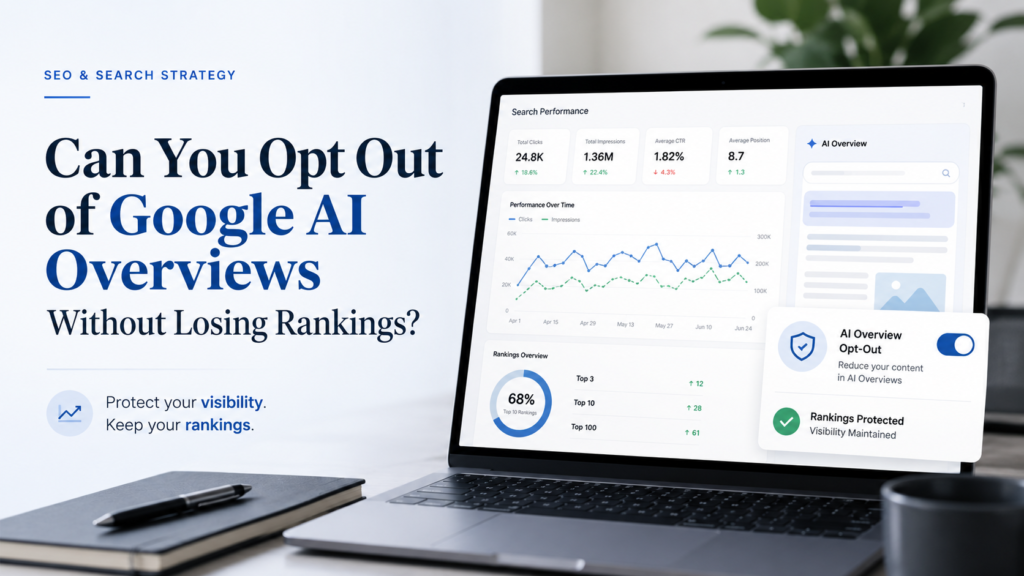
AI Search Controls and SEO
Google AI Overviews Opt-Out: Will It Hurt Your Rankings?
Publishers may be able to keep their content out of Google’s generative search features without leaving traditional Search. The ranking question has a direct answer, but the business decision requires more than switching off AI visibility.
By Rahul Saini, Founder and SEO Strategist at Search Counsel Co. Last updated August 2026.
Featured answer: Can you opt out of Google AI Overviews without losing rankings?
Under the UK publisher controls announced in June 2026, opting out of Google’s generative search features is not intended to affect eligibility or rankings in traditional Google Search. However, the site can lose exposure inside AI Overviews, AI Mode and other covered AI surfaces. Availability and scope should be confirmed inside the site’s Search Console account before making a change.
The important distinction: Keeping a traditional organic ranking does not mean keeping the same total visibility. A page may remain in the blue-link results while no longer being eligible to appear as a cited or supporting source in the AI features covered by the control.
Traditional Search
Remain eligible
The UK control is designed to separate ordinary Search participation from generative AI participation.
AI Visibility
May be removed
The trade-off is losing the AI citations, impressions and discovery covered by the selected control.
Availability
Check your account
Do not assume the same control, scope or rollout applies to every country and website.
Best Decision
Measure first
Compare visibility, clicks and business outcomes before deciding whether AI inclusion helps or hurts.
Jump to what you need
What Is Confirmed About the Google AI Overviews Opt-Out?
In June 2026, the UK Competition and Markets Authority announced requirements intended to give publishers effective tools to prevent their content from powering generative features in Google Search. The announcement specifically referred to AI Overviews and required clearer links and attribution when publisher content is used.
The change matters because older preview controls created a difficult trade-off. A publisher could limit snippets, but those directives could also affect how the site appeared in normal results. The newer UK approach is intended to separate participation in generative Search from ordinary Search visibility.
Current status to verify before acting
- Whether the control is visible in your Search Console account
- Whether your website and country are eligible
- Which Google AI surfaces the control covers
- Whether the choice applies sitewide or supports a narrower scope
- How Google reports the resulting AI visibility
- How quickly a change can be reversed and reprocessed
This is a developing product and regulatory area. The UK requirement should not be treated as proof that every website worldwide has an identical switch. Check the current interface and Google documentation instead of following an old screenshot or a universal implementation claim.
AI Overviews are not the same as the Gemini app
AI Overviews and AI Mode are features within Google Search. Other Google AI products may use different controls, policies and retrieval systems. Do not assume that one Search Console setting controls every Google AI product or every use of published content.
The same separation applies to model training. Google-Extended and related controls concern certain generative AI uses, but Google documents that Google-Extended does not control whether a page appears in Google Search. It should not be treated as a dedicated AI Overview ranking switch.
Will Opting Out Hurt Traditional Google Rankings?
The UK requirement is designed so that a publisher’s decision to opt out of covered generative Search features does not become a ranking penalty in ordinary Google Search. That does not mean the site keeps every form of visibility.
A page can have several distinct search outcomes:
| Search outcome | What it means | Possible effect of opting out | What to measure |
|---|---|---|---|
| Traditional organic result | The normal title link and snippet shown in Search | Expected to remain eligible under the applicable UK control | Position, impressions, clicks and CTR |
| AI Overview citation | The page appears as a source supporting an AI-generated answer | The page can lose eligibility for the covered AI feature | AI impressions, citations and referral visits where measurable |
| AI Mode source | The page helps ground or support a conversational Search response | Covered participation may be removed | Available AI reporting, citations and assisted discovery |
| Brand discovery | A user encounters the brand before making a later search or visit | May decline even when direct organic rankings remain stable | Branded searches, direct visits and assisted conversions |
Traditional ranking and AI citation selection overlap, but they are not identical. A page can rank on page one and still be absent from an AI Overview. It can also appear as a supporting source for a related part of a complex query.
If your page ranks but is not selected as an AI source, use the separate guide to diagnose AI Overview citation gaps. That issue involves source eligibility, answer clarity, related subtopics and citation tracking. It should not be confused with the decision to opt out.
Do not read “no ranking penalty” as “no visibility loss.” The ordinary result may remain, but the site can give up AI-feature impressions, citations and early brand exposure.
Google AI Opt-Out, Nosnippet and Google-Extended Compared
Several controls are often described as if they do the same job. They do not. Choosing the wrong directive can alter normal result snippets or remove the page from Search entirely.
| Control | Primary purpose | Effect on normal Search | Important limitation |
|---|---|---|---|
| Dedicated generative Search opt-out | Exclude eligible content from covered AI Search features | Designed to preserve traditional Search eligibility under the applicable UK requirement | Availability, scope and rollout must be verified |
| nosnippet | Prevent Google from showing a text or video snippet | The title link may remain, but the missing snippet can change result presentation and CTR | It is a broad preview restriction, not a clean ranking-neutral substitute for every AI control |
| max-snippet | Limit the text length Google may use in a snippet | Can restrict the information shown in ordinary results | A very low limit may reduce result usefulness and AI-feature eligibility |
| data-nosnippet | Prevent selected page sections from being used in snippets | The rest of the page can remain available for snippet generation | Requires careful placement and does not automatically remove the whole page from an AI feature |
| Google-Extended | Manage certain uses of crawled content for Gemini-related model improvement and grounding | Google documents it separately from ordinary Google Search inclusion | It is not a dedicated AI Overview removal directive |
| Blocking Googlebot | Prevent normal crawling | Can prevent content from being properly crawled and shown in Search | Do not use this as an AI-only opt-out |
Before changing robots rules or preview directives, read the detailed comparison of robots.txt, llms.txt and AI crawler controls. A crawler directive should be selected according to the exact function being controlled: Search crawling, snippet generation, AI grounding or model-related use.
Should Your Website Opt Out of Google AI Overviews?
There is no universal answer. The value of an AI citation depends on the website’s business model, query mix and ability to turn visibility into business results.
| Website type | Main risk | Potential AI value | Initial decision |
|---|---|---|---|
| News or ad-funded publisher | An AI answer may reduce pageviews that support advertising or subscriptions | Attribution, visibility and discovery | Build a controlled test if eligible and the loss is measurable |
| B2B or professional service site | Top-of-funnel visitors may receive an answer without visiting | Brand recognition and later branded searches | Usually remain included until lead and assisted-conversion data supports a test |
| Ecommerce brand | Comparison and research content may lose clicks | Product and brand discovery during research | Do not rush; separate informational and commercial-page performance |
| Local business | Limited measurable impact from informational AI features | Discovery for complex service questions | Lower priority than local visibility, service pages and conversions |
| Subscription or licensed-content publisher | Summarization can weaken the reason to access the original work | Source attribution and audience discovery | Evaluate content value, licensing strategy and revenue dependence carefully |
Signals that support staying included
- Your business benefits from brand discovery even when the first interaction does not produce a click.
- Your content answers complex questions that encourage users to visit for examples, tools or implementation.
- Branded searches, direct visits or assisted conversions are increasing.
- You do not yet have enough data to distinguish AI effects from ranking, demand or seasonality changes.
- Your main business pages still produce qualified enquiries or sales.
Signals that justify investigating an opt-out test
- Your revenue depends directly on article pageviews, advertising or subscriptions.
- Informational rankings remain stable while qualified clicks decline for AI-heavy queries.
- AI summaries replace the reason users would normally access the full article.
- You have reliable AI-feature reporting, conversion data and a comparison group.
- The applicable control is officially available and its scope is understood.
Do not attribute every CTR decline to AI Overviews. Ads, featured snippets, videos, discussion results, demand shifts, title changes and ranking movement can produce a similar pattern. Use a SERP-feature tracking process to confirm what searchers actually see.
How to Measure the Decision Before Opting Out
A useful test starts before the setting changes. Save a complete baseline so later movement can be compared with the same pages, countries, devices and query types.
Step 1: Establish a complete baseline
Use at least 28 complete days when the website has enough activity. Sparse, seasonal or news-driven websites may need 56 to 84 days. Record:
- Clicks, impressions, CTR and average position
- AI-feature impressions where available
- Informational pages versus commercial pages
- Branded versus non-branded queries
- Country and device
- Leads, subscriptions, revenue or other business outcomes
- Current AI citations for a fixed set of queries
Use the Google Search Console guide to build a clean performance baseline. If brand demand may be masking weaker discovery, separate branded and non-branded search performance.
Step 2: Create a stable query sample
Select a fixed group of queries instead of checking whichever searches are convenient that day. Include:
- Queries that regularly trigger an AI Overview
- Queries where the site is currently cited
- Queries where the site ranks but is not cited
- Queries without an AI Overview as a comparison group
- Branded and non-branded searches
Record the country, device assumption and date. AI results can vary by location, account state, time and query wording.
Step 3: Define success and rollback thresholds
Do not begin the test with “more traffic” as the only goal. Decide what would justify staying opted out and what would trigger a reversal.
Example test rules
This is a hypothetical framework, not a SearchCounselCo client result.
- Continue the test: qualified organic clicks or subscription visits rise while normal rankings and conversions remain stable.
- Mixed result: clicks rise, but branded discovery, leads or assisted conversions fall.
- Rollback candidate: AI visibility disappears without a meaningful improvement in qualified visits or business outcomes.
- Invalid test: a major site migration, algorithm update, tracking change or seasonal event prevents a fair comparison.
Step 4: Compare complete periods
Check technical implementation after seven days, but do not judge business impact from a few volatile days. Review early query movement after 14 days and use 28, 56 and 84 days for increasingly stable decisions.
Track rolling seven-day averages and complete comparable periods. A one-day increase does not prove that the setting caused the change.
What Happens After a Site Opts Out?
The change may not be visible everywhere immediately. Google needs time to recrawl, reprocess and update the affected search experiences. Reporting can also lag behind the live result.
After making a verified opt-out change:
- Record the exact date, account, property and setting changed.
- Confirm that important pages remain indexed and self-canonical.
- Check normal organic results for accidental snippet or crawling changes.
- Monitor AI-feature reporting where available.
- Repeat the same manual query sample.
- Compare qualified clicks and business results—not impressions alone.
- Document any reversal and allow time for reprocessing.
If ordinary rankings fall after an opt-out, do not assume the setting caused the decline. Check whether robots directives, snippet controls, canonicals, internal links, page content or templates were changed at the same time.
Why impressions may fall without ordinary rankings falling
AI-feature visibility can contribute additional impressions. If the page is excluded from a covered AI surface, those impressions may disappear while the traditional result remains in a similar position. That is an expected visibility trade-off, not necessarily a conventional ranking loss.
Why clicks may not recover
Removing your content from an AI answer does not guarantee that users will click your traditional result. Google may cite another publisher, show a different SERP feature or answer the query through another source. The test must measure actual user and business outcomes.
FAQ About Google AI Overview Opt-Out Controls
Can I opt out of Google AI Overviews without leaving Google Search?
The UK publisher controls announced in June 2026 are intended to let eligible publishers prevent content from powering covered generative Search features without removing the site from traditional Google Search. Confirm current availability and scope in your Search Console account.
Will Google lower my rankings if I opt out?
The applicable UK requirement is designed so the opt-out decision does not become a ranking penalty in traditional Search. The site can still lose AI-feature citations and impressions, which reduces total visibility even if ordinary rankings remain stable.
Is the AI Overview opt-out available worldwide?
Do not assume universal availability. The regulatory change began in the UK, and implementation may vary by country, publisher eligibility and rollout stage. Check current Google documentation and the setting shown in your own account.
Does Google-Extended block my pages from AI Overviews?
Google-Extended addresses certain Gemini-related uses of crawled content. It is not documented as a dedicated control for inclusion in ordinary Google Search or a simple universal AI Overview opt-out.
Can I use nosnippet to stay out of AI Overviews?
The nosnippet directive prevents Google from showing a text or video snippet and can restrict use in AI Search features. It also affects the presentation of the normal organic result, so it is a broader control with a different trade-off.
Why does my page rank on page one but not appear in an AI Overview?
A page-one ranking does not guarantee AI citation selection. Google may use related searches and supporting passages from other sources. Review answer clarity, source support and related-subtopic coverage rather than treating the absence as a ranking penalty.
Did Google remove AI Overviews?
No. AI Overviews remain part of Google Search, but their appearance can vary by query, country, account state and Google’s confidence in generating a useful answer. Not seeing one for a particular search does not mean the feature was removed globally.
How long should an opt-out test run?
Allow time for crawling, processing and normal search volatility. Verify implementation during the first seven days, inspect early movement at 14 days, and use 28 to 84 days for a more reliable business decision.
The one thing to do next
Before changing any AI or robots control, export a complete 28-day baseline covering clicks, impressions, query groups, countries, devices and conversions. If the data cannot show whether AI visibility helps or hurts the business, a focused Search Console and AI visibility review should come before the opt-out decision.
Sources used
- UK Competition and Markets Authority: publisher controls for Google AI Search
- Google Search Central: AI features and your website
- Google Search Central: robots meta tags and snippet controls
- Google Search Central: succeeding in AI Search
Regulatory and Google documentation was reviewed in August 2026. Product availability, account interfaces and geographic rollout can change. Search performance recommendations in this article are directional and should be validated against the affected website’s own Search Console, analytics and conversion data.