AI Search Visibility Guide
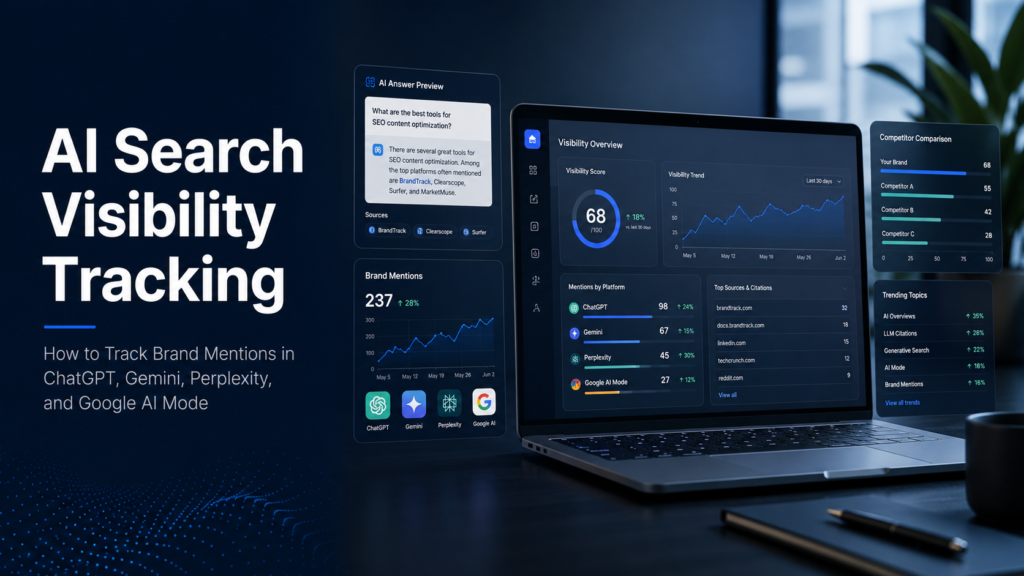
AI Search Visibility Tracking: How to Track Brand Mentions in ChatGPT, Gemini, Perplexity, and Google AI Mode
AI search visibility is not a single screenshot. Your brand may appear in one AI answer, disappear in another, get cited by one platform, or be replaced by competitors in a different prompt. That is why brands now need a repeatable way to track mentions, citations, sentiment, competitors, and Search Console patterns across AI-powered search.
Core Problem
Traditional rank tracking does not show every AI answer, brand mention, citation, competitor comparison, or sentiment shift.
Best Fix
Use a fixed prompt set, repeated checks, competitor tracking, citation review, sentiment scoring, and Search Console comparison.
SEO Goal
Understand where your brand appears in AI search, where competitors win, and which content or entity signals need fixing.
Quick Answer: What Is AI Search Visibility Tracking?
AI search visibility tracking is the process of checking how often your brand appears, is cited, and is described across AI-powered search tools like ChatGPT, Gemini, Perplexity, Google AI Mode, and Google AI Overviews. It measures brand mentions, competitor mentions, citations, sentiment, answer accuracy, source quality, and visibility changes over time.
- Track whether your brand is mentioned.
- Track whether competitors appear more often.
- Track whether your website is cited as a source.
- Track whether the answer describes your brand correctly.
- Track sentiment: positive, neutral, mixed, or negative.
- Track the exact prompt that produced the answer.
- Compare AI visibility with Google Search Console data.
- Repeat the same checks monthly or weekly.
Why AI Search Visibility Is Now a Tracking Problem
For years, SEO reporting was mostly built around rankings, clicks, impressions, CTR, conversions, backlinks, and organic landing pages. Those metrics still matter. But AI search has added a new layer that many reports do not capture clearly.
A buyer may ask ChatGPT for service recommendations, use Perplexity to compare companies, ask Gemini for a summary, or see a Google AI Overview before clicking any result. In each case, your brand may be included, ignored, cited, misdescribed, or replaced by a competitor.
This is why AI search visibility tracking matters. Brands need to know whether AI systems understand them, mention them, cite them, and compare them accurately. A single manual check is not enough. You need a repeatable system.
AI Search Visibility vs Traditional Rankings
Traditional SEO tracking focuses on page visibility inside search results. AI search visibility tracking focuses on answer visibility. That means the unit of measurement changes. You are not only tracking whether a page ranks. You are tracking whether an AI answer mentions the brand, cites a source, uses the right information, and frames the brand accurately.
| Traditional SEO Tracking | AI Search Visibility Tracking |
|---|---|
| Tracks organic rankings | Tracks brand mentions in AI answers |
| Measures clicks and impressions | Measures mentions, citations, sentiment, and answer accuracy |
| Focuses mostly on Google results | Tracks ChatGPT, Gemini, Perplexity, Google AI Mode, and AI Overviews |
| Reports keyword positions | Reports answer presence and source visibility |
| Uses relatively stable URLs and positions | Uses prompts, repeated samples, and changing AI responses |
For background on how Google’s AI search experience is changing SEO reporting, read SearchCounselCo’s guide to Google AI Mode SEO 2026.
Why One AI Search Test Is Not Enough
AI answers can change depending on the prompt, platform, user context, location, freshness, citations, and timing. One answer does not prove that your brand is visible or invisible everywhere.
A brand may appear in Perplexity because a source is cited there, but not appear in ChatGPT for the same service query. A competitor may appear in Gemini for one phrasing but disappear when the query becomes more specific. Google AI Overviews may show a source today and a different source next week.
The rule is simple: AI visibility should be measured repeatedly. Do not base strategy on one screenshot.
Which AI Search Platforms Should You Track?
You do not need to track every AI tool in the world. Start with the platforms that are most likely to influence your buyers. For most brands, that means ChatGPT, Gemini, Perplexity, Google AI Mode, and Google AI Overviews.
| Platform | What to Track |
|---|---|
| ChatGPT | Brand mentions, service descriptions, competitor comparisons, recommendation-style answers |
| Gemini | Brand understanding, category accuracy, Google ecosystem-style summaries, source patterns |
| Perplexity | Citations, source links, competitor mentions, answer source quality |
| Google AI Mode | AI answer visibility, brand inclusion, query response patterns, competitor visibility |
| Google AI Overviews | Citations, source links, answer placement, whether your pages support the generated answer |
What to Track: Mentions, Citations, Sentiment, Competitors, and Sources
AI search visibility tracking is stronger when it measures more than “did we appear?” A brand mention is useful, but it is only one signal. You also need to know whether the answer was accurate, whether your website was cited, whether competitors appeared, and whether the overall tone helped or hurt the brand.
Brand Mention
Does the AI answer mention your brand at all?
Citation
Does the AI answer cite your website, blog, product page, or service page?
Competitor Mention
Which competitors appear more often or more prominently?
Sentiment
Is the brand described positively, neutrally, negatively, or with mixed signals?
Answer Accuracy
Does the answer describe your services, location, category, and value correctly?
Source Strength
Are AI tools using your site, review sites, directories, Reddit, competitor pages, or media mentions?
AI Search Visibility Scorecard
A scorecard helps you turn messy AI answers into a cleaner monthly report. Use a 1–5 score for each area, then compare the total each month.
| Score Area | What to Measure | Score |
|---|---|---|
| Brand Mention Frequency | How often your brand appears across tracked prompts | 1–5 |
| Citation Presence | Whether AI tools cite your website or important pages | 1–5 |
| Answer Accuracy | Whether services, category, and location are described correctly | 1–5 |
| Competitor Gap | How often competitors appear instead of you | 1–5 |
| Sentiment Quality | Whether answers are positive, neutral, mixed, or negative | 1–5 |
| Source Strength | Whether AI tools use strong, relevant, accurate sources about your brand | 1–5 |
| Prompt Coverage | How many important prompts trigger your brand | 1–5 |
Score guide: 7–14 = weak AI visibility, 15–24 = mixed visibility, 25–31 = growing visibility, 32–35 = strong AI visibility.
Brand Mention Tracking Prompts
Use a fixed prompt set so your tracking is consistent. Do not change the wording every time, or your results will be harder to compare. Run the same prompts across ChatGPT, Gemini, Perplexity, Google AI Mode, and Google Search where AI Overviews appear.
- What does [Brand Name] do?
- What services does [Brand Name] offer?
- Is [Brand Name] a trusted company?
- Who are the best companies for [service]?
- Which companies provide [service] in [location]?
- Compare [Brand Name] with [Competitor Name].
- What are common complaints about [Brand Name]?
- What alternatives are there to [Brand Name]?
- Is [Brand Name] good for [specific service]?
- What is [Brand Name] known for?
If AI tools describe your brand incorrectly, use SearchCounselCo’s guide on why your brand looks wrong in AI search to review entity consistency, schema, profiles, and third-party signals.
Competitor Mention Tracking Prompts
AI visibility is competitive. Your brand may be missing not because AI search cannot understand your topic, but because competitors have clearer content, stronger mentions, better citations, or stronger category signals.
| Prompt Type | Example Prompt |
|---|---|
| Best company prompt | Best [service] companies for [industry] |
| Local competitor prompt | Top [service] agencies in [location] |
| Comparison prompt | Compare [Your Brand] vs [Competitor] |
| Buyer decision prompt | Who should I hire for [problem]? |
| Alternative prompt | Best alternatives to [Competitor] |
Track which competitors appear first, which ones are mentioned repeatedly, which sources are cited, and whether their descriptions are clearer than yours.
Citation Tracking: Are AI Tools Using Your Website as a Source?
Being mentioned and being cited are not the same thing. An AI answer may mention your brand because another website discussed you, but it may not cite your own domain. In other cases, it may cite an old blog post, a directory page, a review site, or a competitor comparison article.
- Is your domain cited?
- Which page is cited?
- Is the citation accurate?
- Does the citation support the answer?
- Are competitors cited more often?
- Are third-party sites cited instead of your own pages?
- Are old pages being cited?
- Are review sites or directories shaping the answer?
For a deeper guide on citation opportunities, read AI Overview citation SEO.
Sentiment Tracking: Is AI Search Helping or Hurting Your Brand?
Brand visibility is only useful if the answer helps the buyer understand and trust you. Track the tone of AI answers so you can spot repeated negative, vague, or incomplete descriptions.
| Sentiment Type | Example |
|---|---|
| Positive | “Known for technical SEO and Search Console analysis.” |
| Neutral | “An SEO consulting company.” |
| Mixed | “Offers SEO services but has limited public reviews.” |
| Negative | “Some users report issues with…” |
Do not overreact to one negative answer. Look for repeated patterns across multiple platforms and prompts.
Manual Tracking vs AI Visibility Tools
You can start AI search visibility tracking manually. For larger brands or agencies, AI visibility tools may help scale monitoring. The best approach depends on the size of your brand, the number of competitors, and how often you need reports.
| Tracking Method | Best For | Weakness |
|---|---|---|
| Manual checks | Small brands and quick audits | Hard to scale and easy to forget |
| Spreadsheets | Monthly visibility tracking | Needs consistent prompt and data discipline |
| AI visibility tools | Agencies, larger brands, competitor monitoring | Cost, platform limits, and still needs human review |
| Search Console | Google query behaviour and CTR patterns | Does not show every AI mention across all tools |
Tools can help, but do not treat tool data as the whole truth. AI answers can vary, so human review still matters.
How to Compare AI Visibility With Google Search Console
AI visibility tracking should not replace Search Console. It should sit beside Search Console so you can understand whether AI visibility is affecting branded searches, CTR, impressions, and discovery.
Check these Search Console patterns:
- Branded query impressions
- Branded query CTR
- Brand + service queries
- Brand + competitor queries
- Non-branded discovery queries
- Pages with impressions up and clicks down
- Pages ranking for AI-heavy informational queries
- Pages with declining CTR but stable impressions
Helpful internal guides: Google Search Console AI-powered configuration and Google Search Console branded queries filter.
30-Day AI Search Visibility Tracking Workflow
If you are starting from zero, use this 30-day workflow to create a repeatable visibility baseline.
| Timeline | Task | Goal |
|---|---|---|
| Days 1–3 | Build your prompt set | Create 20–50 prompts across brand, service, competitor, location, and problem queries. |
| Days 4–7 | Run baseline checks | Check ChatGPT, Gemini, Perplexity, Google AI Mode, and Google AI Overviews. |
| Days 8–10 | Score visibility | Record brand mentions, competitor mentions, citations, sentiment, and accuracy. |
| Days 11–15 | Compare with Search Console | Review branded queries, CTR, impressions, and high-impression pages. |
| Days 16–20 | Identify visibility gaps | Find prompts where competitors appear but your brand does not. |
| Days 21–25 | Improve signals | Update service pages, About page, schema, internal links, and third-party mentions. |
| Days 26–30 | Recheck and report | Run the same prompts again and compare changes. |
AI Search Visibility Tracking Sheet: Columns to Include
A simple spreadsheet can work well if the prompts and checks are consistent. Use these columns for a clean monthly AI visibility report.
| Column | Purpose |
|---|---|
| Date | Tracks when the test was run. |
| Platform | ChatGPT, Gemini, Perplexity, Google AI Mode, or Google AI Overviews. |
| Prompt | Exact query tested. |
| Brand Mentioned? | Yes or no. |
| Competitors Mentioned | Names of competitors included in the answer. |
| Citation Present? | Whether a source link was shown. |
| Cited Source | URL or domain cited. |
| Sentiment | Positive, neutral, mixed, or negative. |
| Accuracy | Correct, partly correct, or wrong. |
| Notes | What needs fixing. |
What Not to Do When Measuring AI Visibility
- Do not test only one prompt.
- Do not check only one AI platform.
- Do not treat one answer as final truth.
- Do not ignore competitor mentions.
- Do not ignore citations and source quality.
- Do not ignore sentiment and answer accuracy.
- Do not track screenshots without a sheet.
- Do not change prompts every time.
- Do not ignore Google Search Console.
- Do not report AI visibility without context.
- Do not believe every AI visibility tool blindly.
How SearchCounselCo Reviews AI Search Visibility
SearchCounselCo reviews AI search visibility by looking at the full measurement system, not only one keyword ranking. That can include AI prompt visibility, ChatGPT brand mentions, Gemini and Perplexity visibility, Google AI Mode and AI Overview presence, competitor mention gaps, citation gaps, brand sentiment, entity consistency, Search Console branded queries, CTR patterns, content gaps, and technical SEO blockers.
If you are unsure whether AI search is mentioning your brand correctly, SearchCounselCo can help build an AI search visibility tracking workflow and connect it with content strategy, technical SEO, and an SEO consulting review.
FAQs About AI Search Visibility Tracking
What is AI search visibility tracking?
AI search visibility tracking is the process of measuring how often your brand appears, is cited, and is described across AI-powered search tools such as ChatGPT, Gemini, Perplexity, Google AI Mode, and Google AI Overviews.
How do I track brand mentions in ChatGPT?
Use a fixed prompt set, test the same prompts regularly, record whether your brand appears, and compare the results against competitors over time.
Can I track brand mentions in Gemini and Perplexity?
Yes. Use the same prompts across Gemini and Perplexity, then record mentions, citations, sources, sentiment, and answer accuracy.
What is AI share of voice?
AI share of voice measures how often your brand appears in AI-generated answers compared to competitors across a fixed set of prompts.
Are AI visibility tools accurate?
AI visibility tools can be useful, but AI answers change by prompt, time, and platform, so tool data should be reviewed with human judgment.
How often should I track AI search visibility?
Monthly tracking is a good starting point. For active campaigns, weekly checks may be useful.
Does Search Console show AI search visibility?
Search Console can show branded searches, CTR, impressions, and query patterns, but it does not show every AI mention across tools like ChatGPT, Gemini, or Perplexity.
What should I do if competitors appear more often in AI answers?
Review their content, citations, service pages, mentions, schema, and authority signals. Then improve your own content and entity footprint.
Can AI search visibility improve SEO traffic?
AI visibility can support discovery and branded search demand, but it does not always create direct clicks. Track both AI mentions and Search Console behavior.
What is the best way to report AI visibility?
Use a repeatable scorecard that includes brand mentions, citations, sentiment, competitor mentions, source quality, and Search Console comparison.
Conclusion: AI Visibility Is a Tracking System, Not a Screenshot
AI search visibility is not something you check once and forget. Brands need a repeatable system for tracking mentions, citations, sentiment, competitors, and answer accuracy across ChatGPT, Gemini, Perplexity, Google AI Mode, and Google AI Overviews.
The brands that win in AI search will not only publish more content. They will measure how AI systems describe them, compare them, cite them, and connect them with buyer questions. That is where AI search visibility tracking becomes part of modern SEO reporting.
- Don’t Measure Once: Measuring Visibility in AI Search
- Quantifying Uncertainty in AI Visibility
- How Generative AI Disrupts Search: Google Search, Gemini, and AI Overviews
- Measuring Google AI Overviews: Activation, Source Quality, Claim Fidelity, and Publisher Impact
- TechRadar report on AI visibility tools