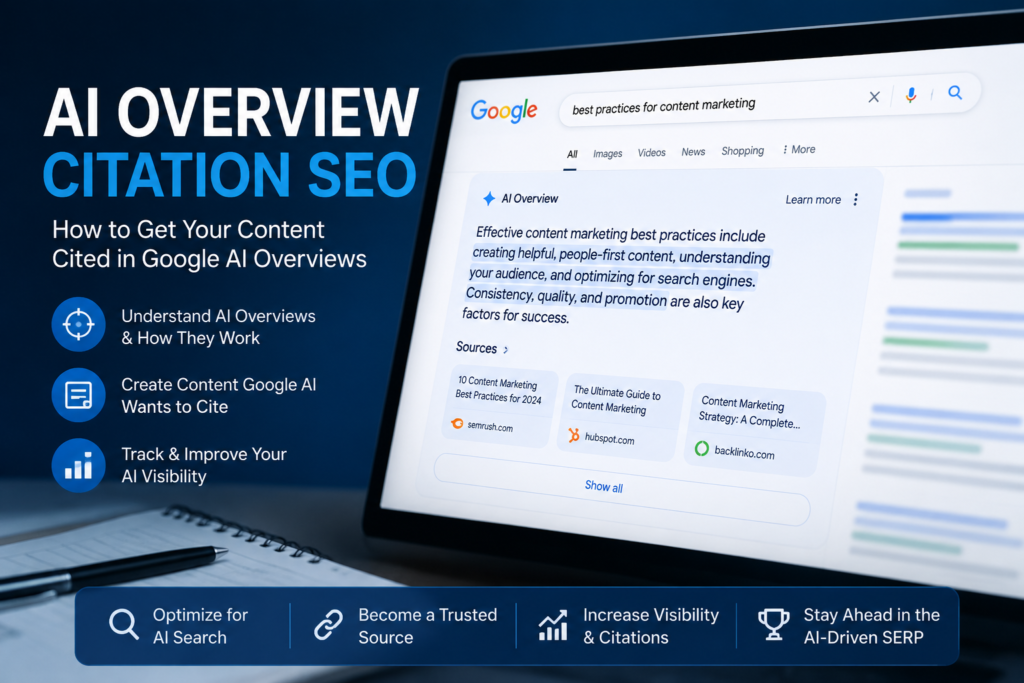
AI Search Visibility Guide • Updated September 2026
Google does not publish a special checklist that guarantees an AI Overview citation. A page first needs normal Google Search eligibility, including indexing and snippet eligibility. From there, AI Overviews and AI Mode can use query fan-out and supporting sources that do not perfectly match the classic organic results. This guide separates Google’s confirmed requirements from industry research, shows why competitors may be cited instead of you, and explains what Search Console can—and cannot—measure.
By Rahul Saini, Founder / SEO Strategist at Search Counsel Co. Substantially updated September 2026.
How do you get cited in Google AI Overviews?
There is no guaranteed AI Overview citation formula. Start with normal SEO: make the page crawlable, indexed, snippet-eligible, useful, and relevant to the searcher’s problem. Then improve the information itself—original evidence, precise answers, first-hand experience, strong sourcing, and coverage of genuinely related questions. Finally, track citations repeatedly because citation sources can change even when the underlying AI answer remains similar.
The important distinction: ranking, citation, brand mention, and generative-AI impression are not the same metric. A page can rank without being cited, be cited outside the classic top results, receive a generative-AI impression without revealing the triggering query, or have its brand mentioned without receiving a supporting link.
1. Eligibility
Can Google use the page?
Indexing, snippet eligibility, canonicalization, crawl access, and Search AI inclusion come first.
2. Retrieval
Can Google retrieve it?
The page still needs enough Search relevance for the original query or related fan-out searches.
3. Source value
Does it add something?
Original evidence and precise information are more defensible than generic AI-search summaries.
4. Measurement
Is visibility persistent?
Track frequency and stability instead of declaring success from one screenshot.
Jump to what you need
1. What is an AI Overview citation?
2. What Google officially requires
3. Is there special AI Overview SEO?
4. How query fan-out changes sourcing
5. Do organic rankings still matter?
6. Why a ranking page is not cited
7. What makes content source-worthy?
8. Schema, llms.txt and AI myths
9. Track AI visibility in Search Console
1. What is a Google AI Overview citation?
An AI Overview citation is a supporting link Google displays alongside or within an AI-generated Search answer. The link points users to a page Google has used as supporting material for the response.
That sounds simple, but AI-search reporting becomes confusing when several different visibility signals are treated as if they mean the same thing.
| Metric | What it actually means |
|---|---|
| AI citation / supporting link | A link to your page appears as supporting material in the generated Search response. |
| Brand mention | Your brand, product, person, or entity is named. A link is not guaranteed. |
| Generative AI impression | Search Console records a link from your site being displayed in a supported Google generative-AI Search feature. |
| Web Search impression | Your result received an impression in Google’s normal Web Search reporting, which can include multiple Search experiences. |
| Citation frequency | How often your domain or URL is cited across repeated observations. |
| Citation stability | How consistently the same citation remains present over time. |
Do not report these interchangeably. “We received AI impressions” does not automatically mean “Google cited us for these exact queries,” and a brand mention does not automatically mean the site received a link.
2. What Google officially requires to appear in AI Overviews or AI Mode
Google’s current guidance is less mysterious than much of the AI-SEO industry makes it sound.
To be eligible as a supporting link in AI Overviews or AI Mode, a page needs to meet the normal technical requirements for Google Search. In particular, the page needs to be:
- accessible to Google;
- indexed;
- eligible to appear in Search with a snippet;
- compliant with applicable Search policies.
Google says there are no additional technical requirements for these AI Search features.
Start here before changing the article
- Confirm that the intended URL is indexed.
- Confirm that the canonical points where expected.
- Check robots and snippet controls.
- Make sure the main information is accessible as visible page content.
- Confirm the site’s Search generative AI setting has not excluded the content.
Search generative AI control
Search Console now provides a Search generative AI control to eligible properties. The default is inclusion.
Site owners can choose to include or exclude their site’s links and content from supported Search generative-AI experiences, including AI Overviews and AI Mode.
That makes this a basic citation-gap check:
If you deliberately excluded your site from Google’s Search generative-AI features, content improvements alone will not make those pages appear there.
For a deeper discussion of inclusion and exclusion, see our Google AI Overview opt-out and ranking guide.
3. Is there a special “AI Overview SEO” algorithm?
Google has not published a separate list of AI Overview citation ranking factors.
Its public guidance continues to emphasize:
- normal SEO foundations;
- helpful, reliable, people-first content;
- unique and non-commodity information;
- good page experience;
- content that Google can access and understand.
That means claims such as:
- “put the answer in exactly the first 150 words”;
- “cover exactly five fan-out questions”;
- “FAQ schema gets you cited”;
- “this heading pattern guarantees extraction”;
should be treated as practitioner recommendations or hypotheses unless there is specific evidence supporting them.
The Search Counsel Co. evidence hierarchy
| Evidence type | How we treat it |
|---|---|
| Google-confirmed requirement | Safe to present as official Search behavior or eligibility guidance. |
| Third-party research correlation | Useful evidence, but methodology, dataset, market and collection date matter. |
| Search Counsel recommendation | A practical editorial or measurement recommendation, not a claimed Google ranking factor. |
| Unproven hypothesis | Something worth testing, not something to promise. |
This distinction matters because AI-search research is changing quickly. A study can be useful without becoming a permanent rule of Google’s systems.
4. How query fan-out changes AI Overview source selection
Google says AI Overviews and AI Mode can use query fan-out.
Instead of relying only on the exact wording of the original query, Google’s systems can issue multiple related searches across subtopics and data sources while building a response.
That helps explain why the pages cited in an AI Overview do not always match the visible top organic results for the original query.
Example
A search about “how to get cited in AI Overviews” may require information about eligibility, ranking overlap, query fan-out, citation tracking, Search Console reporting, source volatility, schema, and content quality. Google may retrieve supporting material from searches around those subproblems rather than from the original wording alone.
What fan-out does not mean
It does not mean you should manufacture a separate thin page for every phrase an AI system might conceivably search.
Google’s current generative-AI guidance warns against creating low-value content merely to target possible fan-out queries.
Cover a subtopic when it genuinely helps solve the user’s problem. Create a separate URL only when the search job is meaningfully different.
For the wider concepts behind topic ownership, see our topical authority guide.
5. Do normal Google rankings matter for AI Overview citations?
Yes—but rankings and citations do not have a one-to-one relationship.
Ahrefs’ March 2026 update analyzed hundreds of thousands of SERPs and millions of AI Overview URLs. Under its newer methodology, roughly 38% of cited URLs also appeared within the top 10 for the same original query.
That was much lower than an earlier Ahrefs study, which reported approximately 76% overlap.
Why can the numbers change so much?
AI citation studies can measure different things:
- the top three citations or every citation;
- blue-link ranking position or SERP-result blocks;
- top 10, top 20 or top 100;
- one country or several;
- one AI model generation or repeated observations;
- the original query rather than the fan-out searches Google may also use;
- different points in time as Google changes models and interfaces.
Correct conclusion: classic rankings still matter, but being outside the visible top 10 does not automatically make a page ineligible for citation. Do not turn any single overlap percentage into a universal Google rule.
6. Why does a page rank but still not get cited?
A page-one ranking confirms that Google’s normal Search systems consider the URL relevant enough to rank for the query. It does not guarantee the page will become a supporting link in every AI-generated response.
Use this diagnosis before rewriting.
| Situation | What it suggests | First priority |
|---|---|---|
| Page is not indexed | Eligibility problem | Fix normal Search indexing first. |
| Indexed but rarely ranks | Retrieval/relevance or authority problem | Improve core SEO before chasing AI-specific tactics. |
| Ranks, AI Overview appears, competitor is cited | Potential source-value or fan-out gap | Compare the exact information the cited pages contribute. |
| Generative-AI impressions but unknown citations | Measurement gap | Run repeated citation checks for priority queries. |
| Cited once, then disappears | Citation volatility | Measure frequency and persistence rather than reacting to one check. |
| Cited in AI Overview but not AI Mode | Different source-selection surface | Track the experiences separately. |
| Neither ranking nor citation visibility | Core SEO problem | Do not start with GEO hacks. |
7. What makes content genuinely useful as a source?
Formatting can make information easier for readers to consume, but the deeper question is:
What does this page contribute that another page could not easily replace?
Google’s current AI-search guidance puts strong emphasis on unique, valuable, non-commodity content.
High-value source material can include
- Original research: a dataset, experiment, benchmark, survey, or repeated observation.
- First-hand experience: what happened when you actually implemented or tested something.
- Primary-source interpretation: explaining a difficult Google change more accurately than generic summaries.
- Specific examples: real workflows, screenshots, edge cases, failure states, or before-and-after evidence.
- Clear methodology: enough detail that another person can understand how the conclusion was reached.
- Reconciled research: explaining why apparently conflicting studies produce different results.
- Expert judgment: a defensible interpretation that goes beyond repeating documentation.
Weak information gain
“Use clear headings, add schema, create helpful content, and build authority.”
Stronger information gain
“We tracked 40 queries for 28 days, found our citation was present in 31% of observations, and identified which cited URLs remained stable versus rotated.”
Do not fabricate first-hand research. A small transparent dataset is more valuable than a large invented one.
8. Does schema or llms.txt help with AI Overview citations?
Does schema guarantee an AI Overview citation?
No.
Google does not require special AI Overview structured data.
Normal structured data can still help Search understand page entities and features when the markup is appropriate and accurately represents visible content, but there is no special “AI citation schema.”
Does llms.txt make Google cite a page?
There is no Google requirement to publish an llms.txt file for AI Overviews or AI Mode.
If you are deciding whether to implement one for other AI-crawler or documentation workflows, use our llms.txt and Google AI Search guide.
What about snippet controls?
Controls such as nosnippet, data-nosnippet, and snippet-length directives can affect how Google is allowed to use page content in Search presentations.
That makes snippet eligibility part of a real AI citation audit—not because it is a special GEO tactic, but because supporting links still depend on normal Search eligibility.
9. How to track AI Overview visibility in Search Console in 2026
Search Console measurement has changed significantly.
Google is rolling out a dedicated Generative AI performance report to eligible properties. The report covers supported generative-AI Search experiences such as AI Overviews and AI Mode.
The report is useful, but it is not a complete AI citation tracker.
What the Generative AI report can show
- Generative-AI impressions over time.
- Which pages receive more or fewer generative-AI impressions.
- Country.
- Device.
- Date.
What it currently does not tell you
| Question | Dedicated Gen AI report |
|---|---|
| Did one of my URLs appear in supported generative-AI Search features? | Yes |
| Which page appeared? | Yes |
| Country, device, and date? | Yes |
| Which query or prompt triggered it? | No |
| AI-specific clicks? | No |
| AI-specific CTR? | No |
| Exact cited passage? | No |
| Citation/source order? | No |
| Separate AI Overview vs AI Mode totals? | No |
Do not call normal Web impressions “AI Overview impressions”
This is an important reporting rule. Google’s standard Web Performance report can include activity associated with AI Search experiences, but a normal Web impression is not proof that the impression came from an AI Overview. Use the dedicated Generative AI report when available if you need generative-AI-specific impression reporting.
For broader Search Console configuration workflows, see our Google Search Console configuration guide.
10. How to track actual AI Overview citations
Search Console tells you about Google Search visibility. It does not currently replace a true query-level citation monitor.
For priority topics, create a repeatable citation log.
| Field | Record |
|---|---|
| Query | The exact search being monitored. |
| Date | When the SERP was checked. |
| Location | Country/market used for the check. |
| Device | Desktop or mobile. |
| AI Overview present? | Yes / no. |
| Your domain cited? | Yes / no. |
| Your cited URL | Which page Google used. |
| Competitors cited | Domains/URLs used instead or alongside yours. |
| Organic position | Classic SERP position at the same observation. |
| Changed? | Compare with the previous check. |
Third-party citation trackers can automate parts of this process. Use them when the query set is too large for manual checks, but document:
- market/location;
- device;
- collection frequency;
- whether the tool tracks AI Overviews, AI Mode, or both;
- how it defines a citation versus a mention.
11. Measure citation frequency and stability—not one screenshot
AI Overview citations can be volatile.
Ahrefs found that roughly 45.5% of cited URLs changed between consecutive observations when AI Overview responses changed in its study.
That means:
One screenshot is evidence of one observation—not evidence of persistent AI visibility.
Better metrics
Citation coverage
Percentage of tracked queries that cite your domain.
Citation frequency
Percentage of eligible observations in which your domain appears.
Citation stability
How often the citation survives consecutive observations.
URL diversity
How many different pages from your site receive citations.
Competitor citation share
Which competing domains repeatedly win the same query set.
12. AI Overview and AI Mode citations are not the same thing
Do not automatically combine these surfaces in one manual citation score.
Google says AI Overviews and AI Mode can use different models and techniques, so the responses and links shown can vary.
Third-party research reinforces this.
In an Ahrefs study of hundreds of thousands of paired responses, only about 13.7% of cited URLs overlapped between AI Overviews and AI Mode.
Practical implication: being cited in an AI Overview does not guarantee that the same page will appear as a source in AI Mode. Track the two experiences separately when your tools and workflow allow it.
For the broader SEO implications of Google’s conversational experience, read our Google AI Mode SEO guide.
13. The Search Counsel Co. AI Citation Gap Audit
When a competitor is cited and you are not, do not begin by randomly adding FAQs or schema.
Audit in this order.
Step 1: Verify eligibility
- Indexed?
- Canonical correct?
- Snippet eligible?
- Accessible to Google?
- Search generative AI inclusion enabled?
Step 2: Verify retrieval
- Does the page rank for the main query?
- Does it rank for the obvious supporting subquestions?
- Are internal links pointing to it with useful context?
- Is another SCC URL competing for the same intent?
Step 3: Inspect the actual cited sources
- What specific fact, example, or explanation do they contain?
- Are they primary sources?
- Do they provide original data?
- Do they answer a narrower fan-out question better?
- Is Google citing a video, forum, documentation page, or article?
Step 4: Find your information deficit
- Are you only summarizing what competitors already say?
- Do you have first-hand evidence?
- Can you add a transparent experiment?
- Can you reconcile conflicting studies?
- Can you make the answer more precise without making unsupported claims?
Step 5: Improve the smallest justified area
Do not rewrite a strong ranking page merely because one citation rotated. Improve the specific section or evidence gap that the comparison supports.
Step 6: Measure repeatedly
Recheck the query set across multiple observations before deciding whether the change helped.
AI Citation Evidence Checklist
| Check | Evidence source | Status |
|---|---|---|
| URL indexed? | Search Console / URL inspection | Pass / fail |
| Snippet eligible? | Page directives / Search eligibility | Pass / fail |
| Included in Search generative AI? | Search Console setting | Include / exclude |
| Generative-AI impressions? | Generative AI performance report | Observed / not observed / unavailable |
| Ranks for relevant queries? | Standard GSC + live SERP | Strong / weak |
| AI Overview triggers? | Repeated live SERP checks | Often / sometimes / never |
| Your domain cited? | Manual/tool citation checks | Frequency |
| Competitor cited? | Citation audit | Domain/URL |
| Unique evidence present? | Editorial review | Strong / weak |
14. FAQ: Google AI Overview citations
How do I get cited in Google AI Overviews?
There is no guaranteed citation formula. Start with normal Search eligibility and strong SEO, then improve the page’s unique value: original evidence, clear factual answers, first-hand expertise, strong sourcing, and coverage of genuinely relevant subquestions. Measure citations repeatedly rather than assuming one optimization guarantees inclusion.
Does my page need to rank in the top 10 to get cited?
No. Traditional ranking and AI Overview citation visibility overlap, but they are not identical. Current third-party research shows that many cited URLs also rank highly, while a meaningful share come from lower-ranking or different supporting-result sets.
Why does my page rank but not get cited?
The cited sources may answer a specific supporting question better, provide stronger evidence, contain original data, or be retrieved through query fan-out. Start by comparing the information Google is citing rather than simply adding more keywords to your ranking page.
Can Search Console show AI Overview citations?
Search Console’s Generative AI performance report can show generative-AI impressions and break them down by page, country, date, and device. It does not currently function as a full query-level citation tracker and does not reveal the exact triggering prompt or cited passage.
Can Search Console show which AI query cited my page?
Not in the dedicated Generative AI report today. It does not currently expose a query or prompt dimension, so you need repeated SERP checks or specialist citation-monitoring tools for query-level citation analysis.
Are normal Search Console Web impressions AI Overview impressions?
No. Standard Web Search reporting can include activity from Google’s Search experiences, but a normal Web impression should not automatically be labelled an AI Overview impression. Use the dedicated Generative AI performance report when your property has access.
Does schema help with AI Overview citations?
There is no special AI Overview schema that guarantees citations. Use structured data when it accurately represents visible content and supports normal Search understanding, not as an AI citation shortcut.
Does llms.txt help Google AI Overviews?
Google does not require llms.txt for AI Overview or AI Mode eligibility. Normal Search accessibility, indexing, snippet eligibility, and useful content remain the relevant foundations.
What is query fan-out?
Query fan-out is a retrieval technique where Google’s AI Search systems can issue multiple related searches around the user’s original request. This helps Google gather supporting information across subtopics and partly explains why AI citations can differ from the visible organic rankings for the original query.
Are AI Overview and AI Mode citations the same?
No. Google says the two features can use different models and techniques, and third-party research shows low URL-level citation overlap between them. Track the two experiences separately when possible.
How often should I check AI Overview citations?
Do not rely on a single check. Citation sources can rotate. For important queries, monitor on a consistent schedule and calculate coverage, frequency, stability, and competitor citation share across repeated observations.
What should I improve first if competitors are cited instead?
First confirm eligibility and normal ranking relevance. Then inspect the cited sources and identify what they contribute that your page does not: primary evidence, original data, first-hand experience, a stronger explanation, a narrower subtopic answer, or a different content format.
The one thing to do next
Choose 20 important queries and start a citation log before rewriting more pages. Record whether an AI Overview appears, which domains it cites, your normal organic position, and whether the same citations remain on later checks. That gives you evidence to distinguish a real citation gap from normal source rotation.
If your broader AI-search strategy is still unclear, use our SEO vs AEO vs GEO guide to separate terminology from actual Search work.
If the problem is larger than one page and you need help interpreting Search Console, ranking, citation, and content evidence together, our SEO consulting service can help with the audit and prioritization.
Sources reviewed for this update
- Google Search Central — AI Features and Your Website
- Google Search Central — Guide to Optimizing for Generative AI Features
- Google Search Central — Guidance on Succeeding in AI Search
- Google Search Console Help — Generative AI Performance Report
- Google Search Console Help — Search Generative AI Control
- Google Search Console Help — Search Performance Report
- Ahrefs — 2026 AI Overview Citation / Top-10 Overlap Study
- Ahrefs — AI Overview Citation Volatility Study
- Ahrefs — AI Overview vs AI Mode Citation-Overlap Study
Editorial note: Google AI Search features, reporting interfaces, and citation behavior change quickly. Google-confirmed requirements are separated from third-party research and Search Counsel recommendations throughout this guide. No citation percentage, page structure, schema type, or content formula should be treated as a guaranteed way to earn an AI Overview citation.