Search Marketing Guide
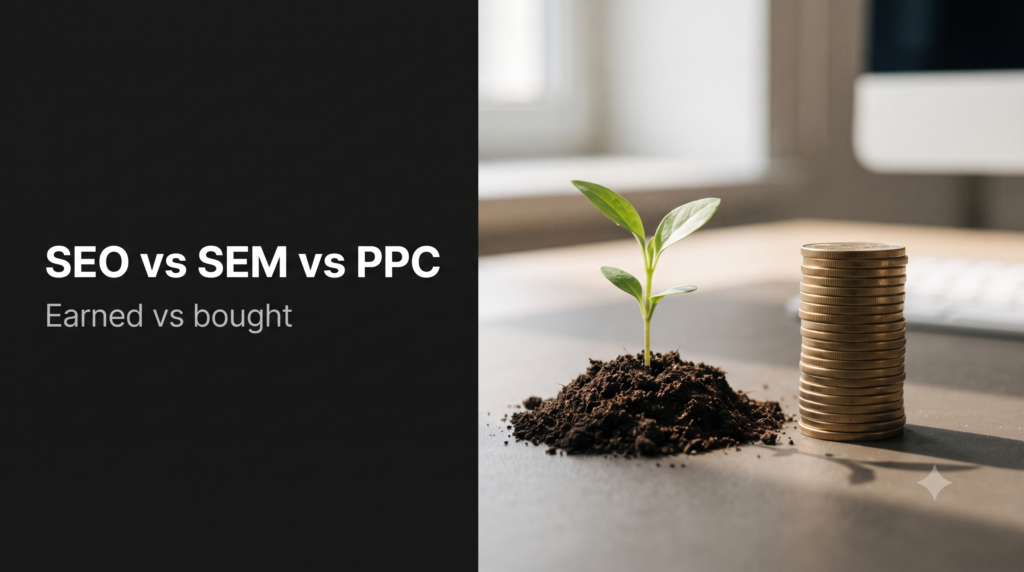
SEO, SEM, and PPC are often explained as if every marketer uses the terms the same way. They do not. SEO refers to organic search optimization. PPC is an advertising payment model. SEM is the confusing one: some major marketing sources use it for all search marketing, while others use it specifically for paid search. This guide explains the terminology, the evidence behind that disagreement, and when organic search, paid search, or both make business sense.
By Rahul Saini, Founder / SEO Strategist at Search Counsel Co. Updated September 2026.
Quick answer: What is the difference between SEO, SEM, and PPC?
SEO improves unpaid organic search visibility. Paid search buys sponsored visibility on search engines. PPC is a payment model where an advertiser pays when someone clicks an ad. SEM has two common meanings: historically it described all search engine marketing, including SEO and paid search, while many marketers today use SEM specifically for paid search. When precision matters, use the terms organic search and paid search.
SEO
Organic search
Earn visibility through relevance, useful content, technical SEO, authority, and user value.
Paid Search
Advertising channel
Buy sponsored visibility for searches relevant to your business.
PPC
Payment model
Pay when a user clicks. PPC can be used in search, social, display, and other advertising channels.
SEM
Ambiguous term
Historically all search marketing. Common modern usage: paid search.
SEO vs SEM vs PPC: The Difference in One Table
| Factor | SEO | Paid Search | PPC |
|---|---|---|---|
| What it is | Organic search optimization | Advertising on search engines | Pay-per-click advertising model |
| Typical placement | Organic search results | Sponsored search results | Search, social, display, marketplaces, video, and more |
| Main cost | People, content, tools, development, authority building | Media budget + management | Cost charged when a click occurs |
| Speed | Usually gradual | Potentially immediate once eligible | Depends on the advertising platform |
| After spending stops | Existing rankings may continue | Sponsored visibility normally stops | Paid click acquisition stops |
The key terminology problem: SEM does not fit neatly into this table because the industry uses two definitions. Our review of current ranking pages confirms that disagreement is real rather than theoretical.
Why Does SEM Have Two Definitions?
Search for “SEO vs SEM” today and you will find reputable marketing publications giving different answers.
Historically, Search Engine Marketing referred to marketing through search engines as a whole:
Historical usage: SEM = SEO + Paid Search
That broad definition remains common.
But in many agencies, job descriptions, advertising teams, and current marketing conversations, SEM now means:
Common modern usage: SEM = Paid Search
This is not just a semantic debate. The pages ranking in Google currently use both definitions.
Original SearchCounselCo Research: How Ranking Pages Define SEM
For this update, I reviewed nine editorial pages appearing across the U.S. search results for:
- SEO vs SEM
- SEO vs SEM vs PPC
- SEM vs PPC
The review was conducted on September 17, 2026.
SearchCounselCo finding
6 of 9 pages reviewed, or 66.7%, used the broad definition of SEM that includes SEO and paid search. 3 of 9, or 33.3%, primarily used SEM to mean paid search.
| Source reviewed | Working definition of SEM |
|---|---|
| American Marketing Association | Broad: SEO + paid search |
| Semrush | Broad: SEO + paid search |
| ActiveCampaign | Broad: while acknowledging paid-search usage |
| LocaliQ | Broad: search-marketing umbrella |
| Thomasnet | Broad: SEO + PPC |
| Backlinko | Broad: SEO + paid search |
| Search Engine Journal | Narrow: SEM primarily means paid search |
| Equinet Academy | Narrow: SEM = paid search |
| Adobe | Narrow/current: SEM primarily means paid search, while acknowledging the historical umbrella meaning |
What does this research tell us?
There is no consistently applied modern definition of SEM even among pages Google itself ranks for these comparison queries.
That explains why two experienced marketers can use “SEM” differently without either necessarily misunderstanding search marketing.
The clearest terminology is therefore:
- SEO = organic search optimization
- Paid search = advertising on search engines
- PPC = advertising payment model where the advertiser pays per click
- SEM = ambiguous industry term that should be defined in context
SearchCounselCo recommendation: when precision matters, use “organic search” and “paid search” rather than assuming everyone uses SEM the same way.
Research methodology
Research by Rahul Saini, Founder / SEO Strategist at Search Counsel Co.
I manually reviewed nine unique editorial pages appearing across the U.S. search results for the three comparison queries above on September 17, 2026.
A page was classified as broad SEM when its working definition explicitly included both SEO and paid search. It was classified as narrow SEM when its working definition primarily equated SEM with paid search.
Where a page discussed both historical and current usage, I classified it according to the definition the article actually used in its explanation or recommendations.
This is a small SERP snapshot, not a statistically representative survey of the entire marketing industry. Search results and article wording can change. The finding should therefore be interpreted as evidence of current terminology inconsistency, not as a permanent industry-wide percentage.
Is SEM the Same as PPC?
No, not technically.
SEM describes search-engine marketing. PPC describes a way of paying for advertising.
For example:
- A Google Search ad may be both paid search and PPC.
- A Facebook ad may use PPC pricing but it is not search-engine marketing.
- An SEO campaign may fall under SEM if someone is using the historical broad definition, but not if they use SEM to mean paid search.
SEM vs PPC in one sentence: SEM describes a search-marketing category or activity, while PPC describes an advertising payment model.
Is Paid Search the Same as PPC?
No.
Paid search is an advertising channel.
PPC is a billing model.
Many paid-search campaigns use PPC pricing, which is why the terms are commonly blended together.
But PPC is also used in:
- paid social;
- display advertising;
- marketplace advertising;
- video advertising;
- other digital advertising platforms.
So:
> Paid search can use PPC, but PPC is not limited to paid search.
What Is SEO?
Search Engine Optimization is the process of improving unpaid visibility in search results.
SEO commonly includes:
- keyword and intent research;
- content;
- technical SEO;
- internal linking;
- site architecture;
- digital PR and links;
- local SEO;
- structured data where appropriate;
- measurement and conversion analysis.
For the main disciplines involved, see our Types of SEO guide.
Is SEO free?
No.
You do not pay Google each time someone clicks a normal organic result, but SEO still requires investment in:
- people;
- content;
- development;
- tools;
- research;
- authority building.
How long does SEO take?
There is no universal timeline.
Existing authority, competition, technical condition, content quality, links, and search intent all affect how quickly a page can improve.
See How Long Does SEO Take? for the deeper analysis.
What Is Paid Search?
Paid search is advertising that appears on search-engine results pages for selected searches.
Google Ads and Microsoft Advertising are common examples.
Paid-search advertisers can control variables such as:
- budget;
- keywords and search themes;
- location;
- audiences;
- bidding;
- schedule;
- ads;
- landing pages.
The main advantage is speed.
A business can become eligible for sponsored search visibility much faster than it can usually earn a competitive organic ranking.
The trade-off is that paid visibility depends on continued campaign economics and budget.
What Is PPC?
PPC means Pay Per Click.
The advertiser pays when someone clicks an ad.
PPC is often associated with Google Ads, but it is not restricted to search engines.
How Google’s ad auction actually works
Google does not simply award the top ad position to the highest bidder.
Google’s current documentation says Ad Rank can consider factors including:
- bid;
- auction-time ad and landing-page quality;
- Ad Rank thresholds;
- competition;
- the context of the user’s search;
- the expected effect of ad assets and formats.
See Google’s official Ad Rank documentation.
A PPC myth worth correcting: Quality Score does not directly rank your ad
The visible 1-10 Quality Score inside Google Ads is a diagnostic metric.
Google explicitly says it is not an input in the ad auction.
It is useful for diagnosing areas such as:
- expected click-through rate;
- ad relevance;
- landing-page experience.
But Google’s auction uses auction-time calculations rather than directly inserting the displayed 1-10 Quality Score into Ad Rank.
See Google’s official Quality Score documentation.
SEO vs SEM: What’s the Difference?
The answer depends on the definition of SEM being used.
If SEM means all search marketing
SEO is part of SEM:
> SEM = SEO + Paid Search
If SEM means paid search
SEO and SEM are separate:
- SEO = organic search
- SEM = paid search
What should businesses actually care about?
Usually not which acronym wins the argument.
The practical decision is:
> Should we invest in organic search, paid search, or both?
SEO vs PPC: Which Is Better?
Neither is universally better.
The answer depends on the business model, competition, urgency, and economics.
| If you need… | Usually favor… |
|---|---|
| Search visibility immediately | Paid search |
| Long-term organic visibility | SEO |
| Conversion data quickly | PPC |
| Evergreen informational demand | SEO |
| Seasonal campaign visibility | Paid search |
| Maximum search coverage | SEO + Paid Search |
Google itself separates organic SEO from paid advertising and states that buying ads does not improve organic search ranking. See Google’s SEO vs PPC explanation.
SEO vs Paid Search: Compare the Economics, Not Just the Click Price
A common comparison says:
> SEO is free and PPC is expensive.
That is not a useful financial model.
SEO has costs.
PPC has costs.
The better question is:
> Which channel produces profitable customers at an acceptable acquisition cost?
Hypothetical PPC example
Suppose:
- average click = $8;
- landing-page conversion rate = 5%;
- 20 clicks are required for one lead on average.
$8 × 20 clicks = $160 advertising cost per leadIf one in four leads becomes a customer:
$160 × 4 leads = $640 advertising cost per customerWhether that is good depends on what a customer is worth.
This is an illustrative calculation, not a market benchmark. Actual CPC, conversion rate, close rate, margin, and customer value vary by business.
Apply the same discipline to SEO.
Measure:
- total SEO investment;
- incremental organic traffic;
- qualified leads;
- revenue;
- customer acquisition cost;
- customer lifetime value.
See our SEO ROI guide for the organic calculation framework.
SearchCounselCo Decision Framework: SEO, Paid Search, or Both?
This is the framework I use when deciding which search channel deserves priority.
| Question | If yes | If no |
|---|---|---|
| Do you need leads immediately? | Test paid search | SEO may take greater priority |
| Is commercial search demand proven? | Scale profitable queries | Validate demand first |
| Can CPC support your margins? | PPC may be viable | Prioritize other acquisition paths |
| Does the landing page convert? | Increase traffic carefully | Fix conversion before scaling ads |
| Is there substantial informational demand? | Build SEO content | Do not create content merely for volume |
| Can you invest for 6+ months? | SEO becomes more attractive | Paid search may solve immediate demand better |
Start with demand rather than assumptions. Our keyword research guide explains how to identify the queries worth evaluating, while our search intent guide helps separate informational searches from genuinely commercial demand.
How SEO and PPC Work Better Together
The strongest search strategy often uses one channel to improve decisions in the other.
Use PPC data to inform SEO
Paid search can quickly reveal:
- which queries convert;
- which messages attract qualified clicks;
- which landing pages work;
- which search terms waste money.
That data can improve:
- SEO keyword prioritization;
- commercial landing pages;
- title and messaging tests;
- content strategy.
Use SEO to reduce dependence on paid acquisition
If PPC proves a query is commercially valuable, earning strong organic visibility for the same underlying intent can diversify acquisition.
The objective is not necessarily to replace PPC.
It is to determine where each channel produces the strongest return.
What AI Search Changes in 2026
AI-generated search experiences have changed the layout of search results, but they do not require us to redefine SEO, paid search, or PPC.
Organic search can now include visibility across traditional results and AI-generated search experiences, while advertising is also expanding into newer search surfaces.
The basic distinctions remain:
- SEO builds unpaid search visibility.
- Paid search buys sponsored search visibility.
- PPC describes how many digital advertising clicks are charged.
For the deeper changes to search behavior, see The Future of SEO and AI Search and our AI SEO guide.
Common SEO, SEM, and PPC Mistakes
Saying SEM has one universally correct definition
Current ranking pages themselves use different definitions.
Saying PPC means paid search
PPC is a payment model that can operate across multiple advertising channels.
Saying paid search and PPC are identical
Paid search describes where advertising runs. PPC describes how advertisers may pay.
Saying SEO is free
Organic clicks do not carry a Google Ads CPC, but SEO still requires resources.
Saying PPC spend improves organic ranking
Google does not provide an organic ranking boost because an advertiser buys Google Ads.
Saying displayed Quality Score directly decides ad position
Google says Quality Score is diagnostic. Auction-time Ad Rank uses dynamic quality, bid, competition, context, and other signals.
Frequently Asked Questions
What is the difference between SEO, SEM, and PPC?
SEO means organic search optimization. PPC is an advertising payment model where you pay for clicks. SEM is an ambiguous search-marketing term: historically it meant SEO plus paid search, while many marketers today use it specifically for paid search.
Is SEM the same as PPC?
No. SEM describes search marketing, while PPC describes a payment model. Many paid-search campaigns use PPC pricing, which is why the terms are often used interchangeably.
Is SEO part of SEM?
Under the historical broad definition, yes. Under the modern usage where SEM means paid search, SEO is separate. Both definitions remain in active use.
Is paid search the same as PPC?
No. Paid search is an advertising channel. PPC is a billing model. PPC can also be used in social, display, video, marketplace, and other advertising channels.
What is the difference between SEO and SEM?
If SEM means paid search, SEO earns organic visibility while SEM buys sponsored search visibility. If SEM is being used in the broad historical sense, SEO is one component of SEM.
Which is better, SEO or PPC?
Neither is universally better. PPC is usually better for immediate testing and visibility. SEO is generally better for building longer-term organic visibility. Many businesses benefit from using both.
Can SEO and PPC work together?
Yes. PPC can quickly identify commercially valuable queries and messaging, while SEO can build durable organic visibility around proven demand.
Does PPC improve SEO?
PPC spend does not directly improve organic rankings. It can indirectly provide useful keyword, messaging, and conversion data that informs SEO decisions.
Is Google Ads SEM or PPC?
Google Search Ads are paid search, which many marketers call SEM. Many campaigns also use a PPC payment model, so a Google Search campaign can reasonably be described as both SEM and PPC depending on context.
What does SEA mean?
SEA means Search Engine Advertising. It is commonly used to describe paid search and can be more precise than SEM because it clearly refers to advertising.
Primary Sources and Editorial Methodology
This article separates first-party platform documentation from industry terminology.
- Google Ads: Ad Rank and auction mechanics
- Google Ads: Quality Score
- Google Ads: SEO vs PPC
- American Marketing Association: broad SEM definition
- Search Engine Journal: paid-search SEM definition
- Adobe: historical vs current SEM usage
SearchCounselCo methodology
The original terminology review in this article was conducted by Rahul Saini for Search Counsel Co. It reviewed nine editorial pages appearing across relevant U.S. search-result sets on September 17, 2026. The percentages describe that specific SERP sample and should not be interpreted as a statistically representative survey of every marketer or publication.
Where to Go Next
- Keyword Research for identifying demand before choosing a search channel.
- Search Intent for understanding what users actually want from each query.
- Types of SEO for the major organic search disciplines.
- How Long Does SEO Take? for realistic organic-growth timelines.
- Measure SEO ROI for comparing search investment with business outcomes.
- SEO Analytics & Reporting for measuring performance.
- Google Ranking Factors for understanding organic ranking systems.
- AI SEO Guide for the broader AI-search layer.
Bottom Line
The cleanest way to understand SEO, SEM, and PPC is to separate channel from payment model. SEO builds organic search visibility. Paid search buys sponsored search visibility. PPC describes an advertising model where the advertiser pays for clicks. SEM is the ambiguous term: our review of nine current ranking pages found that both the broad and paid-search definitions remain in active use. Businesses should therefore spend less time arguing over the acronym and more time deciding which combination of organic search and paid search produces qualified customers at an acceptable cost.