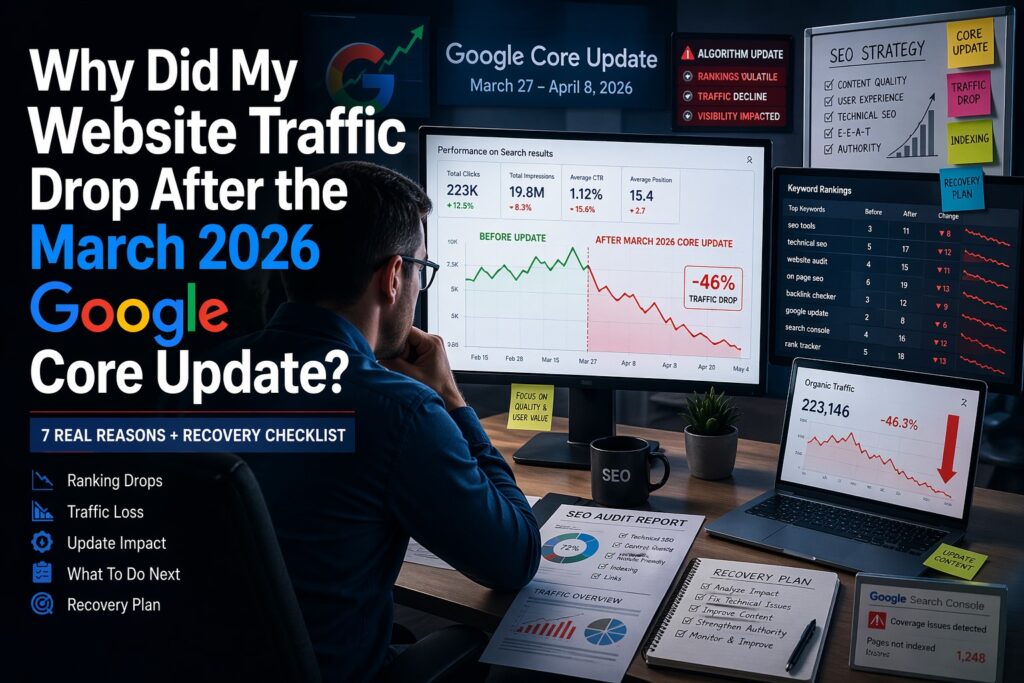
Quick answer:
If your website traffic dropped after the March 2026 Google core update, the most common reasons are ranking reshuffles during the update, stronger competing pages replacing yours, page quality or query-fit issues, or a technical/reporting problem being mistaken for a true SEO drop. Some traffic drops need patience and diagnosis. Others mean your pages now need stronger content, structure, and site support.
This guide is for general SEO education only. It is not legal, financial, or platform support advice. If your traffic drop is tied to core lead pages or revenue pages, treat diagnosis seriously before making broad site changes.
Seeing traffic fall after a Google update can make even a strong business owner panic fast. One week your site looks stable. The next week impressions are down, clicks are soft, and every dashboard seems to tell a different story.
The good news is that not every drop means the same thing. A core update impact is not the same as a spam issue. A reporting anomaly is not the same as a ranking collapse. And a small drop is not the same as a sitewide quality problem.
This guide will help you figure out what actually changed, what to check first, what not to do, and when it makes sense to improve pages instead of reacting blindly.
Table of Contents
- Fast diagnosis: real ranking drop, reporting issue, or something else?
- March 2026 timeline: core update, spam update, and Search Console noise
- Why your website traffic may have dropped
- How to diagnose the drop based on what you are seeing
- When to make changes and when to wait
- How to reduce the risk of future update-related drops
- Official sources worth checking
- FAQ
Fast Diagnosis: Real Ranking Drop, Reporting Issue, or Something Else?
Before you start changing titles, deleting pages, or rewriting half your site, match your symptom to the right problem:
- Impressions dropped, but clicks stayed more stable: this may be partly a reporting issue, not a full SEO collapse.
- Clicks, impressions, and positions all dropped after March 27: this is more likely a real post-core-update visibility loss.
- The drop started on March 24 or 25: the spam update may be involved, not just the core update.
- Only a few pages dropped: the issue is more likely page-level than sitewide.
- Your blog dropped, but service pages held up: the problem may be query-class or content-type specific.
- Local pages softened more than broader pages: part of the issue may overlap with local SEO signals.
If you start with the right diagnosis, you avoid the biggest mistake site owners make here: treating every traffic drop like the same problem.
What a reporting issue usually looks like
A reporting issue often shows up as a noticeable impressions decline without the same level of collapse in clicks or rankings. That can make the drop look scarier than it really is if you only look at one graph.
What a small ranking drop usually looks like
A small ranking drop is when a page slips a bit but still stays visible. That kind of movement can hurt traffic more than people expect, especially if a page moves from the top few spots to slightly lower positions.
What a serious update hit usually looks like
A more serious update hit usually means a sustained decline across important pages or queries, especially after the rollout finishes. In that case, the issue is usually less about one line of copy and more about whether the page still deserves to be one of the best results.
March 2026 Timeline: Core Update, Spam Update, and Search Console Noise
Before you diagnose anything, get the timeline right.
- March 24–25, 2026: Google rolled out the March 2026 spam update.
- March 27–April 8, 2026: Google rolled out the March 2026 core update.
- April 3, 2026: Google confirmed a Search Console logging issue affecting impression reporting from May 13, 2025 onward.
That timeline matters because a lot of site owners mixed all three together and called it one problem.
If your fall started before March 27, the core update may not have been the first cause. If your biggest visible change is impressions while clicks held up better, part of the issue may be Search Console reporting correction. If your rankings and clicks both softened after March 27 and stayed weak after April 8, then the core update is a much stronger suspect.
Why Your Website Traffic May Have Dropped
Your page is no longer the best answer for the query
This is the most common reason.
A lot of pages lose traffic after a core update because they are not terrible, but they are no longer the best result. Maybe the competing page is clearer. Maybe it answers the search faster. Maybe it feels fresher, more complete, or easier to trust.
If another page now does a better job solving the searcher’s problem, Google has a reason to move it higher.
Your content explains the topic, but does not fully help the reader
Some pages sound informative, but they still do not satisfy the real need behind the search.
For a topic like this, readers do not just want a definition of a core update. They want to know:
- Did this drop start during the spam update or the core update?
- Could Search Console data be misleading me?
- Should I wait before touching anything?
- What exact pages and queries should I compare first?
- When does a drop become serious enough to act on?
If your page never gets specific enough to answer those questions, it can lose ground even if the writing sounds “fine.”
If your site needs stronger page planning around topic clusters, support pages, and better query alignment, that is usually where a smarter content strategy starts to matter.
Your site feels like an intermediary instead of a destination
This was one of the strongest observed patterns in March 2026.
If your content mostly repeats what other sites already say, summarizes without adding much, or acts like a middle layer between the user and the real source, you are more exposed during broad updates.
Small sites can still rank. But they usually need to be sharper now. More direct. More useful. More clearly built for a real audience instead of just search traffic.
You have a technical issue mixed into the drop
Not every post-update drop is purely about content.
Sometimes the loss overlaps with:
- indexing problems
- canonical confusion
- internal linking weakness
- crawlability issues
- site changes that buried key pages
- page organization problems that make strong content harder to understand
If only a group of important pages dropped, or if valuable pages became harder to find, a proper technical SEO review often makes more sense than editing random headings.
Your titles and snippets are losing the click
Sometimes the problem is visibility. Sometimes it is click appeal.
If impressions are still present but traffic is softer, your result may simply be getting ignored more often. Another page may look fresher, more direct, more trustworthy, or more specific to the search.
That is often an on-page SEO issue rather than a full page-quality collapse.
Your page has become stale
Freshness matters more when the search itself is tied to a recent event.
If your page about update-related traffic loss does not mention the March 2026 rollout window, the spam update timing, or the Search Console anomaly, it already feels less current than the stronger results.
A stale page does not always lose because it is bad. Sometimes it loses because it is no longer timely enough to trust.
The drop is narrower than you think
Many sites are not “down everywhere.” They are down in one slice.
You may find that:
- informational pages dropped more than commercial pages
- non-branded traffic dropped while branded traffic stayed steady
- image visibility changed more than web search visibility
- local traffic weakened more than broader traffic
That is why diagnosis matters so much. The more specific the pattern, the smarter your fix becomes.
If the weakness overlaps with geographic visibility, maps, or local service pages, some of the solution may sit inside local SEO and Google Business optimization rather than blog content alone.
How To Diagnose the Drop Based on the Symptom You Have
If impressions dropped but clicks did not fall as much
Start by checking whether the issue is partly reporting-related.
- Compare clicks, impressions, and average position together.
- Look at whether your main pages are still getting similar clicks.
- Do not assume a graph drop means an equal ranking drop.
If clicks and rankings both fell after March 27
This points more toward a real post-core-update shift.
- Review your top losing pages first.
- Check which exact queries weakened.
- Look at the pages ranking above you now.
If the fall started on March 24 or 25
Do not skip the spam update possibility.
- Check whether anything sudden happened before the core update officially began.
- Look for more abrupt behavior rather than slow reshuffling.
If only a few pages were hit
This usually means a page-level review matters more than sitewide panic.
- Compare those pages against the new winners.
- Ask whether the competitor is more direct, more current, or more complete.
- Focus your work there first.
If you are not sure whether to wait or act
Use a simple rule:
- Small drop: do not overreact.
- Large sustained drop: do a deeper assessment.
If the problem affects lead pages, service pages, or your main money pages, that is usually when SEO consulting becomes much more useful than guessing alone.
When To Make Changes and When To Wait
Some situations need patience. Some need action.
Usually wait first if:
- the rollout is still in progress
- the drop is small
- you have not yet compared the right date ranges
- the evidence still points to a reporting issue more than a ranking issue
Usually act faster if:
- important pages lost a lot of ground and stayed down
- the drop continued after the rollout completed
- the pages now outranking you are clearly more useful
- the issue overlaps with indexing, internal links, or page structure weaknesses
A lot of traffic recovery work goes wrong because people act too early on the wrong diagnosis.
How To Reduce the Risk of Future Update-Related Drops
- Build pages that solve the exact problem faster, not pages that only talk around it.
- Refresh time-sensitive content when search behavior changes.
- Strengthen internal linking so important pages are clearly supported.
- Improve site structure and crawl clarity so strong pages are easier to understand.
- Avoid generic filler that says what every other site already says.
- Make the site feel like a destination, not a thin summary layer.
A lot of recovery work is not about tricks. It is about making your site clearer, more useful, and easier to trust.
Official Sources Worth Checking
If you want to verify the timeline and Google’s own guidance directly, start here:
- Google Search Status Dashboard: March 2026 core update
- Google Search Status Dashboard: March 2026 spam update
- Google Search Central: Core updates
- Google Search Central: Debugging traffic drops
- Search Console Help: Data anomalies
- Google Search Central: Creating helpful, reliable, people-first content
FAQ
Why did my website traffic drop after the March 2026 Google core update?
The most common reasons are ranking reshuffles, stronger competing pages, weaker query fit, stale content, technical overlap, or reporting confusion that made the drop look worse than it really was.
How do I know if my traffic drop is real?
Compare clicks, impressions, average position, and your top pages together. If impressions dropped but clicks held up better, the issue may be partly reporting-related rather than a full ranking collapse.
Should I change my pages immediately after a core update?
Not always. Small drops do not usually need drastic action. Larger, sustained drops deserve a deeper review.
How long does recovery take after a core update?
Some improvements can show up faster, but broader recovery often takes time. That is why the best work is focused, structured, and based on the right diagnosis.
What kind of pages were more exposed in March 2026?
The strongest March 2026 pattern suggested that weaker intermediary-style pages were more exposed, while clearer destination pages tended to hold up better.
What should I check first in Search Console?
Start with your top losing pages, your most important queries, and whether the loss is in clicks, impressions, average position, or only one search type.
Can a local business be affected differently than a broader site?
Yes. Sometimes local pages soften more than national pages, especially if the issue overlaps with local relevance, trust, or Google Business visibility.
What if I am not sure whether this is a content issue or a site issue?
That is usually the sign to step back and assess the page, the query fit, the internal support, and the technical structure together instead of looking at only one piece.
Bottom line: if your website traffic dropped after the March 2026 Google core update, do not treat every drop like the same issue. Figure out whether you are dealing with a real ranking loss, a reporting shift, a technical overlap, or a page-quality problem, then fix the right thing instead of reacting blindly.