Local SEO · Maps and organic search
Local SEO helps eligible businesses appear when people search for services or products in a specific area. It spans Google’s local Map Pack, Google Maps, and standard organic results. The practical work is to make your business information accurate, show search engines what you offer and where, build a genuine local reputation, and help visitors contact or visit you.
Trying to rank in the Google Map Pack? Start with the diagnostic steps below: check whether your Business Profile is eligible and visible, confirm its primary category and location facts, then compare visibility from several points in your service area. A higher organic page ranking does not guarantee a higher Maps position.
For most businesses, the first step is a correct Google Business Profile. The second is a useful website supported by real reviews and relevant mentions. AI-powered recommendations are another discovery surface worth monitoring, but they do not replace these basics.
By Rahul Saini · Search Counsel Co. · Originally published February 7, 2026. Evidence policy: official Google guidance, independent studies and Search Counsel Co. search data are labeled separately. Sources checked October 2026.
Research basis: verified Google documentation, third-party studies with disclosed methods, and page-filtered Search Console data. Real screenshot examples are dated observations—not rankings claims for every location.
Business listings ranked for local intent. Your Google Business Profile is essential.
Web pages answering location and service queries. Relevant pages and site quality matter.
Start with the right question. Not appearing in the map at all? Check eligibility, category, verification and proximity. Appearing but getting few customers? Check hours, reviews, photos, services and the landing-page experience. An organic web page and a Business Profile are different assets.
Local SEO in seven practical takeaways
- Map Pack SEO and local organic SEO are related, but not identical. A strong business listing does not guarantee your web page ranks, and vice versa.
- Google names relevance, distance and prominence as the main determinants of local visibility; it does not publish precise weights.
- Start with the business facts: eligibility, a verified profile, accurate name, category, address or service area, phone and business hours.
- Reviews should be genuine and voluntary. No incentives, selective requests, forced on-site reviews or dictated wording.
- Build genuinely useful local pages for distinct services or real locations instead of swapping city names in duplicated templates.
- Track actual outcomes: calls, directions, qualified leads, local landing-page visits and conversions—not a single rank checked from your office.
- AI recommendations require separate observation. Google’s ordinary search best practices remain the foundation for AI features.
1. What is local SEO, and who needs it?
A local search has a location component: “dentist in Austin,” “water heater repair near me,” or a search for “coffee shops” when Google infers the searcher wants nearby options. Google may show a map with business listings, regular web results, or both.
Local SEO matters most to storefronts that welcome customers and service-area businesses that travel to customers. Google Business Profile eligibility has rules: online-only businesses and businesses using ineligible virtual offices do not qualify merely by wanting map exposure. Service-area businesses may need to hide their customer-facing address. See our setup and eligibility guide and Google’s business representation guidance.
What is the Google Map Pack?
The Google Map Pack—also called the Local Pack or local three-pack—is a search-result feature that typically presents several nearby or relevant businesses alongside a map. The exact presentation varies by query and device. It may show ratings, hours, service details, website and directions actions. It is not the same thing as the ordinary list of webpage results.

Read the screenshot in three steps:
- Look at the Places section: the visible business names, ratings and categories are business-listing information, not organic page titles.
- Check actions: Website, Schedule and Directions buttons represent ways to contact or visit a business; their availability can vary.
- Separate advertisements: the listing marked Sponsored is paid placement and should not be counted among unpaid local results.
Example query: “plumber in Raleigh NC.” The screenshot is a single observation, not a general ranking guarantee.
Understand the search result, not just the keyword
A typical local result can have three separate parts: a map and local business listings; ordinary organic links to webpages; and, for some categories, paid advertisements. The names, number of businesses, buttons and order change with device, location, query and time.
In the Map Pack, look for the business name, category, ratings, open hours, nearby context and website/directions actions. In the organic results, the blue-link title usually opens a website page. Map Pack placement is about an eligible business listing; organic ranking is about a web URL. Treat both as useful channels, but diagnose them separately.
Maps results can change when you search from another neighborhood, at a different time, or using a different query. A screenshot from one location is not a universal ranking report.
2. How Google Map Pack SEO works: ranking factors
Google says local results are primarily based on relevance, distance and prominence. The wording and definitions in this section follow Google Business Profile Help, rather than inferred algorithm percentages.
| Factor | What it means | Practical action |
|---|---|---|
| Relevance | How closely a profile matches the search. | Select accurate primary and additional categories; list real services; keep information detailed and current. |
| Distance | Distance from the searcher or the place named in the query. | Use the real eligible address or correct service-area setup; do not invent locations. You cannot directly optimize away physical distance. |
| Prominence | How well known the business is, including web information, links and reviews. | Earn genuine customer feedback, relevant local citations and links; maintain an informative website. |
Whitespark’s 2026 Local Search Ranking Factors survey puts primary profile category and distance among its highest-rated Maps factors. This is expert opinion, not a disclosure of Google’s ranking formula. It is useful for prioritization but cannot prove a category edit will produce a specific ranking change.
How to improve Google Map Pack visibility: the practical sequence
- Confirm eligibility and ownership. Search for an existing profile before creating one. Claim it and complete any verification steps Google actually offers.
- Choose an accurate primary category. Select what best describes the core business; do not select an unrelated category because it looks less competitive. Add honest secondary categories.
- Correct location, contact information and hours. Check opening hours, special hours, pin position, service areas and landing-page link.
- Complete services, products, attributes and photos. Describe what customers can actually purchase or book. Photos and descriptions help people decide even where ranking impact is uncertain.
- Request unbiased, genuine reviews. Provide a voluntary link and respond constructively without trying to manipulate ratings or wording.
- Build local credibility. Accurate relevant listings, relationships with local organizations and a useful website help people corroborate your business.
- Measure visibility from different locations. Repeat comparable searches or use a geographically sampled rank grid and compare against actions and leads.
Map Pack troubleshooting example: You rank near your shop but disappear two miles away. That may reflect distance or competitors' stronger local relevance and prominence; check the geography, not just your meta title. If you never appear even beside your location, confirm eligibility, verification, category and account issues before buying citations or backlinks.
If someone says “I don’t rank on Google Maps,” establish what they actually mean:
Check profile eligibility, whether it exists, verification/restrictions and correct category before doing promotion.
Record the query and searcher location, then compare equally spaced map points and real competitors.
Test call buttons, hours, service accuracy, photos, reviews, appointment paths and lead tracking.
Escalation rule: if the profile has a restriction, use Google’s support and appeal procedures; don't create duplicate profiles or use fabricated addresses. If listing actions exist but bookings do not, prioritize conversion and measurement before more citation spending.
For field-by-field instructions, see our Google Business Profile optimization checklist. For a deeper discussion of evidence and uncertainty, see Google Business Profile ranking factors.
Map Pack troubleshooting: diagnose the symptom before paying for a fix
Check eligibility, existing listing, verification/status, accurate business category, address or service-area setting, and whether your search is unbranded and truly local.
Find the actual business listing, inspect its status and correct factual errors. If a profile has restrictions or a suspension, follow Google’s applicable support process. Do not create a second profile as a workaround.
Distance and local competition may explain the geographic pattern. A strong organic page cannot remove this geographic constraint.
Repeat the same query at documented grid points and dates. Compare local competitors, category relevance, reviews, site information and legitimate local mentions. Don't promise citywide placement.
Discovery and conversion are different problems. A listing can be prominent without providing enough confidence to contact the business.
Check hours, contact buttons, relevant services, real photos, review quality, booking workflow and answering speed. Verify lead outcomes separately from clicks.
Search Console evaluates website search appearances, not your live position at every point on Google Maps.
Keep improving relevant pages and inbound links, but create a separate Google Business Profile baseline and geographic visibility sample before diagnosing Maps changes.
The seven-day Map Pack diagnosis: a practical field protocol
If you manage a legitimate local business and have no trustworthy geo-grid report yet, collect the following evidence before changing the listing or purchasing more citations. A short observation window helps establish a baseline; it does not reveal Google's private ranking formula.
- Define the search and geography. Record one non-branded service keyword, the real business category, the service area and the actual location(s) where customers search.
- Check profile eligibility and access. Confirm ownership, verification, correct name, category, opening hours and whether Google reports restrictions. Do not create a duplicate to bypass a profile problem.
- Take repeatable location samples. Use the same query, device type and mapped observation points. Note the date, local time and whether the result is sponsored. Record not found rather than inventing a position.
- Compare only eligible competitors. Inspect their public categories, relevance, offers, visible reviews and genuine local presence. Their address may be closer; a larger review count alone cannot explain causation.
- Test conversion pathways. Tap the website, directions and call actions. Confirm business hours, phone routing and booking experience. If visibility exists but leads do not, fixing conversion may be more valuable than link building.
- Make the smallest justified correction. Examples: repair incorrect hours, correct the primary category, resolve an actual duplicate, or improve a thin service page. Record what changed and when.
- Re-check the same sample later. Compare the original points and business outcomes. Treat any change as an observation, not proven causation, unless the methodology supports it.
The official Google local-ranking explanation establishes relevance, distance and prominence. It does not publish a checklist score or guarantee that these seven steps will move a listing into the top three.
Illustration only · not measured business rankings
Why one “#1 in Maps” screenshot is not enough
Imagine checking the same search from nine points around one service provider. These hypothetical positions illustrate how proximity and competition could change visibility across a neighborhood; they are not data from a customer, case study or ranking tracker.
| Northwest | North | Northeast |
|---|---|---|
| #11 | #6 | #13 |
| #5 | #2 · near base | #7 |
| #12 | #8 | #14 |
How to apply this: choose one non-branded keyword and a fixed grid, record the device, hour and location points, and compare the same locations in future scans. A wider area of good placements may matter more to customers than a single best-position screenshot.
3. Map Pack SEO, local organic SEO and AI recommendations
A local business can appear on several different surfaces. Each serves a different user need and requires different measurement. Treating them as one ranking obscures what to improve.
| Where you appear | Typical search | Main work | How to measure |
|---|---|---|---|
| Google Map Pack / Maps | “coffee shop near me” | Eligible and accurate profile; service/category fit; reputation; geography. | GBP Performance, calls, directions, maps visibility from different points. |
| Local organic webpages | “emergency plumbing Raleigh” | Useful service/location pages, internal links, relevant evidence and technical SEO. | GSC landing-page queries/clicks, GA4 leads. |
| AI-powered search and recommendations | “Which local shops can repair my bike today?” | Consistent facts, descriptive indexed content, strong reputation and independent coverage. | Repeatable prompt checks, cited links when available, referral/lead outcomes. |
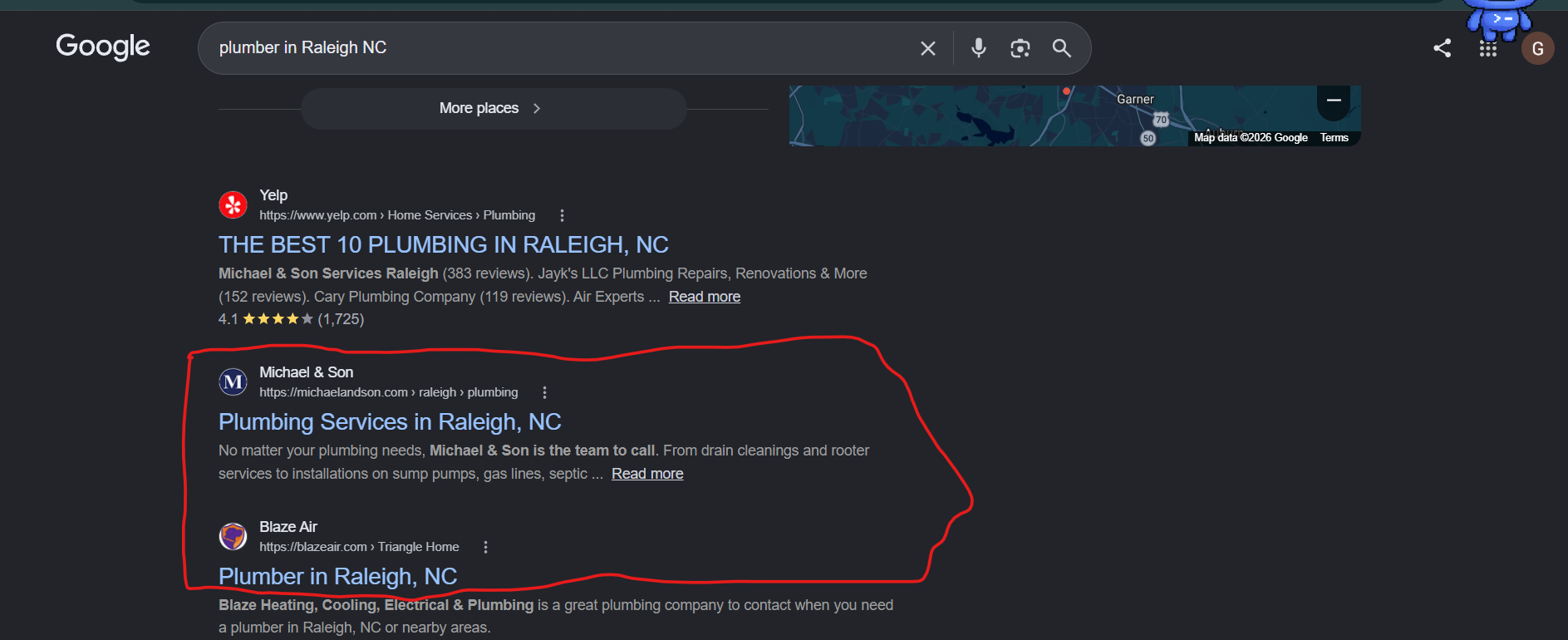
What changed after scrolling? The “More places” control marks the transition out of the visible local-listing section. The results below link to webpages such as Yelp and service-provider websites. Optimizing an eligible business listing and optimizing a webpage are related but distinct tasks.
Why the same Google search has two SEO contests
In the photographed search for “plumber in Raleigh NC”, the Places section shows individual business listings beside the map. One additional result is explicitly labeled Sponsored, so it cannot be counted as an unpaid Map Pack position. Immediately below More places, the captured results include Yelp, Michael & Son and Blaze Air webpages. Those blue-link results compete on the relevance and usefulness of their webpages rather than by being identical to the list of businesses in the pack.
| Observed evidence | Supported interpretation | Do not conclude |
|---|---|---|
| Business cards, map pins and action buttons | Google is displaying local listings for this query | These same businesses rank in every nearby neighborhood |
| A result marked Sponsored | A paid business listing is present | That listing earned its placement organically |
| Yelp and service-company webpages below | Organic results are a separate page-level search opportunity | A website's GSC position equals its Google Maps position |
Observation limit: one desktop search, one geographic context and one date. We have not repeated this observation across devices or neighborhoods. The result names are examples of what appeared, not recommendations or current ranking claims.
Important: a Google Search Console average position is a metric about your page’s reported Search appearances. It does not tell you exactly where a customer sees your Business Profile in Maps. These two channels need separate baselines.
Research shows growing use of AI for local discovery. In a 2026 BrightLocal consumer survey, 45% of surveyed consumers reported having used AI for local business recommendations in the previous year, compared with 6% in the prior survey. Those figures describe respondents, not the percentage of all local searches handled by AI.
Worked decision example — hypothetical, not a client result
Imagine a plumber who operates from Raleigh and serves nearby neighborhoods. Their customer searches fall into different journeys:
- “emergency plumber near me”: the first check is whether the business's eligible profile is accurate and visible from the searcher's area.
- “water heater replacement Raleigh”: a useful service page should explain the actual service, scheduling, coverage, project constraints and next steps.
- “why does my water heater leak?”: a troubleshooting page should give safe, accurate guidance and link to the relevant service when appropriate.
What makes the comparison actionable: check where the searcher wants to act, choose the matching asset, and measure Maps contacts separately from organic page clicks. None of these examples represents a measured ranking or revenue increase.
4. Optimize the Google Business Profile first
Make the profile match the real business
Use your real-world business name without SEO modifiers or city stuffing. Match the profile to a staffed storefront or eligible service-area operation. Keep the chosen main category, business hours, telephone, website, appointment methods, and map pin correct. Google may select verification methods based on the business; there is no universal video-verification requirement.
Separate visibility tasks from conversion tasks
Accurate primary categories and locations help Google understand eligibility and relevance. Customer-friendly photos, current products, services and relevant posts can also help searchers decide to contact you. Do not assume each field has a measurable independent ranking effect.
For businesses with multiple legitimate staffed locations, maintain a correct profile for each eligible location. For a home-based service-area business, follow Google’s address visibility rules; simply adding numerous nearby cities to the service-area field does not make you physically closer to all of them.
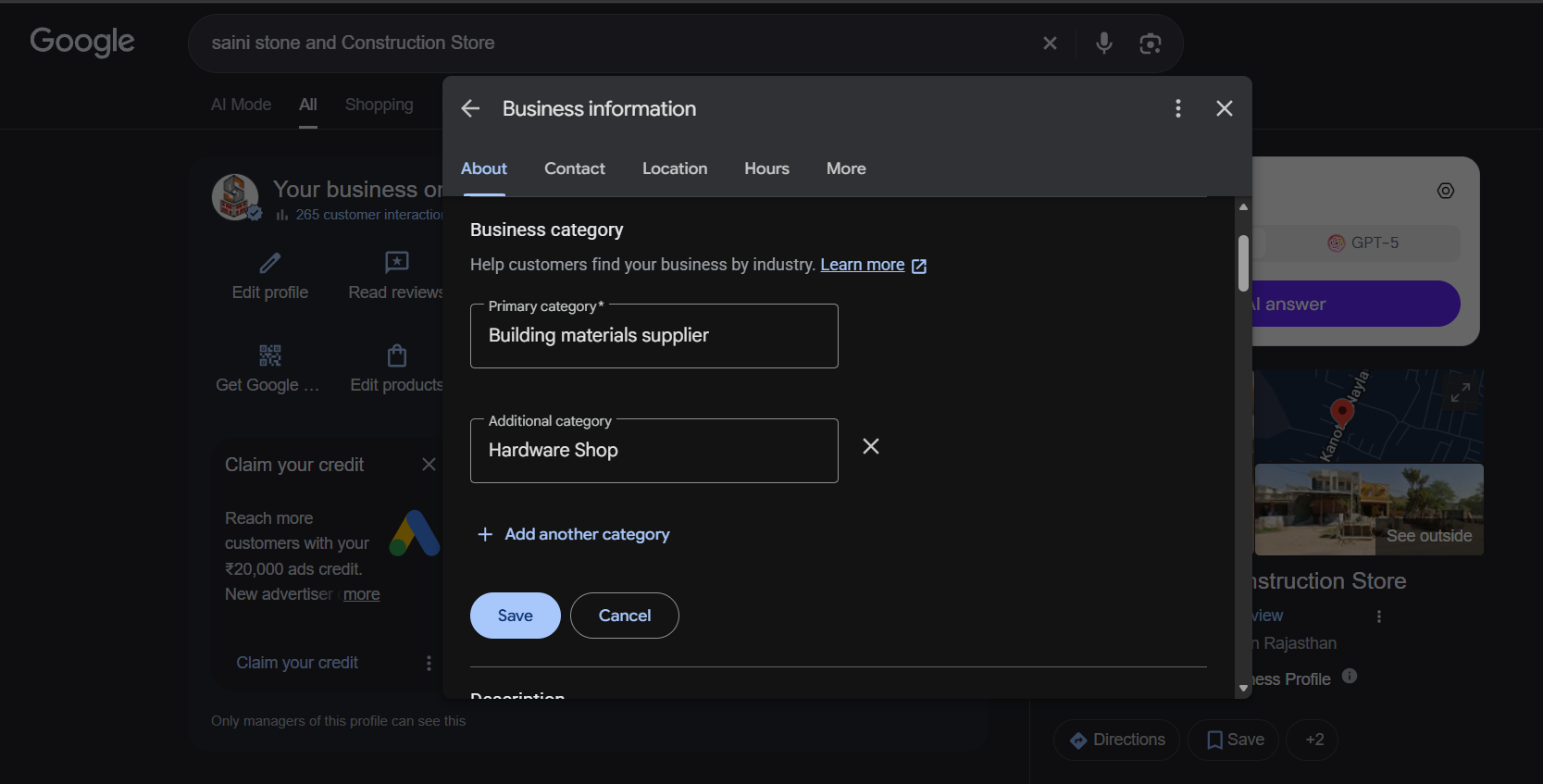
What to notice: the first field is the primary category and the next is an additional category. The screenshot is an interface demonstration using a real managed profile, not evidence that changing categories improved rankings. Choose categories that truthfully describe the business and avoid edits solely for screenshots.
- Search your business name on Maps and inspect what a customer sees.
- Confirm your primary category reflects your core paid service.
- Verify regular and holiday hours.
- Open your website and booking links from the listing on a phone.
- Look for a duplicate or an old incorrect address.
If you're not verified yet: how to set up and verify a Google Business Profile.
5. Build accurate local citations and NAP information
NAP stands for name, address and phone number. A local citation is a relevant business mention or listing on another website. Consistency helps customers find the right company and corrects confusion caused by duplicate or outdated records; it is not a guaranteed rankings multiplier.
What to do, in order
- Create an internal master record of your official name, eligible address, local number, website and hours.
- Check your website, Google Business Profile and other customer-facing platforms for material conflicts.
- Prioritize the directories and platforms that matter to your market, such as Apple Business Connect, Bing Places, relevant industry directories and local associations.
- Correct the original source of a persistent bad record when you can identify it; then check downstream directories.
- Track duplicate listings and recheck after changes.
A business with no physical address displayed to customers should not publish a home address across directories just to satisfy a rigid NAP template. Follow your business type and privacy requirements. You do not need hundreds of irrelevant citations. See the NAP consistency guide and local citation sources.
6. Collect reviews without violating Google's rules
Reviews influence decisions and Google identifies review quantity and positive ratings among signals that may help local ranking. A steady flow of genuine recent experiences also gives potential customers evidence that the business is active.
Google’s rating-manipulation policy prohibits incentivized reviews, selective solicitation of only positive reviews, pressure to review while on premises, staff quotas and attempts to dictate a review’s contents. Do not ask customers to mention a keyword, employee or desired star rating. Google permits appropriate requests for genuine unbiased feedback.
Reply to legitimate positive and negative reviews constructively. Replies may help readers evaluate how you handle service problems; do not promise that inserting service keywords in replies will increase Map Pack rankings. Details: getting more Google reviews safely and review response management.
7. Improve local website pages and earn relevant links
Local keyword research: match the query to the right asset
“Near me” queries often trigger location-aware business results, while “service + city” and “service + neighborhood” searches may also deserve useful local webpages. Do not force “near me” into paragraphs. Instead, identify questions customers ask, services you deliver, and locations you genuinely serve.
| Query intent | Best destination | Example useful content |
|---|---|---|
| Brand or nearby availability | Google Business Profile + relevant contact page | Hours, directions, accessibility and booking details. |
| Specific service in a city | Service page | Actual service scope, exclusions, process, examples, and CTA. |
| Multi-location business | Real location page for each eligible operation | Street address, staff/service details, local contact and location-specific proof. |
| Research question before buying | Guide/article linking to relevant service page | Cost drivers, timelines, comparison criteria, troubleshooting. |
Build pages only when they deserve to exist
A useful city or service page should answer what the company does there, how to contact it, where service is available, what changes locally, and what a customer can expect. Do not generate dozens of near-identical city pages or make false claims of physical offices. If a business genuinely serves several areas from one base, a strong service-area explanation may be more honest than dozens of thin pages.
Internal links, technical hygiene and structured data
Connect local guides to the pages where users can act. Keep mobile navigation usable, render important content as readable text, and test forms and calls to action. Where appropriate, implement accurate LocalBusiness structured data on the business’s own relevant pages—not boilerplate markup pasted into this informational SEO guide. Google does not award self-serving review stars just because a business adds review markup to its website.
Local links worth earning
Consider legitimate local associations, community organizations, relevant suppliers, neighborhood publications, local journalists and industry groups. A strong link is useful because the source is trusted and relevant—not because an agency claims a magic amount of “local authority.” Do not purchase spam listings or exchange irrelevant links. More detail: local keyword research, service-area pages, and local link building.
A page-planning decision most competitors gloss over
Before producing a new “service + city” page, answer three questions: (1) Is the service substantially different from other offerings? (2) Can you truthfully explain how the business serves this area? (3) Does the new page offer information beyond changing the city name? If not, improve an existing service page instead of creating a thin near-duplicate.
For multi-location businesses, each real location may need useful distinct operational information. For service-area businesses, never imply an unstaffed office is a customer-facing branch. Related detailed planning appears in the local keyword research section above.
8. What does local SEO mean for AI search in 2026?
ChatGPT, Gemini, Perplexity and Google’s AI search features may help users compare businesses, but their products, data sources and presentation vary. A recommendation from one assistant is not equivalent to a ranking in Google’s Map Pack. Some answers may be incorrect or incomplete.
45% of surveyed consumers said they had used AI for a local business recommendation within the previous year; this is surveyed adoption, not a search-market share estimate. Study.
A 2026 analysis reported ChatGPT recommendations in 1.2% of measured location opportunities. The sample concerns multi-location brands and tested prompts—not all businesses everywhere. Study.
To improve the information available for possible recommendations, maintain a clear, up-to-date business website, consistent public contact information, real third-party references and complete listings. Publish detailed answers to questions people ask when comparing providers. These are sensible discoverability practices; no technique guarantees an AI mention.
Google’s official guidance for AI features says its foundational search best practices still apply; there is no special markup or AI-specific file required to appear. We could not verify an actual AI Overview panel for this article's target query during this review, so this section describes an opportunity, not an observed citation win.
Local AI Overviews, AI Mode and Maps: similar questions, different evidence
Google’s AI Overviews are generated summaries that may cite webpages; AI Mode supports more exploratory conversational searching. Google Maps and the Local Pack show local business listings. A business may be prominent in one experience and absent from another, so one shared “AI rank” is misleading.
| Discovery surface | What a business should check | Measurement limitation |
|---|---|---|
| Local Pack / Maps | Business listing, category and geographic visibility | Results vary by searcher location; one query screenshot is not a citywide rank. |
| Google AI Overview | Whether an answer appears, its supporting links and whether business facts are correct | Not every query triggers one; supporting links can change. |
| Google AI Mode | Business mentions, linked sources and quality of generated guidance | Conversations and prompts vary; links are not guaranteed. |
| ChatGPT / other assistants | Names mentioned, website references, location and business-detail accuracy | Separate platforms with different methodologies and fluctuating answers. |
A September 16, 2026 BrightLocal study examined more than 200,000 localized, non-branded AI prompts over approximately 1,300 business locations. In that particular testing design, Google Maps mentioned a tracked business in 66% of searches versus 32–38% for the measured AI surfaces. The study also reported that business websites made up 42% of citations. These are study-specific observed rates, not universal probabilities for every company or keyword. Study, methodology and sample.
What this changes: maintain verifiable, current service pages and business details, but never treat a good Maps position as proof of an AI recommendation. Record the actual prompt, location, platform, response and linked sources before concluding anything about citations.
How to check whether Google cites a local SEO guide in an AI Overview
When researching a query such as “how to rank in Google Map Pack”, observe whether an AI Overview is actually shown in that particular search. If it is, record the linked webpages, the subjects the answer covers and where the links appear. If there is no panel, write not observed rather than treating an AI Overview as universal.
- Document the exact query, country, device, date and signed-in state; note that AI surfaces can vary.
- Distinguish a cited webpage from a local business recommended by name. They are not interchangeable outcomes.
- Check source URLs and the factual claims shown. Do not claim an assistant used your page merely because the answer sounds similar.
- For Google-wide observation, consult the Generative AI Search Console report if available; it reports AI-feature impressions, not the full content of answers.
- Repeat a small fixed question set over time, and record source turnover rather than assuming permanent visibility.
What justifies enhancing this article? Google’s 2026 AI-search guidance specifically favors unique, useful content and real images that help users. Our original screenshot explanations, decision protocol and page-filtered GSC evidence are improvements designed for readers, not artificial AI-citation tricks.
Official Google Search Console feature · 2026
How to measure whether your webpage appears in Google's AI search features
Google’s Generative AI performance report (Search) now provides impressions for Google Search AI Overviews and AI Mode, including a Pages dimension. Google stated that the report was rolled out worldwide by August 31, 2026.
- Open Search Console for the correct verified site property.
- Find the Generative AI performance (Search) report if available, and choose Pages.
- Check whether the canonical URL for the local guide appears and compare complete date windows, countries and devices.
- Keep these impressions separate from manual ChatGPT or Maps business-mention checks. An AI impression means the linked site appeared in a supported feature; it is not a lead, a business recommendation, or proof the AI endorsed it.
If the report is missing, Google says the property may not have enough eligible impressions. Do not infer zero citations across every platform. Google's 2026 AI optimization guidance recommends distinctive, reliable content—not AI-only markup, artificial chunking or an llms.txt ranking shortcut.
How to audit local AI answers without pretending to have a universal rank
- Pick a small set of representative questions: “best [service] in [city],” “who offers [specialist service] nearby,” and “cost of [service] in [city].”
- Record the tool, date, location context, query wording and response.
- Check whether the business is mentioned, whether its facts are correct, and whether the response links to verifiable sources.
- Repeat consistently; use results as diagnostics, not guaranteed market-wide performance statistics.
Further reading: local AI Overviews and tracking AI visibility.
AI visibility experiment you can reproduce
Choose three representative prompts across comparison, availability and price-related intent. Record the exact prompt, product, date, geography, business mentions, quoted details and supporting links. Repeat the identical protocol later. If an answer changes, inspect the underlying facts first; do not interpret one response as market share or evidence of a permanent platform ranking.
Keep your Business Profile and website accurate, check independent third-party references, and answer real customer questions. Google says there is no additional AI-specific markup required for its AI search features.
9. A realistic 30/60/90-day local SEO roadmap
Claim/verify GBP; fix category, hours, location, site links; identify duplicates; establish GSC, GBP and lead tracking. Start compliant review outreach.
Improve core service pages, explain service areas, add real FAQs, build contextual internal links and address recurring customer questions.
Earn useful local mentions; improve directory records; compare map-grid coverage, organic queries, lead quality and repeatable AI checks.
The timeline is a planning framework, not a promise of how long ranking changes take. A new listing in a difficult market may need much longer. Keep a dated log so later results can be compared with the work done.
- Monday: check GBP changes, hours and new reviews.
- Wednesday: improve one high-value service page or useful local answer.
- Friday: review calls, forms and qualified inquiries, then note wins and issues.
- Monthly: compare map-grid coverage, GSC landing pages and search-intent groups, and check business details across AI tools.
10. Local SEO tactics to treat with skepticism
| Popular claim | Better conclusion |
|---|---|
| “Add keywords to the Google Business Profile name.” | Only use the real-world business name; keyword stuffing risks policy enforcement. |
| “Geotagged images guarantee Maps rankings.” | There is no dependable official basis for that guarantee. Prioritize accurate imagery customers can use. |
| “Publishing GBP Posts is a proven ranking boost.” | Posts may communicate offers or news; do not count them as a guaranteed ranking lever. |
| “Every town needs an almost identical location page.” | Build distinct pages where actual operations, services and useful local information justify them. |
| “A thousand citations fix local SEO.” | Relevance and factual accuracy usually matter more than buying indiscriminate listing volume. |
| “A new llms.txt file guarantees AI citations.” | Google does not require special AI files for its AI search features; focus on useful indexed content. |
| “Google Ads directly buys better local organic placement.” | Paid advertising and organic local ranking are separate systems. |
11. How to measure local SEO performance correctly
First distinguish business-listing activity from website organic traffic. Google Business Profile Performance can help you see listing interactions such as calls and directions; Search Console reports search performance for indexed URLs. GA4 and your lead or booking system help connect website visits to outcomes.
| Goal | Metric | Source / caveat |
|---|---|---|
| Maps discovery | Geographically sampled Map Pack visibility | Rank grid or repeatable location checks; sample time and location consistently. |
| Listing actions | Calls, website visits, direction requests | Business Profile Performance; actions are not necessarily qualified leads. |
| Organic reach | Impressions, clicks, CTR, average position, queries | GSC page-filtered and country/device views; group by intent; beware anonymized queries. |
| Business results | Booked appointments, form submissions, verified calls and sales | Analytics plus CRM / backend; avoid equating a click with a sale. |
| AI discovery | Mentions, accuracy, supporting links; referrals if measurable | Documented test prompts or product-specific reports; coverage can fluctuate. |
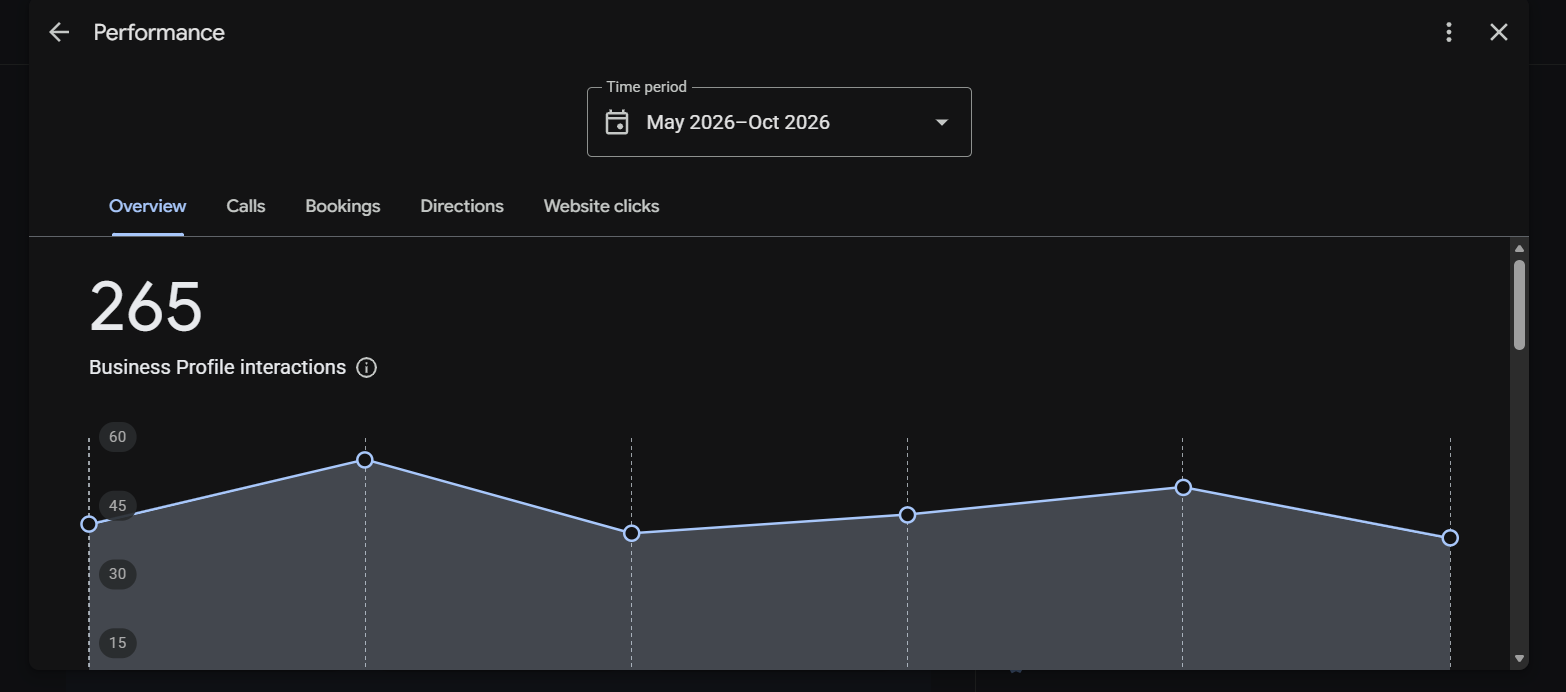
How to interpret this screen: the overview total counts interactions reported by the Business Profile for the selected period. Open Calls, Directions or Website clicks for the relevant action counts, then compare with independently verified leads. The headline total is not an SEO ranking, customer count or sales figure.
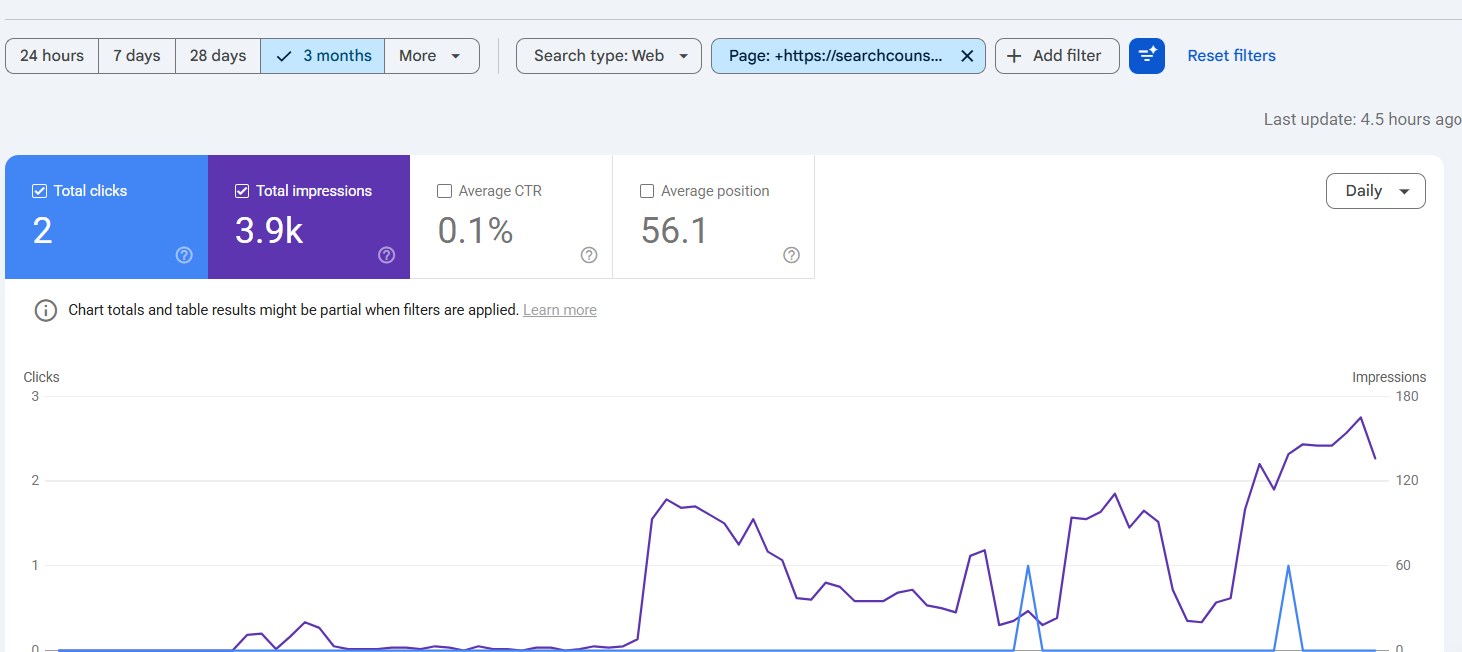
Why we expanded the Map Pack section of this guide
We examined Google Search Console data for the exact page /local-seo/, filtered to Web search, for July 22–October 21, 2026. The page-level export recorded 3,533 impressions, two clicks, approximately 0.06% CTR and average position 57.05. This is a baseline before the revised article is published—not a demonstration of improved performance.
| Actual query | Impressions | Clicks | Avg. position |
|---|---|---|---|
| map pack seo | 764 | 0 | 59.24 |
| local pack seo | 731 | 0 | 64.25 |
| seo local pack | 528 | 0 | 58.99 |
| local maps seo | 354 | 0 | 49.41 |
| local map pack seo | 198 | 0 | 59.50 |
| These five rows | 2,575 | 0 | — |
Our editorial decision: keep the comprehensive local SEO pillar but explain the Map Pack near the top, include a real Search screenshot, provide troubleshooting by symptom, and distinguish local business listings from organic websites. These changes address observed intent; the export does not establish that they will cause ranking gains.
Our actual local SEO page impressions: visible progress, not proven impact
The same exported Web search, exact-page time series shows uneven but increasing impressions across the last four complete seven-day periods. These figures come from the file's Chart.csv; they are not keyword-volume estimates.
How we use the evidence: improving query relevance is warranted, because the page already appears for Map Pack queries. But the old content was still live when this export was collected. We cannot attribute the change in impressions to Version 5 or Version 6.
The query table is subject to Search Console anonymization and filtering; the daily chart is page-level and is the proper source for the overall total. Week-by-week position changes may also reflect changing query mix. This chart is not a comparison of AI citations, Google Maps rankings, or qualified leads.
Data source: Search Counsel Co. page-filtered Google Search Console export dated October 23, 2026. The displayed top-query list is not necessarily the full set of query impressions because Search Console may omit anonymized queries. The later dashboard screenshots use a rolling period and should not be treated as the same fixed-date export.
Four reports, four different questions
| Report | Question answered | Common mistake |
|---|---|---|
| GBP Performance | Did people interact with the business listing? | Counting calls or directions as completed sales |
| GSC Search results | Did this exact webpage appear and receive clicks in Web search? | Treating average position as a Maps-grid rank |
| GSC Generative AI | Did Google show a URL from this property in eligible AI features? | Calling an impression an AI business endorsement |
| CRM / call / booking records | Did interactions become actual inquiries or customers? | Attributing every new customer to one traffic source |
For a defensible before/after review, record the publication date, compare complete 28-day windows, segment by country and device, and inspect the same query intent clusters. If the query mix changes, report it rather than presenting an average-position change as an automatic ranking win.
What to do when results look disappointing
- Impressions rise while clicks stay flat: inspect query mix and position first. More impressions at position 50 rarely mean an immediate CTR opportunity.
- Strong Map Pack placement but few contacts: investigate hours, service fit, photos, ratings, phone link, available appointments and user experience.
- Organic visits rise but leads do not: review the landing page's intent, contact flows, audience geography, and tracking accuracy.
- Rankings change abruptly: check location sampling, competitors, site changes, GBP edits and possible reporting issues before making another major rewrite.
Repeatable measurement protocol
Local Pack: choose one commercial keyword, the same business and a fixed set of geographic observation points. Record the search date, time, device and sampled positions. A change measured at just your office is not a citywide change.
Business Profile: note Performance views, calls, website clicks and directions for equivalent periods. These are interactions and may include activity from both ads and organic discovery; they are not verified sales.
Organic webpages: in Search Console filter the exact page URL, use complete comparable date windows and group queries by intent. Confirm lead submissions through your analytics or CRM instead of treating an impression as a conversion.
Decision rule: compare a meaningful before/after period, annotate material edits and holidays, and investigate changes in geography and query mix before claiming improvement.
12. Three local SEO decision examples you can adapt
These short examples are hypothetical teaching scenarios, not client achievements. Use them to choose the next action before buying more services.
Check eligibility and profile restrictions first; verify the claimed location and primary category. Creating more webpages cannot fix a suspended profile.
Compare a fixed search grid before and after appropriate work. A weak distant grid suggests that proximity and competition deserve investigation.
Test the real phone number, booking flow, business hours, review quality and lead capture; ranking may not be the bottleneck.
Decision principle: diagnose the surface (Maps, webpage or AI recommendation), verify the symptom, choose the smallest useful fix, and record its outcome. Do not confuse a new screenshot with evidence of improvement.
13. Limits, trade-offs and risks
- Proximity is real. You cannot make a legitimate business physically nearer by repeating city keywords or adding service areas.
- No fixed score guarantees top-three ranking. Industry competition, location and search context change outcomes.
- Expert surveys are not Google's algorithm. We use them to form hypotheses, not to claim exact weights.
- AI discovery is not uniform. A platform may recommend different businesses for the same question over time. Survey or prompt-test percentages have specific populations and designs.
- Review rules matter more than shortcuts. Never fake customer accounts, review-gate, offer rewards for ratings or force review content.
The 20-point local SEO audit: check your fundamentals
Check each statement only when it is true for your business. This is a self-assessment to expose work priorities—not a ranking-prediction tool or an audit of your live listing.
Start with eligibility, verification and accurate business information.
Frequently asked questions about local SEO
What is the difference between local SEO and Map Pack SEO?
Map Pack SEO focuses on a business’s visibility in Google’s map-based listings. Local SEO is broader: it also includes local organic webpages, business information, review management and customer conversion paths.
How do I rank in the Google three-pack?
Start with an eligible, verified and accurate Business Profile. Improve category relevance, hours, real services and genuine reputation. Then earn relevant local mentions and measure results from several geographic points. Google weighs relevance, distance and prominence; nobody can guarantee inclusion.
Does a service-area setting make my business rank in every chosen city?
No. Entering a service area does not move your business address or remove proximity constraints. Serve those customers honestly and build useful local organic pages when justified.
How much does local SEO cost?
Creating and maintaining a Google Business Profile is free. A local SEO budget can include your time, website development, content, review management, directory corrections and specialist help. Costs vary with the market and the work required; no fixed package guarantees rankings.
How long does it take to rank locally?
There is no universal duration. Profile corrections may be visible quickly, while competitive prominence and organic-page improvements may require sustained work over months. Use a documented baseline rather than a deadline-based ranking promise.
Do I need to pay for citations or special AI schema?
No. Focus on important accurate third-party listings and useful website information. Google says there is no special structured data or AI text file required for inclusion in its AI features.
Why is my business visible on Google Search but missing from the Map Pack?
The ordinary website result may be ranking through its page content, while the Map Pack uses a local business listing with location-sensitive results. Check the correct profile's eligibility, verification, category and search context, then compare positions from multiple nearby points. Do not treat your website's Search Console average position as a Maps ranking.
Does appearing in Google Maps mean an AI Overview will recommend the business?
No. Google’s Maps listings, AI Overviews, AI Mode and other assistants can select different businesses or supporting webpages. Use real AI-feature impressions in Search Console where available, and document manual prompt tests separately; neither guarantees future citations.
Why did this page get Map Pack impressions but almost no clicks?
Our page-filtered GSC export showed the five leading Map Pack query variants averaging positions roughly 49–65 and generating no clicks in the visible query rows. That is a visibility-and-position problem before it is a meta-description problem. The revised guide addresses those questions more directly, but actual improvement can only be confirmed after it is published and measured.
Can an AI Overview citation replace a Maps listing?
No. An AI Overview can link to an informative webpage, whereas a Maps listing helps customers find and contact an eligible business. Treat citations, business recommendations and completed enquiries as different events with different evidence and reporting.
Can AI Overviews or ChatGPT guarantee referrals to my business?
No. Platforms make their own choices and may show incomplete information. Confirm your business facts, build genuine credibility, and measure actual qualified referrals where possible.
Sources, dates and research notes
Google's own policy and ranking guidance is distinguished from practitioner opinions and third-party studies. Research percentages are not presented as guarantees. This revision does not claim to have performed first-party experiments or obtained AI Overview screenshots.
Our evidence standards
Establishes what Google publicly states or permits—for example, its local-ranking factors and review rules. It does not reveal undisclosed ranking weights.
Establishes this webpage's recorded visibility in a specific date window. It does not prove an editorial change caused the trend, or show Maps-grid positions.
Useful for patterns and hypotheses when sample size, date, platform and methods are disclosed. The findings are not universal guarantees.
Helpful for explaining decisions, but explicitly illustrative and never represented as real customer results or original ranking experiments.
- Google Business Profile Help: improve local ranking — Google's descriptions of relevance, distance and prominence.
- Guidelines for representing your business on Google — eligibility and business-information rules.
- Google Maps prohibited and restricted content — review manipulation and review request rules.
- Whitespark Local Search Ranking Factors, 2026 — practitioner survey, not an algorithm disclosure.
- BrightLocal 2026 consumer survey on AI local recommendations — survey-based consumer adoption estimates.
- SOCi 2026 Local Visibility Index benchmarks — observed rates in a multi-location brand research sample.
- Google Search Central: AI features and your website — indexability and no special AI requirements.
- Google Search Central: review snippet guidelines — limitations on self-serving review stars.
- Google Business Profile Help: Performance & insights — business listing views, clicks, calls, directions and measurement limitations.
- Google Search Central: helpful, reliable, people-first content — original value, accurate authorship and useful first-hand evidence.
- Google Search Central: Image SEO — descriptive alt text, filenames and relevant placement near supporting content.
- BrightLocal Local AI Visibility study, September 16, 2026 — More than 200,000 non-branded localized prompts; platform overlap, citation and mention rates.
- Google Search Console: Generative AI performance (Search) — Official AI Overview and AI Mode impression reporting, Pages dimension and limitations.
- Google Search Central AI optimization guide — People-first, original content and ordinary SEO fundamentals for AI features.
- Google Business Profile: how to get reviews — Official guidance on honest voluntary review requests.
- Search Engine Land — Google Local Pack guide — examples of local pack formats and location-dependent troubleshooting (expert editorial source; not an official Google ranking disclosure).
Screenshots and examples should be from real interfaces and carry query, location and capture-date context where ranking order is shown. Do not use fabricated search results or customer case studies. This article separates Google's official documentation, cited practitioner research, and explicitly illustrative examples. Editorial source checks: October 25, 2026. The article update date should be set only when the revision is published.
Editorial principle: eligible businesses, genuine reviews, useful local pages, and verifiable business information come before ranking hacks. This guide does not endorse falsified reviews or ineligible locations.