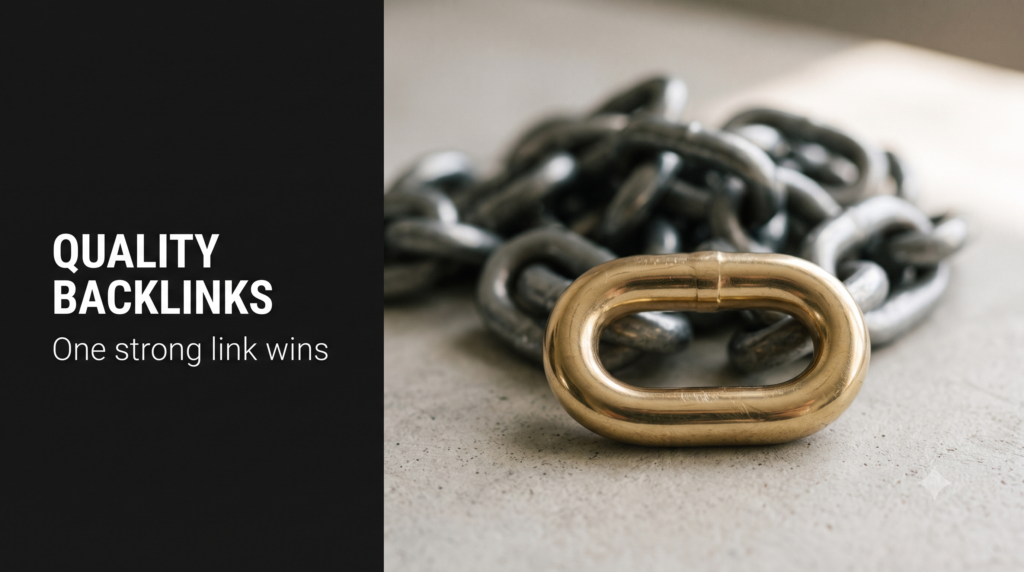
A good backlink is a relevant, editorially justified link from a legitimate page to a destination that genuinely helps the reader. The best links make sense even before you think about SEO: the source and destination belong together, the anchor reads naturally, the placement is visible in useful content, and any commercial relationship is disclosed correctly.
By Rahul Saini, Founder & SEO Strategist at Search Counsel Co. · Updated October 2026
Quick answer: what makes a backlink high quality?
A high-quality backlink has a real reason to exist. The exact linking page is relevant, the publisher is legitimate, the link appears in useful editorial context, the anchor is natural, the destination matches the promise of the click, and any paid or user-generated relationship is qualified correctly. DA, DR, traffic and similar metrics are supporting evidence—not the verdict.
Backlink quality is three separate decisions
Most backlink guides collapse everything into a single score. We do not. In our client work, we separate three questions because a placement can be strong in one area and weak in another.
This distinction prevents a common mistake: calling a placement “good” simply because it has a high authority metric. A sponsored mention can be legitimate advertising but should not be treated as a followed ranking link. A nofollow editorial citation can have substantial audience value even when you should not count on ranking credit.
The 8 checks for a high-quality backlink
Use these checks as a decision framework, not as eight equal ranking factors.
| Check | What to inspect | Strong evidence | Weak or risky evidence |
|---|---|---|---|
| 1. Page relevance | The exact source page, its audience and the paragraph around the link. | The destination genuinely helps the reader continue or verify the topic. | The source and destination have no credible topical relationship. |
| 2. Publisher legitimacy | Site purpose, authorship, editorial standards, original content and maintenance. | A real publication, company, organization or specialist resource. | A thin network that appears to exist primarily to host paid or automated links. |
| 3. Editorial reason | Why the writer included the citation. | Evidence, attribution, recommendation, entity identification or a genuinely useful next step. | The placement has no reason to exist beyond influencing rankings. |
| 4. Placement and context | Main content vs. boilerplate, surrounding copy and visibility to readers. | A natural in-content citation supported by the surrounding paragraph. | Repeated footer/template links, disconnected link blocks or hidden placement. |
| 5. Anchor text | The clickable words plus the broader external anchor pattern. | Descriptive, varied wording that fits the sentence. | Repeated commercial exact-match anchors that look engineered. |
| 6. Relationship qualification | Whether money, goods, services, sponsorship or UGC affects the link. | Ordinary editorial links need no special rel value; paid links are appropriately qualified; UGC is treated appropriately. | A compensated link deliberately left unqualified to pass ranking credit. |
| 7. Source-page quality | Crawlability, indexability, content depth, internal prominence, own links and outbound-link behavior. | A substantive page with a real reason to be found and read. | Autogenerated, orphaned, expired-domain or low-value content built mainly to host links. |
| 8. Destination quality | The final URL, redirects, page usefulness and match with the anchor/context. | The visitor lands on the most relevant, useful page for the promise made by the source. | Unexpected redirects, a thin sales page or a destination unrelated to the citation. |
For the mechanics behind the first six checks, see our separate guide to how Google evaluates links. This page stays focused on the practical question: should we value this individual backlink opportunity?
Anatomy of a good backlink
A backlink is easier to judge when you stop looking at it as a row in a tool and look at the full sentence a reader sees.
Backlink evaluation
Explains why the destination is useful
Descriptive without forcing an exact-match phrase
The page actually delivers the promised checklist
If the same anchor appeared in an unrelated article, a sitewide footer, a copied guest-post template or an undisclosed paid placement, the words alone would not make it a high-quality backlink.
A real backlink evaluation from our work: Mary Jane’s Bakery Co. × LeafPuffs
For this guide, we wanted one example that came from actual work rather than a hypothetical “perfect backlink.” In our September 3, 2026 backlink campaign workbook for Mary Jane’s Bakery Co., the LeafPuffs article “A Practical Guide to Buying Wholesale Hemp Flower Without Guesswork” was recorded as an approved blog-article placement.
The campaign workbook contained several placement types, including profiles, listings, classifieds and articles. We chose this article for the case study instead of choosing the highest authority number in the sheet. That is the point: a backlink report is an inventory, not a quality verdict.
| SCC review area | What we observed | Decision |
|---|---|---|
| Topical relationship | The source article is specifically about buying wholesale hemp flower. Mary Jane’s Bakery Co. publicly sells hemp-derived products and promotes hemp flower and wholesale purchasing on its own site. | Strong. The topics belong together naturally. |
| Source-page purpose | The live LeafPuffs page is a buyer-focused guide discussing freshness, cultivation, testing and purchase considerations—not an empty profile page. | Positive. The source has substantive informational context. |
| Third-party metrics | Our September report recorded DA 34, DR 45 and spam score 2. | Supporting context only. These numbers did not create the topical fit. |
| Page durability | The source page remained discoverable when we rechecked it in October 2026. | Positive practical signal. A live, persistent page is more useful than a placement that disappears immediately. |
| Exact anchor and destination | The campaign record verifies the source placement, but our available evidence does not independently expose the rendered anchor text and final href. | Verify before final approval. Never infer anchor quality from DR or a spreadsheet status. |
| Commercial relationship / rel attribute | The workbook does not establish the acquisition relationship or final live rel value. | Verify before claiming ranking value. If compensation was involved, Google’s qualification guidance applies. |
| Measured SEO impact | We do not have clean evidence that isolates this one link as the cause of a ranking or traffic change. | Do not claim causation. A real placement is not the same thing as a proven ranking lift. |
rel treatment are confirmed.Good, weak and risky backlink examples
nofollow. It may still be valuable for referral traffic, discovery, reputation and future citations even when you should not count on ordinary ranking credit.How to check backlink quality in five minutes
- Open the exact source page. Do not approve a link from DA, DR or a spreadsheet row alone.
- Read the paragraph around the link. Ask why the destination helps this specific reader.
- Inspect the publisher and the page. Check site purpose, authorship, content quality, indexability, internal prominence and outbound-link behavior.
- Verify the relationship. If money, goods, services or UGC are involved, make sure the link treatment matches the relationship.
- Follow the link. Confirm the final URL, redirects, anchor and destination all match what the placement promises.
Backlink decision checker: quality, policy and business value
This is an internal decision aid, not a Google score. Choose Yes, Unsure or No. Critical failures override the total so a link cannot “pass” just because seven weaker checks look good.
Editorial quality
Policy and implementation
Business value
How much do DA, DR, page authority and traffic matter?
Third-party metrics are useful when they help you ask better questions. They become dangerous when they replace the page-level review.
What is a good DA or DR for a backlink?
There is no universal minimum. A DR 25 specialist page can be a better opportunity than a DR 80 profile with no topical relationship or editorial reason. Use authority metrics as a filter after relevance and legitimacy, not before them.
Should I check the page or the domain?
Both, but make the page the final review unit. A strong domain does not guarantee that every page is relevant, indexed, internally supported, visible or editorially useful.
Dofollow, nofollow, sponsored and UGC: what actually matters?
“Dofollow” is industry shorthand for a normal crawlable link without a qualifying rel value. Google says ordinary links do not need a special value. It recommends rel="sponsored" for advertisements and paid placements, rel="ugc" for user-generated links, and rel="nofollow" when other values do not apply and the publisher would rather Google not associate with the linked page.
Do not reduce the decision to “follow = good, nofollow = useless.” A qualified mention can still be useful advertising, brand exposure, referral traffic or third-party validation. At the same time, you should not describe a paid sponsored link as if it were ordinary editorial ranking credit.
Backlink red flags Google explicitly warns about
Google defines link spam around links created primarily to manipulate rankings. Its current examples include buying or selling links for ranking purposes, excessive link exchanges, automated link creation, low-quality directory or bookmark links, widely distributed footer/template links, optimized links in paid guest posts and forum-comment links with optimized anchors.
A suspicious backlink is not automatically a disavow candidate. Google says most sites do not need the Disavow Links tool and recommends it only for serious cases involving a considerable pattern of artificial/spammy links plus a manual action or a likely manual action.
Do backlinks help with AI Overviews and AI Mode?
Google does not publish a separate “AI backlink score,” and it does not require special backlink markup for AI Overviews or AI Mode. Its current guidance says the same core SEO and quality principles continue to apply, and supporting pages must first be eligible for Google Search and snippets.
The strongest AI-search strategy is therefore not to manufacture links “for AI.” Build legitimate third-party references around work that deserves to be cited, then make the destination unusually useful: original evidence, first-hand experience, clear definitions, comparisons, examples, tools and transparent sourcing.
Our evidence hierarchy for backlink decisions
- Current Google documentation: highest confidence for present link policy, attributes, spam guidance and Search eligibility.
- The live source page: the exact context, anchor, destination and publisher behavior we can inspect directly.
- First-party campaign records: delivery dates, source URLs, recorded metrics and implementation notes from work we actually performed.
- Third-party link tools: useful estimates for authority, traffic, referring domains and link discovery.
- Industry studies and tests: useful evidence, but not a substitute for Google documentation or proof of causation.
This hierarchy is why the Mary Jane’s Bakery Co. case above is labeled strong candidate pending link-level QA, not “this backlink definitely improved rankings.” That distinction is deliberate.
FAQ: high-quality backlinks
What is an effective backlink?
An effective backlink gives a real reader a useful reason to visit your page while giving search engines clear context about the relationship between the source and destination. Relevance, editorial purpose, source-page quality and destination fit matter more than hitting an arbitrary DA, DR or traffic threshold.
What is an example of a good backlink?
A strong example is a relevant article that cites your research, expertise, company or resource inside the main content because the citation genuinely helps the reader. The surrounding paragraph explains the relationship, the anchor reads naturally and the destination fulfills the promise of the click.
Is a backlink from a high-DA website always good?
No. DA is a third-party metric, not a Google metric. A high-DA domain can still host an irrelevant, low-value, paid or poorly placed link. Inspect the exact source page and the reason for the citation.
Does the linking page need organic traffic?
No universal Google threshold exists. Traffic can be useful evidence that a page is visible and can send referral visitors, but a new or niche page can still be a legitimate, relevant editorial source.
Are nofollow backlinks useless?
No. They can still provide audience, referral, brand and discovery value. Judge the placement for what it actually delivers rather than assuming every nofollow link is worthless or every followed link is valuable.
Should I disavow every toxic backlink?
No. Google says most sites do not need the Disavow tool. Use it cautiously for serious cases involving a considerable volume of artificial or low-quality links plus a manual action or a likely manual action—not because a third-party tool displayed a red score.
How many backlinks do I need to rank?
There is no universal number. Requirements vary by query, competitors, content quality, site strength, internal linking, brand/entity signals and many other factors. Compare relevant competitors, but do not turn their raw backlink counts into a quota.
How do I know whether a backlink is worth pursuing?
Ask three questions: Is it editorially defensible? Is the relationship compliant? Would the placement still have business value without ranking credit? If one of those answers is clearly no, a high DA or DR should not change the decision.
Primary sources and further reading
- Google Search Central: Spam policies for Google web search — official link-spam examples and policy language.
- Google Search Central: Qualify outbound links — current guidance for ordinary, sponsored, UGC and nofollow links.
- Google Search Console Help: Disavow links to your site — when Google says disavowal is appropriate.
- Google Search Central: AI features and your website — Search and AI-feature eligibility.
- Google Search Central: Generative AI optimization guide — current guidance for succeeding in AI search experiences.
- Ahrefs: What makes a high-quality backlink? — authority, relevance, anchor, placement and destination as practical evaluation concepts.
- Backlinko: High-quality backlinks — current first-hand examples and link-quality framing.
- Search Counsel Co.: How Google evaluates links — our evidence-based mechanics guide.
Need a backlink profile you can defend?
Search Counsel Co. evaluates backlinks at the page level—relevance, editorial purpose, implementation, policy risk and real business value—rather than treating a third-party authority score as Google’s hidden formula.
Explore our Link Building & Authority Growth service, read how Google evaluates links, or build editorial authority through digital PR.
Methodology note: This guide separates Google-documented policies from third-party metrics and hands-on review heuristics. DA, DR, estimated traffic and spam/toxicity scores are analytical aids, not Google ranking scores. The Mary Jane’s Bakery Co. example comes from a real campaign record; where the available evidence does not independently verify anchor text, final href, relationship or ranking impact, we say so rather than fill the gap with assumptions.