SEO Content Strategy
How to Build Topic Clusters and Pillar Pages
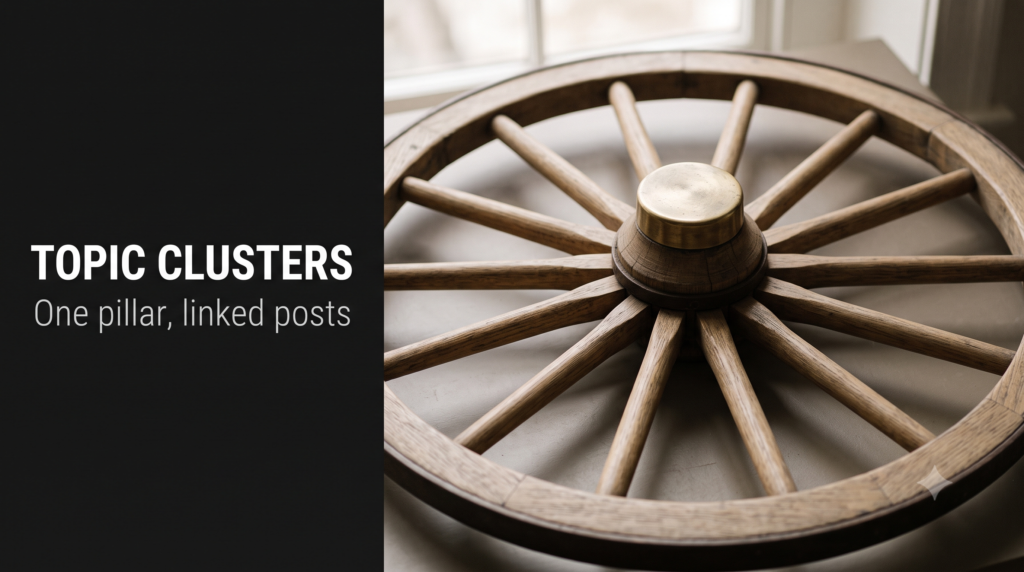
A topic cluster is how you turn a pile of blog posts into a subject you own. One broad pillar page, a set of focused posts around it, all linked together. Done right, the whole cluster ranks as a unit, and it lets a smaller site compete with far fewer backlinks. Here’s how to plan, build, and connect one.
By Rahul Saini, Author at Search Counsel Co. Last updated [July] 2026.
Featured answer: what is a topic cluster and pillar page?
A topic cluster is a group of related pages built around one subject. At its center sits a pillar page, a broad overview of the whole topic, surrounded by cluster posts that each cover one subtopic in depth. Every cluster post links back to the pillar and the pillar links out to each of them, which tells search engines the pages are one connected body of work.
Why bother with the structure? Because one well-built cluster can rank for dozens of related queries instead of one, and because the internal links concentrate relevance on your key pages. That’s what lets newer sites with lean budgets punch above their weight: you compete on coverage and structure, which you control, rather than on raw backlink count, which takes years.
Pillar
The hub
One broad page covering the whole topic at overview depth.
Cluster posts
The spokes
Deep pages, one per subtopic, each linking back to the pillar.
The links
The glue
Internal links tell Google the pages form one topic.
The payoff
Rank as a set
One cluster can rank for a whole topic, not a single keyword.
Jump to what you need
What pillar pages and topic clusters are
A pillar page is a single page that covers a broad topic at overview depth. It touches every major part of the subject but doesn’t exhaust any one of them, because the depth lives in the cluster posts it links to. A cluster post is a focused article that takes one of those subtopics and goes deep. Together, the pillar and its cluster posts form a topic cluster: a hub with spokes.
Segmentation
Deliverability
Automation
Welcome series
Email marketing
pillar page
The model is sometimes called hub and spoke, pillar and cluster, or content hubs. The names don’t matter. What matters is the structure: one central page, several supporting pages, and internal links connecting them in both directions. Those links are the signal. When a pillar links to a cluster post with descriptive anchor text, and the post links back, you’re telling Google these pages belong together and that your site covers the topic broadly and in depth. Do that across a dozen connected pages and you’ve built a clear map of your expertise.
This is the practical machinery behind topical authority. Authority is the outcome; the cluster is the thing you actually build to earn it. It also makes life easier for readers, who get to move from a broad overview into the exact subtopic they need without leaving your site.
The three types of pillar page
Pick the format that matches what people are searching for, before you write a word.
- The guide pillar. A comprehensive overview of a topic, structured as chapters, that links out to deeper posts on each part. Best for broad informational topics, and the most common type. Ahrefs’ beginner’s guide to SEO is a textbook example: it overviews the whole subject, then routes readers into deeper guides on each part.
- The “what is” pillar. A definitional page that explains what something is, how it works, and why it matters, then routes to detailed subtopic posts. Good for emerging or misunderstood subjects.
- The product or service pillar. A page targeting commercial intent that overviews a solution and links to supporting content and use cases. Best when the topic maps directly to what you sell.
How to build a topic cluster, step by step
Here’s the process, with a running example: a cluster on email marketing.
1. Choose the core topic
Use the Goldilocks rule. Too broad (“marketing”) and you can’t own it. Too narrow (“subject line length for Tuesday sends”) and it can’t support a cluster. You want a subject wide enough to spin off eight or more real posts, narrow enough that you can be the best answer on it, and close enough to your business to matter. “Email marketing” works as a pillar topic for the right site.
2. Find the subtopics
This is where most of the work lives. List every question and subtopic a real expert on this subject would cover. Pull them from keyword research, the “People also ask” and “People also search for” boxes, your sales and support team’s most common questions, and your own Search Console queries that already convert. For email marketing you’d surface subtopics like list building, welcome sequences, subject lines, segmentation, deliverability, automation, and re-engagement. A structured content gap analysis turns this into a real map, and our Content Audit and Topical Map template gives you the grid to do it.
3. Map the cluster and assign one page per subtopic
Give every subtopic exactly one page with a distinct angle and its own primary keyword. If you can’t write a one-line reason a post is different from its neighbours, it’s a cannibalization risk and should be merged. This map is your plan: pillar in the middle, one row per cluster post, each with a target keyword, an intent, and the two or three internal links you’ll place on day one.
4. Build the pillar page
Write the pillar as a broad, well-organized overview, not an exhaustive essay. Cover each subtopic briefly, then link out to the cluster post that goes deep on it. A few best practices that hold up: add a table of contents so readers can jump around, make the outbound links to cluster posts easy to spot, keep the URL clean and consistent, and resist the urge to answer everything on the pillar itself. If the pillar already exhausts a subtopic, readers have no reason to click through, and the cluster post has nothing left to own.
5. Write the cluster posts
Each cluster post is a complete, deep treatment of its subtopic and should be the best answer available on that narrow question. Original insight, real examples, current data, a named expert behind it. Every post links back to the pillar with descriptive anchor text, and links across to sibling posts where that helps the reader.
6. Interlink the whole cluster
The links are what make this a cluster rather than a folder of posts. Connect supporting posts up to the pillar, the pillar down to each post, and siblings across to each other using anchor text that names the topic. There’s real craft to doing this well, from anchor text choices to link placement and avoiding orphan pages, and it’s covered in full in our guide to internal linking mechanics.
7. Make the cluster legible to AI
One step most guides skip. Add schema that names the relationships: use the about property on the pillar to declare its primary subject, and isPartOf on cluster posts to connect them back. This turns your cluster from a human organizing trick into something AI systems can read and trust, which increasingly decides whether you get cited by AI answer engines. And write for information gain: cover the angles the current top results don’t, because unique coverage is what both Google and AI models reward.
Here’s what that map looks like filled in for the email marketing example, with one page per subtopic and a distinct primary keyword for each:
| Page | Primary keyword | Intent |
|---|---|---|
| Pillar | email marketing | Overview / guide |
| Cluster post | how to build an email list | Informational |
| Cluster post | welcome email sequence | How-to |
| Cluster post | email subject line best practices | Informational |
| Cluster post | email list segmentation | Informational |
| Cluster post | improve email deliverability | Troubleshooting |
| Cluster post | email marketing automation | Commercial |
Each row is one page with one job. The pillar links out to all of them; each of them links back. That’s the whole cluster on a page.
How many posts do you need, and how to avoid cannibalization
There’s no fixed number, and anyone who gives you one is guessing. As a working range, a healthy cluster is a pillar plus roughly six to twelve cluster posts, though comprehensive subjects can carry twenty or more. The right count is however many it takes to cover the subtopics your map surfaced, no padding.
Cannibalization is the failure mode to watch. It happens when two pages target the same intent and end up competing with each other, splitting your rankings. The fix is the discipline from step three: one intent per page, one page per intent. If two planned posts overlap, merge them into one stronger page. If an old post already covers a subtopic, fold it into the cluster rather than writing a duplicate.
Common mistakes that kill clusters
- A pillar that says everything. If the pillar is exhaustive, the cluster posts are redundant and nobody clicks through. Keep the pillar broad and the posts deep.
- Orphan cluster posts. A post with no link from the pillar (or from siblings) sits disconnected, and the cluster signal breaks. Every post needs to be linked in.
- Clustering by words, not meaning. Grouping pages purely by matching keywords produces clusters that read badly and confuse intent. Group by what the reader actually wants.
- Thin filler to hit a number. A shallow post to round out the cluster drags on the whole domain in the current ranking climate. Cover a real subtopic or leave it out.
- Building and forgetting. A cluster is an asset you maintain. Refresh posts, fill new gaps as the subject evolves, and keep the internal links current.
This whole site is built as a set of clusters, so the model isn’t theory here. It’s the same structure you’re reading right now.
FAQ
What is the difference between a pillar page and a cluster post?
A pillar page is a broad overview of a whole topic that links out to deeper pages. A cluster post takes one subtopic from that pillar and covers it in depth, then links back. The pillar goes wide; the cluster posts go deep.
How many cluster posts should a pillar have?
There’s no rule, but a pillar plus roughly six to twelve cluster posts is a healthy working range, with comprehensive topics carrying more. Let the number be decided by how many real subtopics your topic map surfaces, not by a target.
How long should a pillar page be?
Long enough to give a genuine overview of every major part of the topic, but not so long that it exhausts the subtopics. Match the depth of the pages already ranking for your core keyword, then earn the click-through to your cluster posts by leaving the deep detail to them.
Do topic clusters help with AI search?
Yes. The same structure and depth that build topical authority for Google also make your content easier for AI systems to interpret and cite, especially when you add schema that names the pillar and cluster relationships. Clear, connected, comprehensive coverage is what AI answer engines pull from.
Can I turn my existing blog posts into a cluster?
Often, yes. Map your existing posts against a topic, group the related ones, build or designate a pillar page, and add the internal links that connect them. Merge any posts that overlap on the same intent so they stop competing with each other.
What is the difference between a pillar page and a landing page?
A pillar page is built mainly for SEO and traffic: a broad, in-depth overview that links out to supporting content. A landing page is built mainly for conversion, focused on a single action like a signup or purchase. They can look similar, but the pillar’s job is to rank and educate, not to close.
Do topic clusters still work in 2026?
More than ever. The March 2026 core update pushed Google toward domain-level topical authority, which is exactly what clusters build. The one change is the quality bar: a cluster of thin posts now hurts you, so each piece has to earn its place with real depth and original value.
The one thing to do next
Start with the map, not the writing. Pick one topic you can own, list every subtopic a reader would expect, and assign one page to each. The pillar and cluster posts almost write themselves once the map is right, and the map is the heart of a working SEO content strategy.
Sources used
Pillar and cluster fundamentals and best practices: HubSpot, Search Engine Land, Wix SEO, and Clariant Creative guidance on the topic cluster model. AI and schema recommendations (about, isPartOf, information gain) drawn from Conductor’s 2026 topic-cluster guidance. Cluster-size and cannibalization guidance is directional best practice, not a Google rule, and should be applied to your own subject rather than followed as a fixed number.