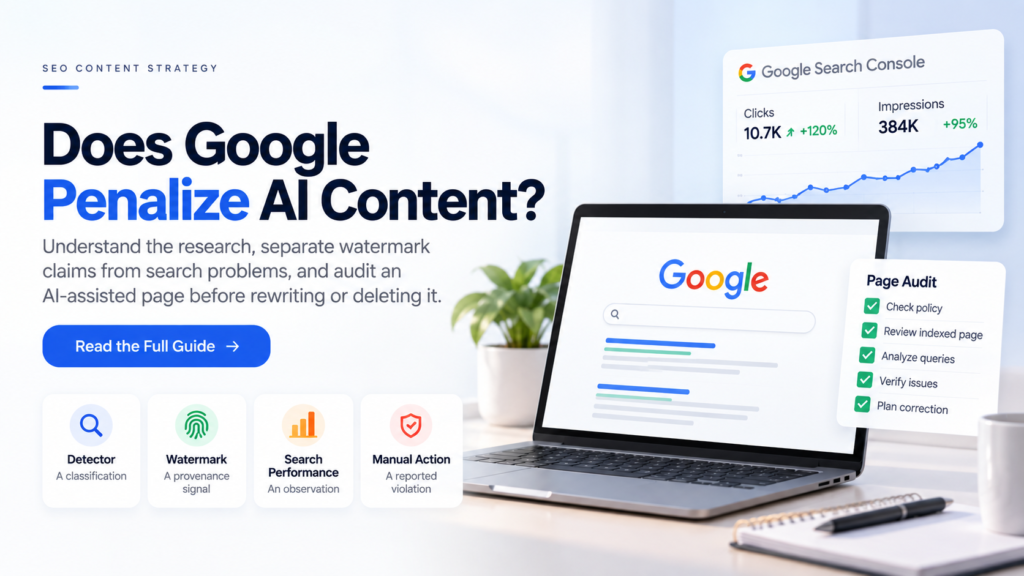
SEO Content Strategy
Understand the research, separate watermark claims from search problems, and audit an AI-assisted page before rewriting or deleting it.
By Rahul S., Author at Search Counsel Co. Updated September 2026.
Does Google penalize AI content?
Google does not prohibit content simply because AI helped produce it. Appropriate AI use is permitted, while publishing that violates spam policies can lose visibility. A detector score, watermark finding or traffic decline does not by itself establish an AI-content penalty. Check the actual policy issue, indexed page and affected queries before choosing a correction.
Start with the evidence: Record what changed and what you can verify. Do not use an AI detector percentage as the diagnosis for a search-performance problem.
Detector
A classification
A vendor estimates characteristics of the submitted text.
Watermark
A provenance signal
A particular system checks for a watermark within its coverage.
Search performance
An observation
Clicks, impressions or visibility changed for a defined scope.
Manual action
A reported violation
Search Console identifies a policy issue and affected scope.
What Google’s AI-content policy actually says
Google’s AI-content guidance focuses on the resulting content and its purpose. It does not publish an acceptable AI percentage or say that human authorship guarantees visibility.
The scaled content abuse policy covers producing many pages primarily to manipulate rankings without helping users, regardless of how the pages are made. Human editing alone does not establish compliance. Replacing a city name across hundreds of otherwise interchangeable pages deserves scrutiny; organizing an expert’s original notes presents a different editorial task.
Keep the diagnosis specific. A page can fail to compete without receiving a manual action. A decline can also reflect an indexing problem, changing demand or other changes. A low detector score does not resolve any of those issues.
How to audit an AI-assisted page that lost visibility
Use one affected URL first. Save its current text, publication history and relevant exports before editing. Then compare a small group of pages with the same purpose. The steps below are our proposed investigation workflow; they are not a test that certifies Google compliance.
1. Check the Manual Actions report
Open the report for the correct Search Console property. Record the exact issue and whether it affects a page, section or whole site. Follow the relevant correction and review process in Google’s manual-action documentation. An empty report means no manual action is reported there; it does not rule out automated spam effects.
2. Confirm which version Google has indexed
Use URL Inspection to record indexed status, last crawl, indexing directives and Google-selected canonical. Distinguish that indexed record from the live test: a successful live test does not guarantee indexing or predict Google’s canonical choice.
If the wrong URL is selected or access is blocked, investigate that evidence first. Our indexing troubleshooting guide covers the next checks.
3. Define the search-performance change
Compare equivalent, complete periods. Keep country, device, search type and page filters consistent. Review query groups as well as page totals, using the Search Console Performance report guide when you need help reading the measurements.
Google’s traffic-drop guidance lists several possible explanations. Treat the following patterns as investigation leads, not conclusions:
| Observed pattern | Check next | What remains unproven |
|---|---|---|
| Clicks fall while impressions remain similar | Query mix, CTR, title/snippet relevance and current search-result layout. | That Google applied an AI-content penalty. |
| Impressions and positions decline for a query group | Competing results, intent, content changes and broader site patterns. | That the authoring tool caused the decline. |
| The intended URL is not indexed | Indexed status, canonical choice, crawl access and directives. | That rewriting the text will fix the underlying issue. |
| A manual action is reported | The named violation, affected scope and required remediation. | That all AI-assisted content must be removed. |
4. Identify a specific defect
Inspect claims, sources, duplicated intent and usefulness. Compare affected pages with similar pages that retained visibility. Record a defect you can point to: an unsupported statistic, missing instructions, an outdated product claim or a technical change. “It sounds like AI” is too vague to define a correction.
5. Correct it and preserve the comparison
Save the original passage, replacement, supporting evidence, owner and change date. Note simultaneous changes to links, templates, titles or indexing settings. After publication, confirm the revised content is accessible and inspect subsequent observations using the same reporting scope. If several variables changed, do not credit one of them with any later recovery.
A copyable AI-content audit worksheet
Copy these fields into your working document. Complete one record per URL. Use “not checked” for missing evidence and “not applicable” when a field does not apply; an empty field must not become an assumed clean result.
- Page and scope: URL, Search Console property, reader task, editor and audit date.
- Observation: symptom, comparison periods, country, device, search type, query filters and export references.
- Search checks: manual-action issue/scope, indexed status, last crawl, directives and Google-selected canonical.
- Editorial finding: exact questionable claim or omission, source, original contribution and competing page on your site.
- Correction: old passage, replacement or technical change, reason, owner and implementation date.
- Follow-up: next review date, post-change evidence, other changes and limits on attribution.
Choose an action: keep an accurate, distinct page; improve an identifiable defect; combine pages serving the same task after reviewing their existing visibility and links; or consider removal when the page has no useful purpose or violates policy. A bulk AI score is insufficient evidence for deleting a content library.
Use your SEO content strategy to assign the preferred page for each task. For an existing page worth improving, follow the content optimization process.
What AI-content ranking studies can establish
Studies ask different questions. A sample of pages that already rank cannot establish the success rate of every article published. A detector classification also differs from documented authorship. Read the method before using a percentage to make a publishing decision.
| Study and date | Method and useful contribution | Limit on interpretation |
|---|---|---|
| Rankability June 23, 2026 |
487 results for competitive commercial queries, classified with a blended detector. Includes the publisher’s own rewrite examples. | A focused, retrievable sample. Detector labels do not verify authorship; rewrites changed quality as well as production method. |
| Semrush December 9, 2024 |
20,000 blog articles selected from top-20 results, classified with GPTZero, alongside a survey of 700+ users. | Ranking-page selection and self-reported survey answers limit generalization. It is not a controlled comparison of otherwise identical pages. |
| Ahrefs July 27, 2026 |
Separate samples examine ranking position, indexing and impressions over time. Uses Ahrefs’ detector and explains its limitations. | The samples and measures differ. The combined headline count is not one controlled experiment, and inferred AI use does not establish a ranking cause. |
Why the findings should not become an AI-percentage target
The Ahrefs analysis reports weaker performance associated with higher detected AI levels, while also finding highly classified pages in leading positions and no obvious abrupt impression collapse in its time-series comparison. The authors discuss several possible explanations; its data does not isolate authorship as the cause.
Our interpretation: policy permission and competitive performance answer different questions. A permitted production method can still produce an unhelpful page. Likewise, a page improving after a rewrite supports keeping the useful correction, but does not prove that changing authorship was the decisive variable.
For your own comparison, record topic, intent, page age, technical changes and the actual improvements. Avoid comparing an untouched generic draft with a rewritten article containing new evidence and treating the difference as an authorship-only experiment.
Can Google detect AI content through watermarks?
Google’s SynthID Text documentation describes a watermark embedded during generation. Detection is probabilistic and can return watermarked, not watermarked or uncertain results. This documents a particular technology, not universal identification of every AI-written passage.
Does a watermark establish a Google ranking penalty?
The reviewed SynthID documentation explains watermarking and detection. It does not document a Search penalty for carrying that watermark. The reviewed Search guidance also does not provide a detector-score threshold that makes a page compliant. An undocumented connection should remain an open question, not become a claim of guaranteed safety or punishment.
Keep provider claims separate. A statement about SynthID does not establish whether a particular ChatGPT or Claude output uses the same mechanism. Check documentation for the specific product, model and configuration before making that claim.
What should you do with an “80% AI” result?
Read the vendor’s definition. Its percentage might describe a classification confidence or an estimated text proportion. Neither becomes an 80% probability of a Google penalty without separate validation. Save the tool, version, definition and tested text if the result matters to your audit, then check the page’s actual accuracy and usefulness.
A documented correction made to this article
Evidence type: an actual AI-assisted editorial revision on September 29, 2026. This records a change to an unpublished draft. No client campaign, detector test or ranking improvement is represented.
The earlier research section discussed Rankability and Semrush, but omitted the July 2026 Ahrefs analysis. Its questions about selected ranking samples were useful, yet readers could not see the additional indexing and longitudinal evidence. This was a coverage gap, not proof that the older studies were invalid.
| Record | What changed |
|---|---|
| Original scope | Two study summaries: Rankability and Semrush. No corresponding Ahrefs entry. |
| Evidence checked | The Ahrefs publication date, methods, separate samples and stated limitations. |
| Implemented correction | Added the three-study comparison and a paragraph separating association from cause. |
| Editorial result | Readers can now distinguish the studies’ questions and limits in one place. |
| Search result | Not measured. The revision itself cannot demonstrate indexing, ranking or traffic improvement. |
How to reproduce the check: open each linked study, find its methods, identify how authorship was classified, and check whether the sample includes non-ranking pages or performance over time. Match those observations to the table above.
A real performance case would additionally need the affected URL, dated exports, correction history and subsequent observations. Preserve unchanged or negative outcomes too. A source-checking example demonstrates the editorial process; it does not substitute for that performance evidence.
What to check before publishing AI-assisted content
Google’s generative AI guidance emphasizes accuracy, quality and relevance, including page metadata. Use the following release checks on the finished page:
- Reader task: the opening answers the question and the instructions help someone act.
- Claims: numbers, quotations, dates and platform behavior match identifiable sources.
- Original contribution: the page adds a useful analysis, demonstration, decision aid or first-hand evidence.
- Examples: real observations and constructed demonstrations are labelled accurately.
- Ownership: the byline and any reviewer label reflect actual involvement.
- Page experience: mobile readers can use the tables, navigation, links and next action.
- Release record: preserve the version, publication date, editor and planned follow-up.
Google’s helpful-content guidance asks publishers to consider originality, sourcing and who created the page. A biography cannot replace evidence in the article. Our E-E-A-T guide explains how to make genuine experience and editorial responsibility visible.
Frequently asked questions
Does Google penalize ChatGPT content?
Google’s published guidance does not prohibit a page simply because ChatGPT helped produce it. Assess the content and publishing practice against the applicable policies.
How much AI content is acceptable?
The reviewed guidance supplies no acceptable percentage. Set editorial standards for verifiable claims, useful instructions and original contribution instead of treating a detector score as a compliance limit.
Can AI-generated content rank on Google?
The cited studies contain ranking pages classified as AI-generated. Those classifications have limitations and do not predict how your page will perform.
Should I rewrite a page just to lower its AI score?
Identify a concrete problem first. Improving an incorrect claim or incomplete explanation has a clear editorial purpose. Moving a vendor score alone does not show that the page became more useful.
Should I disclose AI assistance?
Google recommends production context where readers would reasonably expect it. Describe the workflow accurately, including any review that actually happened. Separate platform, contractual or legal requirements need their own assessment.
How soon should I expect recovery?
There is no guaranteed timetable or outcome. Check the implementation, retain consistent reporting filters and assess subsequent observations. Schedule follow-ups around your data volume and the issue corrected.
The one thing to do next
Complete the audit record for one page and resolve its first verified defect. If the same issue affects many pages, SearchCounselCo’s content strategy and audit services can help prioritize corrections and assign clear page ownership.
Sources used and method
- Google Search: AI-content guidance
- Google Search: spam policies
- Google Search: generative AI publishing guidance
- Google Search: helpful-content guidance
- Google AI: SynthID Text documentation
- Search Console: Manual Actions report
- Search Console: URL Inspection
- Google Search: traffic-drop diagnosis
- Rankability: reported research and methodology
- Semrush: reported research and methodology
- Ahrefs: reported research and methodology
Sources checked September 29, 2026. Developed with AI assistance and source checks. The audit workflow is an editorial aid, and the documented correction concerns this draft. Third-party studies are observational. No controlled experiment or client-performance result is claimed.